
What Is the Hardest Language to Learn? Complete Student Guide for 2026
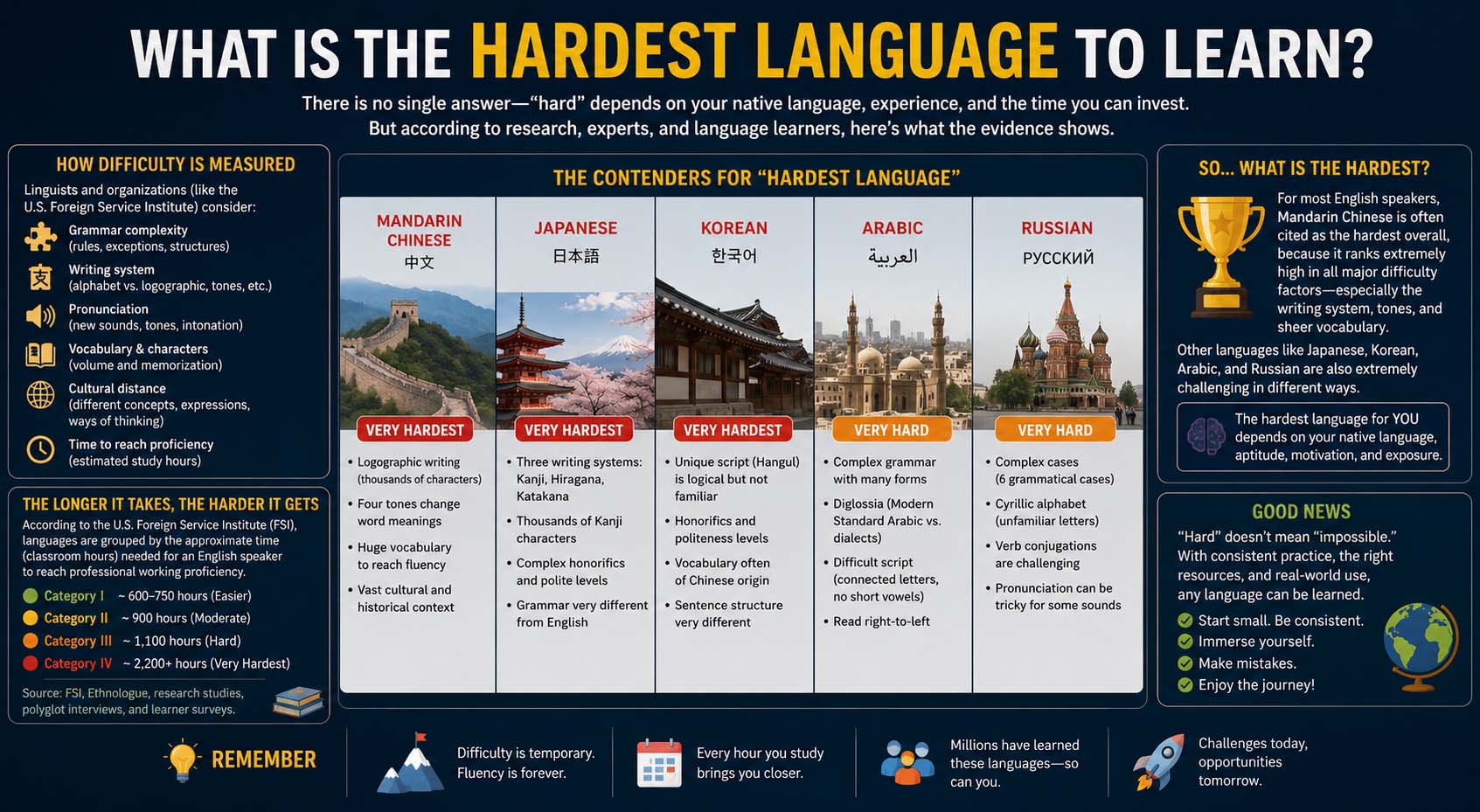
What Is the Hardest Language to Learn? Complete Student Guide for 2026
Some languages are relatively easy for beginners, while others require years of study and practice. Because of this, many students ask what is the hardest language to learn or wonder which language is the most difficult for English speakers.
The answer depends on several factors. For example, grammar, writing systems, pronunciation, vocabulary, sentence structure, and cultural differences can all affect the learning process. Therefore, a language that feels easy for one person may feel extremely difficult for another.
What Makes a Language Difficult to Learn?
Not all languages are equally difficult for every learner. In fact, several features can make a language more challenging.
These factors include:
- Writing systems
- Grammar complexity
- Pronunciation
- Sentence structure
- Vocabulary differences
- Listening speed
- Cultural context
Generally, languages that share similarities with your native language may feel easier. For example, English speakers may find some Spanish vocabulary familiar because the two languages share certain words and linguistic influences.
In addition, organized notes can make language study easier. Keeping useful information with How to Make a Study Guide can help students review grammar rules, vocabulary, and pronunciation.
Language-learning difficulty can vary by language and learner background. For additional information about language learning categories, see the U.S. Department of State Foreign Language Training
What Is the Hardest Language to Learn in the World?
When people ask what is the hardest language to learn in the world, they often expect one specific answer. However, there is no universal hardest language for every person.
Languages frequently discussed as challenging include:
- Mandarin Chinese
- Arabic
- Japanese
- Korean
- Russian
- Hungarian
- Finnish
Each language creates different challenges. For instance, Mandarin Chinese uses tones and characters, while Japanese uses multiple writing systems.
Similarly, Arabic has a different script and grammatical structure, whereas Korean has sentence patterns that can feel unfamiliar to English speakers.
Therefore, the answer depends on the learner’s native language, previous experience, and study environment.
What Language Is the Hardest to Learn for English Speakers?
For English speakers, languages with major differences in writing, grammar, pronunciation, and vocabulary can require more time and practice.
The U.S. Department of State provides information about language training for English-speaking diplomats and places languages into different training categories. This information can provide useful context when comparing language-learning difficulty.
Therefore, when asking what is the hardest language to learn, it is better to consider several characteristics instead of relying on a single ranking.
What Is the Hardest Language to Learn: Mandarin Chinese?
Mandarin Chinese is often discussed as one of the most challenging languages for English speakers.
First, Mandarin uses tones. A change in tone can affect the meaning of a spoken syllable. As a result, beginners need regular listening and pronunciation practice.
Second, written Chinese uses characters instead of an alphabet like English. Therefore, learners must develop character recognition and writing skills over time.
In addition, Mandarin sentence patterns and vocabulary may feel unfamiliar to English speakers. However, regular practice can make these patterns easier to recognize.
What Is the Hardest Language to Learn: Arabic?
Arabic can also be challenging for English speakers. It uses a different writing system, and letters can change shape depending on their position within a word.
Furthermore, Arabic has different regional varieties. Because of this, learners may encounter differences between formal Arabic and everyday speech.
Pronunciation can also require practice because some sounds may be unfamiliar to English speakers. Nevertheless, consistent exposure can gradually improve reading, listening, and speaking skills.
What Is the Hardest Language to Learn: Japanese?
Japanese presents several challenges for English speakers. Most notably, it uses multiple writing systems.
These include:
- Hiragana
- Katakana
- Kanji
Therefore, beginners need to understand how these systems work together.
Japanese sentence structure also differs from English. In addition, learners need to understand particles, verb forms, and different levels of polite speech.
As a result, Japanese can require consistent practice in reading, grammar, listening, and speaking.
What Is the Most Hardest Language to Learn?
Many people search for what is the most hardest language to learn. However, “most hardest” is not grammatically correct in standard English.
The natural form is “what is the hardest language to learn?”
Even so, the question does not have one universal answer. A language that seems difficult to an English speaker may feel more familiar to someone whose native language has similar grammar or vocabulary.
Therefore, language difficulty should always be considered in relation to the learner.
Why Mandarin Chinese Is Difficult to Learn
Many learners find Mandarin challenging because pronunciation, tones, and writing require consistent practice.
First, Mandarin tones can change the meaning of a spoken syllable. Therefore, learners need to develop accurate listening skills as well as pronunciation.
Second, Chinese characters require a different approach from alphabetic writing. Instead of relying on letters to spell words, students learn to recognize and remember individual characters.
However, Mandarin becomes more manageable when students study gradually. For example, learners can begin with common words and simple sentences before moving to more advanced material.
Why Japanese Is Challenging for Beginners
Japanese combines several learning elements. Consequently, beginners may need extra time to become comfortable with its writing and grammar.
Students commonly practice:
- Kanji characters
- Polite speech forms
- Sentence structure
- Particles
- Context-based meanings
Listening comprehension can also take time. In natural conversations, speakers may leave out information that listeners can understand from context.
However, regular listening practice can make these patterns easier to recognize.
Understanding reading concepts such as What Is a Central Idea can also help learners focus on the main meaning of written passages.
Arabic Grammar and Writing Challenges
Arabic introduces learners to a writing system that differs from English. Therefore, beginners need time to become familiar with reading and writing.
Arabic letters can take different forms depending on their position within a word. In addition, Arabic grammar contains structures that may be unfamiliar to English speakers.
Another challenge is regional variation. Spoken Arabic differs across regions, so learners should choose study materials that match their communication goals.
As a result, learning Arabic may require practice with reading, grammar, pronunciation, and listening.
Korean Sentence Structure and Language Difficulty
Korean can also be challenging for English speakers. Its sentence structure differs considerably from English, and this difference can require learners to develop new habits.
For example, Korean commonly places verbs toward the end of sentences. In addition, learners need to understand particles, verb endings, and different speech levels.
Hangul provides a distinct writing system. However, becoming comfortable with natural Korean conversation still requires listening and speaking practice.
Therefore, students should combine grammar lessons with real examples and regular conversation practice.
Hardest Languages to Learn Compared
| Language | Main Difficulty |
|---|---|
| Mandarin Chinese | Tones and characters |
| Japanese | Multiple writing systems |
| Arabic | Grammar and dialect variation |
| Korean | Sentence structure and speech levels |
| Russian | Cases and pronunciation |
| Finnish | Complex grammar |
| Hungarian | Grammar and vocabulary |
This table provides a general comparison rather than a universal ranking. In other words, the same language can feel more or less difficult depending on the learner.
Can Difficult Languages Become Easier?
Yes. Even languages that seem extremely difficult at first can become more manageable with consistent practice.
For example, students can:
- Practice every day
- Listen to native speakers
- Watch suitable movies or shows
- Use language-learning apps
- Read beginner material
- Speak regularly
However, consistency is usually more useful than studying for many hours only once in a while.
Over time, familiar vocabulary and sentence patterns can become easier to recognize. Therefore, learners should focus on gradual progress rather than immediate fluency.
Step-by-Step Tips for Learning Difficult Languages
Start With Basic Vocabulary
First, learn common words and useful phrases. This approach gives you practical vocabulary that you can use in everyday situations.
Practice Listening Daily
Next, listen to native speakers regularly. This can help you become familiar with pronunciation, rhythm, and common expressions.
Use Flashcards
Then, use flashcards to review vocabulary and writing systems. Regular review can reinforce information that you have already studied.
Study Grammar Slowly
Instead of trying to master every grammar rule immediately, learn one concept at a time. As a result, complicated structures can feel easier to manage.
Speak Without Fear
Finally, practice speaking even when your sentences are not perfect. Making mistakes is a normal part of learning, and regular speaking can build confidence.
Reading about Types of Writing can also expose learners to different sentence structures and writing styles.
Best Resources for Language Learners
Modern students have access to many language-learning resources. Therefore, you do not have to depend on one method.
Useful options include:
- Language-learning apps
- Online tutoring
- YouTube lessons
- Podcasts
- Interactive games
- AI-powered study tools
- Virtual language exchanges
For example, you can use an app for vocabulary practice and videos for listening. Then, you can use conversations to improve speaking.
This combination can make your study routine more balanced.
Why Motivation Matters When Learning a Difficult Language
Learning a difficult language takes time. Therefore, motivation can play an important role in maintaining a regular study routine.
Helpful strategies include:
- Watching foreign movies
- Following music artists
- Reading simple books
- Setting small goals
- Celebrating progress
In addition, personal interest can make language practice more enjoyable. For example, someone interested in Japanese culture may feel more motivated to continue studying Japanese.
Practicing writing with exercises such as Metaphor in a Sentence or reviewing Examples of Adverbs can also strengthen general language skills.
Common Mistakes Students Make
Many learners become frustrated because they expect fast results. However, language learning is a gradual process.
Common mistakes include:
- Trying to study too much at once
- Ignoring pronunciation practice
- Comparing progress with other learners
- Skipping listening exercises
- Expecting fluency too quickly
Instead, set realistic goals and review your progress regularly.
For example, learning a small number of useful phrases each week can be more manageable than trying to memorize hundreds of words at once.
Frequently Asked Questions About the Hardest Language
What is the hardest language to learn?
There is no single hardest language for every learner. Difficulty depends on factors such as native language, grammar, writing system, pronunciation, vocabulary, and previous experience.
What language is the hardest to learn for English speakers?
Mandarin Chinese, Arabic, Japanese, and Korean are often discussed as particularly challenging for English speakers because they differ from English in several important ways.
Is Japanese harder than Korean?
It depends on the learner. Japanese has multiple writing systems, while Korean has grammar and sentence structures that may be unfamiliar to English speakers.
Can adults learn difficult languages?
Yes. Adults can learn challenging languages through regular practice, suitable learning methods, and consistent exposure.
How long does it take to become fluent?
There is no fixed timeline for fluency. Progress depends on the language, study schedule, previous experience, learning goals, and amount of practice.
What is the best way to learn a difficult language?
A balanced approach can be helpful. Therefore, combine vocabulary, listening, speaking, reading, and writing practice instead of relying on only one activity.
Final Thoughts
So, what is the hardest language to learn? There is no universal answer because language difficulty depends on the learner.
For English speakers, Mandarin Chinese, Arabic, Japanese, and Korean can present significant challenges because they differ from English in areas such as writing, grammar, pronunciation, and sentence structure.
However, a difficult language does not have to remain difficult forever. With regular practice, realistic goals, and useful learning resources, students can gradually improve their skills.
In the end, consistency matters. Start with manageable goals, practice regularly, and give yourself enough time to build confidence.