
What Is a Central Idea? Complete Student Guide for Reading and Writing 2026
What Is a Central Idea? Complete Student Guide for Reading and Writing 2026
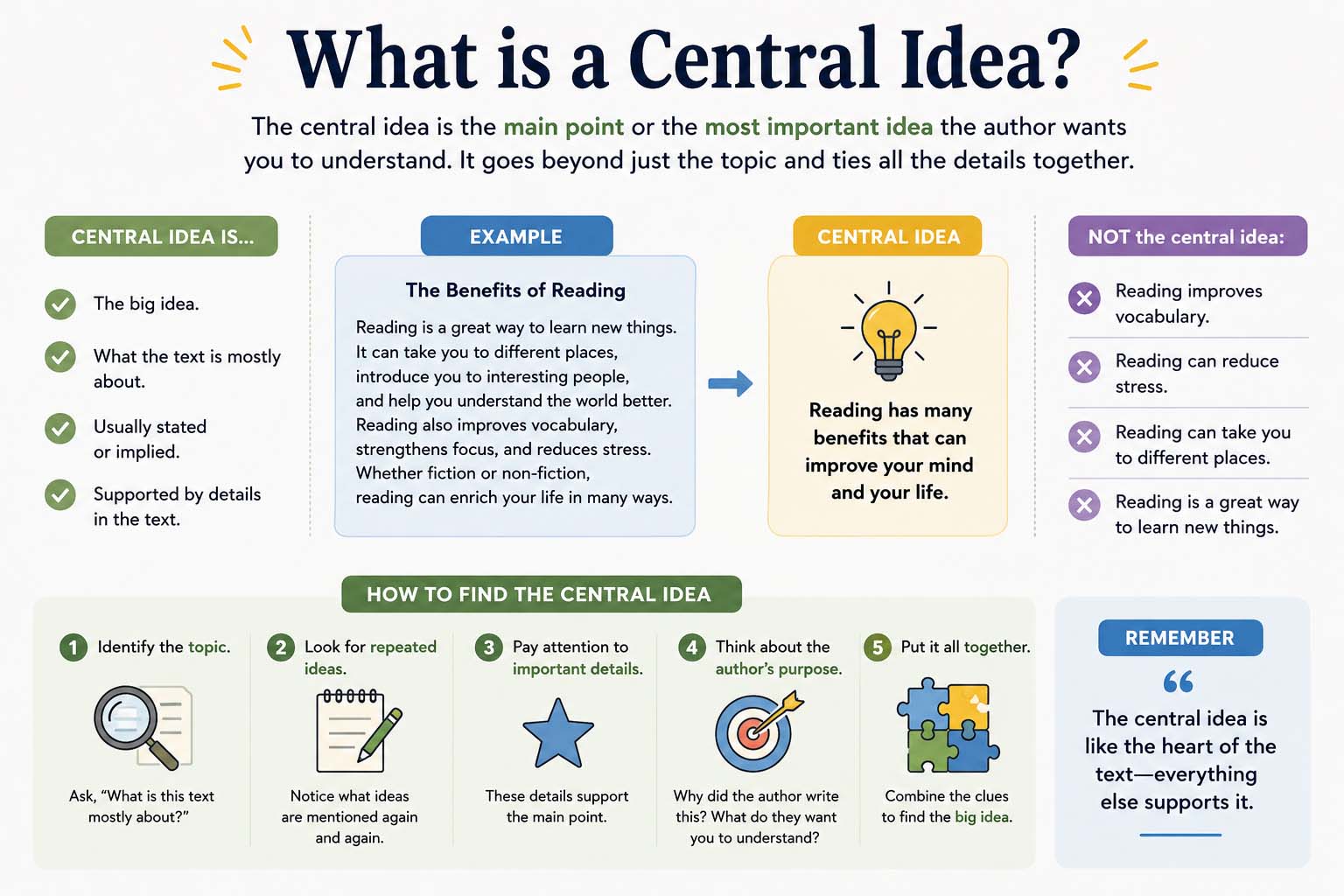
A central idea is the main point or message that an author wants to communicate in a piece of writing. It helps readers understand what the text is mostly about and why the author wrote it. The central idea is usually supported by important details, facts, examples, or explanations throughout the text. Understanding what is a central idea can help readers summarize information, identify the author’s main message, and better understand different types of texts.
Many students ask questions like , and because the concept appears frequently in reading comprehension assignments and exams.
What Is a Central Idea?
A central idea is the primary message, lesson, or focus of a piece of writing.
It tells readers what the text is mainly about.
Authors use supporting information such as:
- Details
- Examples
- Facts
- Characters
- Events
- Descriptions
to help explain and strengthen the main idea.
What Is a Central Idea? Simple Beginner Explanation
For beginners, think of the idea as the “big picture” of the text.
If someone asked:
“What is this entire passage mostly about?”
your answer would usually describe the idea.
For example:
A story about teamwork overcoming challenges may have a idea about cooperation and friendship.
Learning to recognize the message also helps students write stronger assignments, including What Is a Narrative Essay, where every story should communicate a clear lesson or purpose.
What Is the Central Idea of a Text?
The central idea of a text refers to the most important overall point in informational or nonfiction writing.
Examples include:
- Articles
- Essays
- Reports
- Biographies
- Educational texts
In nonfiction writing, the idea is often supported by facts and explanations.
Example
Text Topic:
Recycling helps reduce pollution.
Central Idea:
Recycling benefits the environment by reducing waste and conserving resources.
The topic and idea are related, but they are not exactly the same.
Difference Between Topic and Central Idea
Many students confuse topics with ideas.
| Topic | Central Idea |
|---|---|
| General subject | Main message about the subject |
| Short phrase | Complete explanation |
| Example: Pollution | Example: Recycling reduces pollution and protects nature |
The topic tells what the text is about, while the idea explains what the author says about that topic.
What Is the Central Idea of a Story?
The central idea of a story focuses on the main message behind fictional events and characters.
Stories often include themes such as:
- Friendship
- Courage
- Family
- Perseverance
- Honesty
- Growth
Example
Story:
A student works hard after repeated failures.
Central Idea:
Persistence and determination can lead to success.
In literature, the idea often connects closely with the story’s theme.
How to Find the Central Idea of a Text
Students can follow several steps to identify the idea more easily.
Step 1: Identify the Topic
Determine what the text discusses overall.
Step 2: Look for Repeated Ideas
Authors often repeat important concepts multiple times.
Step 3: Examine Supporting Details
Examples and facts usually support the message.
Step 4: Summarize the Text
Write a short sentence explaining the main point. Organizing notes with techniques from How to Make a Study Guide can make it much easier to identify the most important ideas while reading.
Step 5: Avoid Small Details
The idea focuses on the overall meaning, not minor information.
Why Central Ideas Matter in Education
Understanding ideas improves many academic skills.
Students use this ability for:
- Reading comprehension
- Essay writing
- Critical thinking
- Research projects
- Test preparation
- Class discussions
Strong idea skills also help students summarize information more effectively.
Central Idea vs Theme
The terms central idea and theme are sometimes similar but slightly different.
Central Idea
The main message or point of the text.
Theme
A broader life lesson or universal meaning.
For example:
Central Idea:
Teamwork helps solve difficult problems.
Theme:
Cooperation leads to success.
Themes are often more general and philosophical.
Examples of Central Ideas
Informational Text Example
Text:
An article explains the effects of climate change.
Central Idea:
Climate change affects weather, wildlife, and human communities globally.
Story Example
Story:
A character learns responsibility after caring for a pet.
Central Idea:
Responsibility develops through experience and commitment.
Examples help students understand how ideas connect to supporting details.
Common Mistakes Students Make
Many students struggle with idea questions because they focus too much on details.
Common mistakes include:
- Choosing minor facts instead of the overall message.
- Confusing the topic with the idea.
- Writing summaries that are too broad.
- Ignoring repeated ideas in the text.
Practice and careful reading improve these skills over time.
Tips for Students to Improve Central Idea Skills
Read Slowly
Understanding improves when students avoid rushing.
Highlight Key Details
Important supporting points often reveal the main message.
Ask Questions
What is the author trying to teach or explain?
Practice Summarizing
Short summaries help identify ideas faster.
Read Different Types of Texts
Stories, articles, and essays all strengthen comprehension skills. Paying attention to sentence structure and Examples of Adverbs can also improve understanding of how authors emphasize important ideas and actions.
Why Central Ideas Are Important for Exams
Many school exams include reading comprehension sections.
Students may need to:
- Identify the idea.
- Support answers with evidence.
- Compare ideas between texts.
- Explain themes and messages.
Because of this, mastering idea questions can improve academic performance significantly.
Real-World Importance of Central Ideas
idea skills are useful outside school as well.
Adults use these skills when reading:
- News articles
- Business reports
- Instructions
- Research papers
- Online content
Understanding the main point quickly helps improve communication and decision-making.
Technology and Reading Comprehension in 2026
Modern educational technology now helps students practice reading comprehension more effectively.
Popular tools include:
- Interactive reading apps
- AI tutoring systems
- Digital flashcards
- Online quizzes
- Educational videos
These resources help students strengthen central idea skills in engaging ways. Students also use similar analytical thinking when solving math concepts such as What Is a Mixed Number or learning How to Find Percent Increase, where identifying the key information is essential before solving the problem.
FAQ About What Is a Central Idea
What is a central idea?
A idea is the main message or most important point in a text.
What is the idea of a text?
It is the overall message the author wants readers to understand.
What is the central idea of a story?
It is the main lesson or message behind the story’s events and characters.
How do you identify a central idea?
Look at repeated ideas, supporting details, and the overall purpose of the text.
Is the idea the same as the topic?
No. The topic is the subject, while the idea explains the main point about that subject.
Conclusion
Understanding what is a central idea is an essential skill for reading, writing, and academic success. Whether students analyze nonfiction articles or fictional stories, identifying the main message helps improve comprehension and critical thinking. Developing this skill enables students to become stronger readers, more organized writers, and more confident learners across every subject.