
Social Emotional Learning Activities: A Complete Guide for Students and Teachers
Social Emotional Learning Activities: A Complete Guide for Students and Teachers
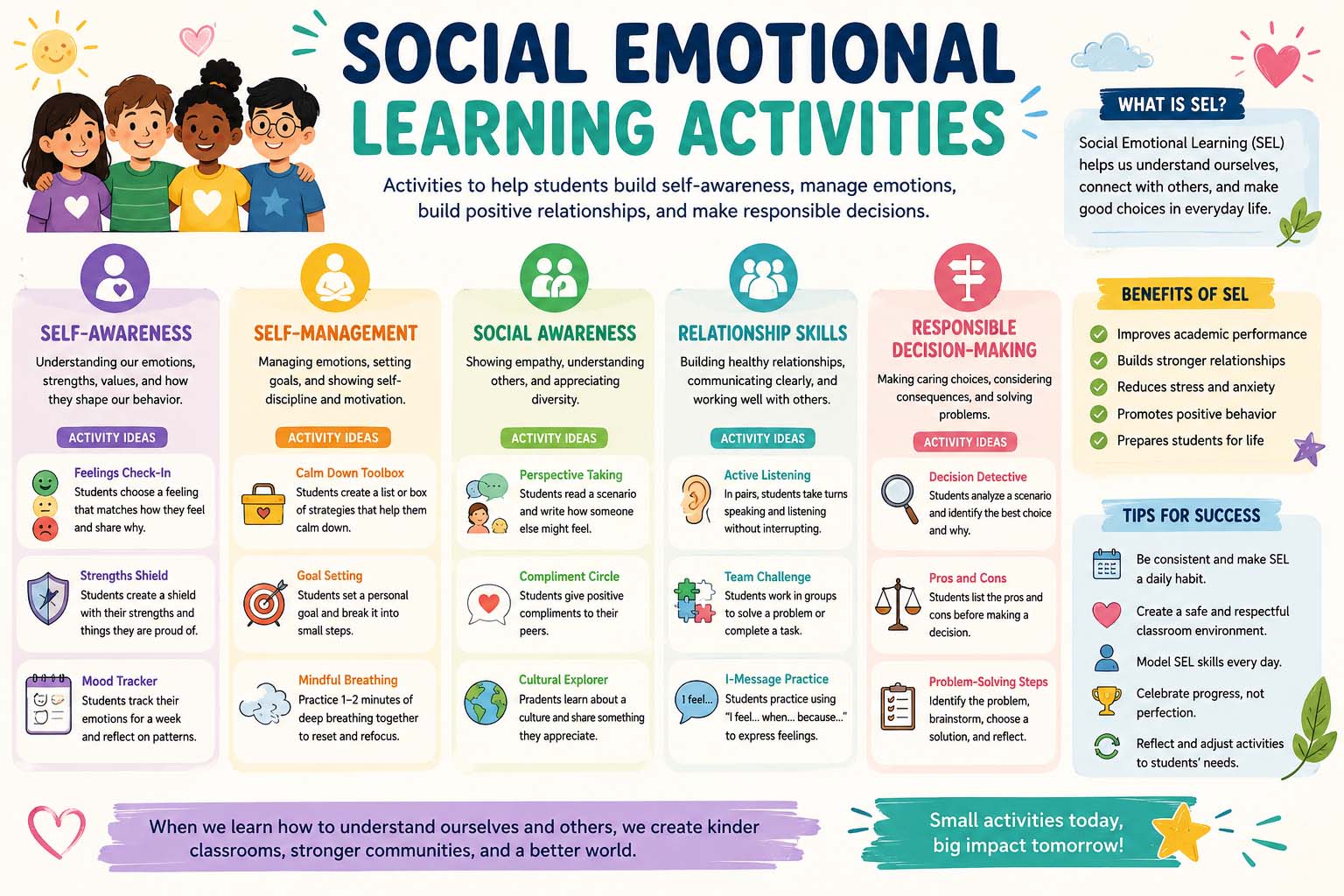
Social emotional learning activities help children recognize emotions, develop empathy, build healthy relationships, and make responsible decisions. Teachers and parents can use simple games, discussions, and daily exercises to support these skills in classrooms and at home.
Academic learning and emotional development often influence each other. For example, students who manage frustration and communicate respectfully may find it easier to participate in lessons and work with classmates.
Today, schools use a variety of SEL exercises to encourage cooperation, confidence, and emotional awareness. However, activities work best when educators adapt them to students’ ages, needs, and learning environments.
This guide explains the benefits of SEL, practical activities for different age groups, classroom implementation strategies, and useful resources for teachers and families.
What Are Social Emotional Learning Activities?
Social emotional learning activities are exercises, games, discussions, and classroom strategies that help students develop emotional awareness and social skills.
These activities teach students how to:
- Recognize and name emotions
- Communicate respectfully
- Manage stress and frustration
- Build positive friendships
- Resolve conflicts peacefully
- Develop empathy
- Strengthen self-confidence
According to the Collaborative for Academic, Social, and Emotional Learning (CASEL), social and emotional learning includes five interconnected competencies: self-awareness, self-management, social awareness, relationship skills, and responsible decision-making.
For example, identifying feelings develops self-awareness, while working through disagreements supports relationship skills. As a result, SEL can complement academic instruction and everyday classroom routines.
Why Social Emotional Learning Activities Matter
Children face challenges such as academic pressure, friendship conflicts, bullying, and changes in their daily routines. Therefore, learning to recognize emotions and respond thoughtfully can help them handle difficult situations.
SEL also supports a positive classroom environment. When students practice empathy, listening, and respectful communication, they have more opportunities to cooperate with classmates.
Well-designed SEL programs may support:
- Positive classroom behavior
- Student participation
- Emotional regulation
- Conflict resolution
- Problem-solving skills
- Academic engagement
However, results depend on the quality of the program, consistent implementation, and students’ individual needs.
In addition, educators can reinforce these skills through ordinary classroom interactions rather than relying only on separate lessons.
Social Emotional Learning Activities for Preschool
Social emotional learning activities for preschool should be simple, playful, and appropriate for young children’s developmental stages.
At this age, children are beginning to recognize feelings, practice sharing, and understand how their actions affect others. Therefore, short activities with pictures, stories, and movement often work well.
SEL Emotion Matching Games for Preschoolers
Teachers can show pictures of facial expressions and ask children to identify feelings such as happiness, sadness, anger, or excitement.
For example, children might match a smiling face with the word happy. Then, the teacher can ask when someone might feel that way.
This exercise encourages emotional recognition and introduces useful vocabulary.
Social Skills Through Sharing and Cooperation
Simple sharing games help preschool children practice patience, turn-taking, and cooperation.
Teachers can provide blocks, crayons, or other classroom materials for a small-group activity. Meanwhile, they can model polite requests and encourage children to take turns.
Social Emotional Learning Through Storytelling and Role Play
Reading stories about kindness and friendship helps children explore emotional situations through familiar characters.
After reading, teachers can ask what a character felt and why. Discussing the What Is a Central Idea of each story can also support reading comprehension and emotional understanding.
Role-playing simple situations, such as helping a friend or apologizing, gives children opportunities to practice positive responses.
Calm-Down Corners for Emotional Regulation
A calm-down corner offers children a quiet place to regain emotional balance.
For example, teachers may include comfortable seating, picture books, emotion cards, or simple breathing prompts.
However, educators should present this space as a supportive option rather than a punishment.
At the preschool level, regular practice and gentle adult guidance help children build familiarity with emotional language.
Social Emotional Learning Activities for Elementary Students
Social emotional learning activities for elementary students can introduce more complex ideas about emotions, friendships, decision-making, and problem-solving.
As children grow, they can reflect on experiences and consider different perspectives. Therefore, teachers can introduce structured discussions, writing exercises, and cooperative challenges.
Classroom SEL Discussions
Teachers can invite students to discuss feelings, challenges, or positive experiences.
For example, a discussion might explore how to respond when someone feels excluded from a group activity.
Students should have the option to pass when a question feels too personal. This approach helps maintain a respectful environment.
Gratitude Journals for Emotional Awareness
Students can write about positive experiences, supportive people, or moments they appreciate.
For instance, a child might describe how a classmate helped with an assignment. Over time, journaling can encourage reflection and awareness of positive relationships.
SEL Group Projects for Teamwork
Group projects allow children to practice listening, sharing responsibilities, and resolving disagreements.
Teachers can assign simple roles so everyone has a chance to contribute. As a result, students gain opportunities to strengthen teamwork and communication.
Mindfulness and Emotional Regulation Exercises
Short breathing exercises can help students pause and refocus during a busy school day.
For example, teachers might guide children through a brief period of slow, comfortable breathing before beginning a lesson.
However, mindfulness should remain optional and adaptable for students who find particular exercises uncomfortable.
Classroom Kindness Activities
Students can practice small acts of kindness, such as helping a classmate, welcoming someone new, or expressing appreciation.
Afterward, teachers can invite students to reflect on how these actions affect classroom relationships.
How to Implement Social Emotional Learning Activities in the Classroom
Teachers and parents can introduce emotional learning through a few manageable steps.
Step 1: Create a Supportive SEL Environment
Students need opportunities to express themselves without embarrassment or unnecessary judgment.
First, establish clear expectations for respectful listening and communication. Teachers should also avoid requiring children to disclose private experiences.
Step 2: Begin With Simple SEL Exercises
Start with short discussions, picture-based activities, or storytelling.
For example, a two-minute emotion check-in can introduce the topic without interrupting the daily schedule.
Step 3: Encourage Social and Emotional Communication
Allow students to share thoughts and feelings in age-appropriate ways.
Meanwhile, teach children to listen without interrupting and respond respectfully when classmates have different opinions.
Step 4: Practice Emotional Learning Skills Consistently
Regular practice helps children become familiar with emotional vocabulary and positive social habits.
For instance, teachers can include brief SEL exercises during morning meetings or classroom transitions.
Organizing weekly lessons using How to Make a Study Guide techniques can also help educators structure activities and review learning goals.
Step 5: Model Positive Social Behavior
Children learn from the adults around them. Therefore, teachers and parents should demonstrate patience, empathy, and respectful problem-solving.
When adults acknowledge mistakes and explain how they resolve disagreements, students see practical examples of emotional regulation.
Examples of Social Emotional Learning Activities for the Classroom
Different classroom exercises support different emotional and social skills.
Morning SEL Check-Ins
Students identify how they feel at the beginning of class.
For example, teachers can use emotion cards, colored symbols, or simple written responses. However, children should not have to explain personal feelings publicly.
SEL Team-Building Games
Cooperative games encourage students to communicate and work toward shared goals.
For instance, groups might build a structure using limited materials while practicing turn-taking and respectful discussion.
Emotional Reflection Writing Activities
Students can write about challenges, achievements, or personal growth.
A useful prompt might ask, “What helped you stay calm when something was difficult?”
As a result, students have an opportunity to reflect on their choices and consider different approaches.
Social Problem-Solving Discussions
Teachers present everyday situations and ask students how they might respond.
For example, a scenario could involve two classmates who disagree about sharing equipment.
Students can discuss possible solutions and explain why respectful communication matters.
Compliment Circles and Positive Feedback
Students can offer specific, respectful compliments to classmates.
For example, one child might say, “I appreciated how you helped our group finish the project.”
Teachers should also allow alternatives, such as written appreciation, for children who prefer not to speak publicly.
Social Emotional Learning Activities PDF Resources
Teachers often search for social emotional learning activities PDF materials because printable resources can simplify classroom preparation.
Common SEL printables include:
- Emotion identification worksheets
- Discussion prompts
- Classroom cooperation games
- Reflection journal templates
- Behavior observation sheets
- Group activity instructions
For example, an emotion worksheet might ask students to match facial expressions with feelings. A reflection sheet could encourage older children to describe how they handled a disagreement.
However, teachers should review printable resources before using them. Materials should suit students’ ages, reading levels, accessibility needs, and classroom goals.
Digital resources can also support remote learning or home activities when families have access to suitable devices.
How Social Emotional Learning Supports Academic Success
Emotional learning does more than teach children to recognize feelings. It also supports behaviors that help students participate in academic activities.
Students who practice emotional regulation and communication may become better equipped to:
- Concentrate during lessons
- Cooperate with classmates
- Manage frustration
- Ask for help appropriately
- Complete group assignments
- Approach challenges calmly
For example, a student who learns to recognize frustration may use a calming strategy before returning to a difficult assignment.
In addition, supportive classroom relationships can encourage students to participate more confidently.
SEL can also help teachers establish routines that reduce unnecessary disruptions. Activities involving Morning Meeting Questions provide opportunities to practice listening, empathy, and respectful discussion.
However, emotional learning should complement effective academic teaching rather than replace it.
Common Challenges in Social Emotional Learning
Although SEL offers useful opportunities, schools may face practical challenges when introducing these activities.
Limited Classroom Time for SEL
Teachers already manage busy schedules. Therefore, adding separate lessons may feel difficult.
Short emotion check-ins or cooperative exercises can help integrate SEL into existing routines.
Different Emotional and Developmental Needs
Children develop emotional skills at different rates.
For this reason, educators should adjust activities and provide alternatives when students need additional support.
Limited SEL Teaching Resources
Some schools lack dedicated SEL materials or professional training.
However, teachers can begin with accessible activities such as storytelling, guided discussions, and reflection exercises.
Student Participation in Emotional Learning
Some children feel uncomfortable discussing emotions in front of classmates.
Instead of requiring public sharing, teachers can offer private writing, individual conversations, or nonverbal responses.
Respecting students’ boundaries helps maintain trust and supports meaningful participation.
Social Emotional Learning Activities at Home
Parents and caregivers can reinforce emotional learning through ordinary family interactions.
Useful approaches include:
- Encouraging open conversations
- Teaching respectful communication
- Practicing patience during disagreements
- Reading stories about emotions
- Modeling calm responses
- Recognizing thoughtful and helpful actions
For example, parents can ask children how they handled a challenging moment at school. Then, they can discuss possible responses without immediately criticizing the child’s feelings.
Family activities such as cooking, playing cooperative games, or completing household tasks also create opportunities to practice teamwork.
Older students can strengthen communication through writing exercises such as Argumentative Essay Examples. Meanwhile, learning to use descriptive language, including Examples of Adverbs, may help students express their ideas more clearly.
Regular conversations and supportive relationships give children opportunities to practice these skills beyond the classroom.
Frequently Asked Questions About Social Emotional Learning Activities
What Are Social Emotional Learning Activities?
They are exercises and learning experiences that help students develop emotional awareness, self-management, empathy, communication, and responsible decision-making.
Why Are SEL Activities Important?
These activities help children practice managing emotions, developing relationships, and responding thoughtfully to challenges.
In addition, well-designed programs can support positive classroom behavior and academic engagement.
What Are Examples of SEL Activities?
Common examples include emotion matching games, gratitude journals, mindfulness exercises, role-playing, cooperative projects, and classroom discussions.
Teachers can choose activities based on students’ ages and learning needs.
Are Social Emotional Learning Activities Good for Preschool Students?
Yes. Preschool activities can help young children identify emotions, practice sharing, and develop early friendship skills.
However, teachers should use simple language, visual materials, and short exercises suited to young learners.
Where Can Teachers Find SEL Resources?
Teachers can find printable worksheets, lesson plans, and activity ideas through educational organizations, school resource collections, and teacher learning platforms.
Before using a resource, educators should check whether it matches their students’ developmental levels and learning objectives.
Building Social and Emotional Skills Through Daily Activities
Social emotional learning activities give children practical opportunities to understand feelings, develop empathy, and build positive relationships.
From preschool emotion games to elementary classroom discussions, educators can adapt SEL exercises to different ages and learning environments.
Consistent practice matters more than complicated activities. Therefore, teachers and parents can begin with simple conversations, supportive routines, and cooperative learning experiences.
By combining emotional learning with respectful communication and positive adult guidance, schools and families can help children develop skills they can use throughout their lives.