
What’s the Hardest Language to Learn?
What’s the Hardest Language to Learn?
Learning a new language is one of the most rewarding experiences in life, but it can also be one of the most difficult because every language has its own unique grammar, pronunciation, writing system, and cultural expressions. The answer often depends on the learner’s native language, study habits, and exposure to the language. Some languages are considered difficult because they use unfamiliar alphabets, while others challenge learners with complex grammar rules or tones.
Developing effective learning habits can make the process easier. Many students create vocabulary lists, practice daily conversations, and even learn How to Make a Study Guide to organize grammar rules, pronunciation tips, and new words more efficiently.
For English speakers, languages that are very different from English are usually the hardest to master. However, learners from other countries may find different languages more difficult depending on their background. In this article, we will explore several challenging languages and understand why they are often ranked among the toughest languages in the world.
What’s the Hardest Language to Learn in the World
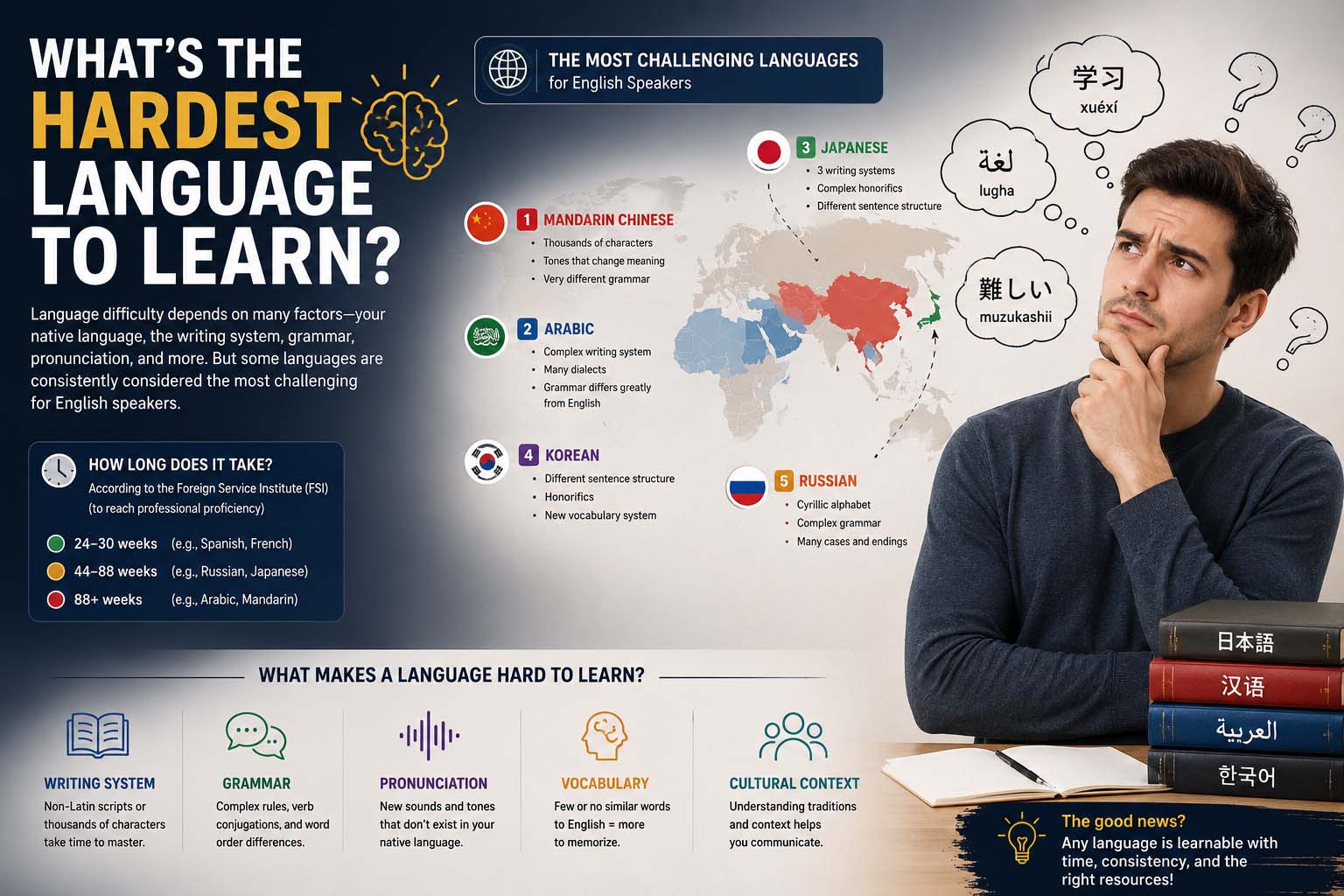
When discussing what’s the hardest language to learn, many experts often mention Mandarin Chinese. Mandarin is spoken by more than a billion people, yet it remains extremely challenging for learners because of its tonal nature and writing system. In Mandarin, the meaning of a word can completely change depending on the tone used. A small pronunciation mistake may create confusion or even change the sentence entirely.
Another major difficulty is the Chinese writing system. Instead of using an alphabet, Mandarin uses thousands of characters. Learners must memorize many symbols just to read newspapers or books comfortably. This requires patience and long-term practice. Despite the challenge, Mandarin is highly valuable for business, travel, and international communication.
Arabic is another language frequently mentioned when people ask what’s the hardest language to learn. Arabic has a completely different script from English and includes sounds that many foreign learners struggle to pronounce. In addition, Arabic grammar is highly detailed, and the language contains many regional dialects. A student may learn Modern Standard Arabic but still find it difficult to understand local conversations in different countries.
Japanese is also considered one of the toughest languages because it combines three writing systems: Hiragana, Katakana, and Kanji. Kanji alone includes thousands of characters borrowed from Chinese. Japanese sentence structure is very different from English, which can make speaking and comprehension difficult for beginners.
Learning these writing systems often improves overall reading and writing skills. Students who enjoy practicing handwriting may also find it helpful to explore How to Write Cursive, as both activities encourage patience, consistency, and attention to detail while developing new writing habits.
What’s the Hardest Language to Learn for Non English Speakers
The answer to what’s the hardest language to learn for non English speakers can vary greatly depending on the learner’s native language. For many people around the world, English itself is considered one of the most confusing languages. English spelling rules are inconsistent, pronunciation often changes, and grammar contains many exceptions. Words may look similar but sound completely different, creating confusion for learners.
For example, words like “through,” “though,” and “thought” have different pronunciations even though they appear similar in writing. This makes English difficult for students who come from languages with more consistent spelling systems. English also contains a huge vocabulary influenced by many other languages, which increases the complexity.
Another challenge is understanding expressions and figures of speech. Learners often study examples of Metaphor in a Sentence to better understand how native speakers communicate beyond the literal meanings of words.
Russian is another language that non-English speakers often find difficult. Russian uses the Cyrillic alphabet and contains complicated grammar cases. Nouns and adjectives change forms depending on their role in the sentence. Learners must memorize many endings and grammatical rules before they can speak accurately.
Korean can also be challenging for non-English speakers, especially because of its honorific system. The way you speak changes depending on the age and status of the person you are addressing. This social aspect of the language requires cultural understanding in addition to grammar and vocabulary study.
What’s the Most Hardest Language to Learn
People often debate what’s the most hardest language to learn because language difficulty is subjective. Still, some languages repeatedly appear on lists of the world’s hardest languages. One of these is Japanese due to its combination of grammar complexity and writing systems. Japanese learners often spend years mastering Kanji and improving listening skills because spoken Japanese includes fast and connected sounds.
Mandarin Chinese is another strong candidate for what’s the most hardest language to learn. Besides the tones and characters, Mandarin also requires learners to understand cultural expressions and sentence patterns that differ greatly from Western languages. Memorizing characters alone can take several years of consistent study.
Icelandic is another surprisingly difficult language. It has preserved many old grammatical forms from ancient Norse languages, making it challenging even for speakers of other European languages. The pronunciation and sentence structure can be difficult for foreigners to understand.