
Examples of Adverbs: A Complete Guide for Students
Examples of Adverbs: A Complete Guide for Students
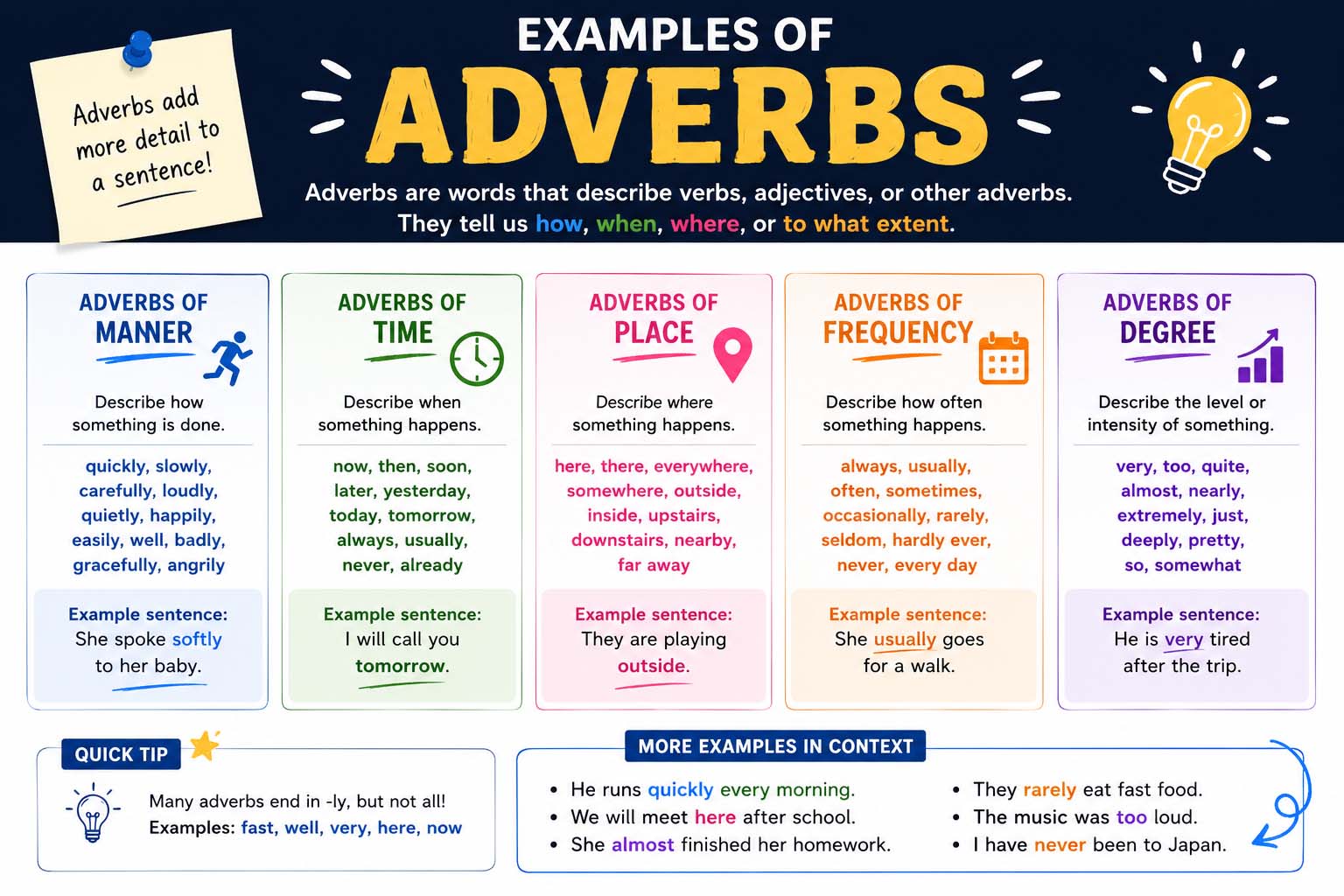
They help make sentences more detailed, interesting, and meaningful by describing how, when, where, or how often an action happens. Understanding examples of adverbs can improve both writing and speaking skills, making communication clearer and more effective.
Whether you are a student learning grammar for the first time or someone looking to improve English skills, knowing how adverbs work is essential. This guide explains what adverbs are, the different types of adverbs, and many practical examples to help you understand them easily.
What Is an Adverb?
An adverb is a word that modifies or describes a verb, an adjective, another adverb, or an entire sentence.
Adverbs often answer questions such as:
- How?
- When?
- Where?
- How often?
- To what extent?
Examples
- She sings beautifully.
- We arrived early.
- The dog ran outside.
- He is very tall.
In these examples, the adverbs provide additional information that helps the reader understand the action or description more clearly.
Why Are Adverbs Important?
Using correct grammar is especially important in academic writing tasks, including Argumentative Essay Examples, where clear sentence structure helps communicate ideas effectively.
Adverbs add detail and precision to language. Without adverbs, sentences can sound incomplete or vague.
Compare these examples:
- The athlete ran.
- The athlete ran quickly.
The second sentence gives a clearer picture of how the athlete ran.
Adverbs are commonly used in:
- School essays
- Creative writing
- Business communication
- Everyday conversations
- Academic assignments
Learning examples of adverbs can strengthen grammar skills and improve writing quality.
Types of Adverbs
There are several categories of adverbs. Each type serves a different purpose in a sentence.
Adverbs of Manner
Adverbs of Manner Examples
- Quickly
- Slowly
- Carefully
- Happily
- Easily
- Loudly
- Quietly
- Gracefully
Sentence Examples
- She completed the project carefully.
- The children played happily.
- He answered the question quickly.
- The singer performed beautifully.
These adverbs help describe the way an action is performed.
Examples of Adverbs in Sentences
Understanding grammar concepts also supports stronger reading and writing skills, including identifying important elements such as What Is a Central Idea in a text.
One of the best ways to understand grammar is by studying real examples.
- The teacher spoke clearly.
- We will leave tomorrow.
- The cat jumped upstairs.
- She always arrives early.
- They worked efficiently to finish the task.
- The baby slept peacefully.
- He nearly missed the bus.
- The weather became extremely cold.
Adverbs of Frequency Examples
These words are commonly used in daily conversation and writing.
Common Adverbs of Frequency
- Always
- Usually
- Frequently
- Often
- Sometimes
- Occasionally
- Rarely
- Never
Adverbs of Frequency Examples in Sentences
- She always completes her homework.
- We often visit our grandparents.
- They sometimes play soccer after school.
- He rarely misses a meeting.
- I never skip breakfast.
These adverbs help readers understand the regularity of an action.
Adverbs of Time
Examples
- Today
- Yesterday
- Tomorrow
- Soon
- Later
- Recently
- Already
- Eventually
Sentences
- We will travel tomorrow.
- She finished the assignment yesterday.
- The package arrived recently.
- He will call later.
Adverbs of Place
Adverbs of place indicate where an action happens.
Examples
- Here
- There
- Everywhere
- Upstairs
- Outside
- Nearby
- Abroad
Sentences
- Please come here.
- The children are playing outside.
- We looked everywhere for the keys.
- She went upstairs to study.
Adverbs of place help provide location information.
Examples of Conjunctive Adverbs
Conjunctive adverbs connect ideas between clauses or sentences. They often show relationships such as contrast, cause, effect, or sequence.
Common Examples of Conjunctive Adverbs
- However
- Therefore
- Moreover
- Nevertheless
- Consequently
- Furthermore
- Meanwhile
- Thus
Examples of Conjunctive Adverbs in Sentences
- The weather was bad; however, the event continued.
- The company expanded; moreover, profits increased.
Conjunctive adverbs improve sentence flow and create logical connections between ideas.
How to Identify Adverbs
Students often wonder how to recognize adverbs in a sentence.
Step 1: Find the Verb
Identify the action word.
Example:
The boy ran quickly.
Verb: ran
Step 2: Ask a Question
Ask:
- How did he run?
- When did it happen?
- Where did it happen?
Answer:
Quickly
This shows that “quickly” is the adverb.
Step 3: Check What the Word Describes
If a word modifies a verb, adjective, or another adverb, it is often an adverb.
Common Adverb Mistakes
Understanding common mistakes can improve grammar accuracy.
Confusing Adjectives and Adverbs
Incorrect:
She sings beautiful.
Correct:
She sings beautifully.
Overusing Adverbs
Too many adverbs can make writing less effective.
Instead of:
He ran very quickly and extremely carefully.
Consider:
He sprinted carefully.
Strong verbs often reduce the need for excessive adverbs.
Incorrect Placement
Adverbs should be positioned where they clearly modify the intended word.
Correct:
She always studies at night.
Incorrect:
Always she studies at night.
Tips for Using Adverbs Effectively
Students can also improve their grammar preparation by organizing key rules and examples in a structured resource using How to Make a Study Guide.
Students can improve their writing by following these simple guidelines:
Use Specific Adverbs
Choose adverbs that provide meaningful details.
Avoid Repetition
Do not repeatedly use the same adverb throughout a paragraph.
Read Sentences Aloud
This helps identify awkward or unnecessary adverbs.
Focus on Clarity
Use adverbs only when they add useful information.
Good writing balances detail with simplicity. Learning about Types of Writing alongside adverbs can also strengthen writing by helping students understand how grammar supports clear and engaging sentences.
Practice Examples
Identify the adverbs in these sentences:
- The dog barked loudly.
- We will meet tomorrow.
- She rarely watches television.
- The children played outside.
- Therefore, the project succeeded.
Answers:
- Loudly
- Tomorrow
- Rarely
- Outside
- Therefore
Practicing with examples helps students strengthen grammar skills over time.
Frequently Asked Questions
What is an adverb?
An adverb is a word that modifies a verb, adjective, another adverb, or an entire sentence by describing how, when, where, how often, or to what extent something happens.
What are some examples of adverbs?
Examples include:
- Quickly
- Slowly
- Always
- Never
- Here
- Tomorrow
- Very
- Carefully
What are adverbs of manner?
Adverbs of manner describe how an action is performed. Examples include carefully, quickly, happily, and quietly.
What are adverbs of frequency?
Examples include always, often, sometimes, rarely, and never.
What are conjunctive adverbs?
Conjunctive adverbs connect ideas between clauses or sentences. Examples include however, therefore, moreover, and consequently.
Conclusion
Learning examples of adverbs is an important step toward mastering English grammar. Adverbs add detail, clarity, and precision to sentences by explaining how, when, where, and how often actions occur. From adverbs of manner examples like “carefully” and “quickly” to adverbs of frequency examples such as “always” and “sometimes,” these words help create stronger communication.