
Difference Between Classical and Operant Conditioning
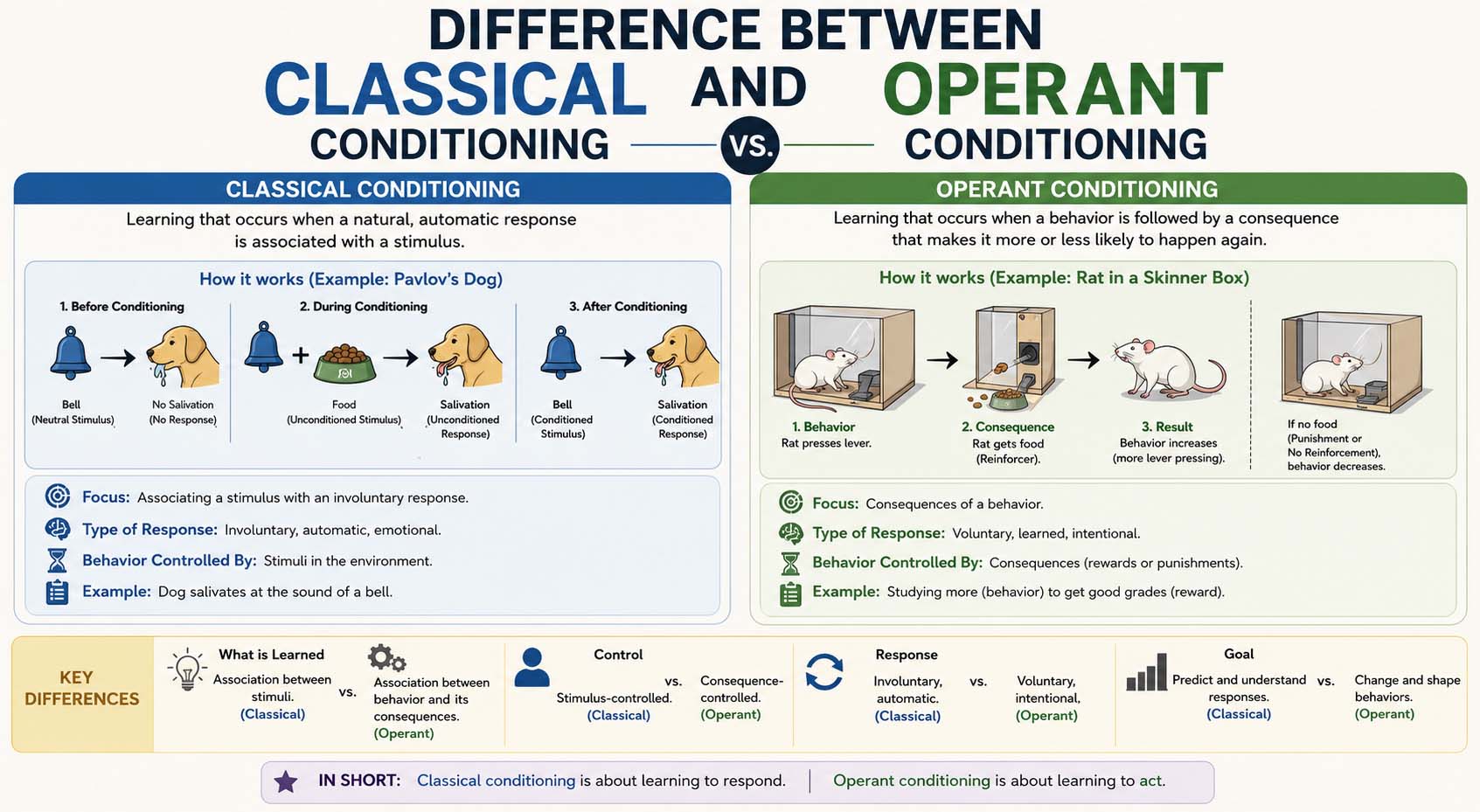
Difference Between Classical and Operant Conditioning
Imagine studying for a test every evening while listening to the same playlist. After a few weeks, hearing those songs alone puts you in “study mode.” Now imagine earning extra credit every time you submit homework early, making you more likely to repeat that behavior. These two situations demonstrate the difference between classical and operant conditioning, two of the most influential learning theories in psychology.
Although both explain how people and animals learn, they work in different ways. Classical conditioning focuses on forming associations between stimuli, while operant conditioning explains how rewards and consequences shape behavior. Understanding both theories makes psychology easier to study and helps explain many everyday experiences.
Difference Between Classical and Operant Conditioning at a Glance
The easiest way to understand the difference between classical and operant conditioning is by comparing their main features.
| Feature | Classical Conditioning | Operant Conditioning |
|---|---|---|
| Main Idea | Learning through association | Learning through consequences |
| Developed By | Ivan Pavlov | B. F. Skinner |
| Focus | Automatic responses | Voluntary behaviors |
| Learning Trigger | Pairing two stimuli | Rewards or consequences |
| Behavior Type | Reflexive or involuntary | Intentional or voluntary |
| Common Example | Salivating when hearing a bell | Studying harder after earning a reward |
Both theories explain learning, but they describe different processes.
What Is Classical Conditioning?
Classical conditioning is a type of learning in which a neutral stimulus becomes linked with a naturally occurring stimulus until it produces a similar automatic response.
Russian physiologist Ivan Pavlov discovered this concept while studying digestion in dogs.
During his experiments:
- Food naturally caused dogs to salivate.
- A bell initially had no effect.
- After repeatedly ringing the bell before presenting food, the dogs began salivating when they heard only the bell.
This process became known as classical conditioning.
Psychology students often practice identifying variables in experiments. Learning about an Operational Definition Psychology can make these experiments easier to understand because it explains how researchers clearly define behaviors and observations.
Key Elements of Classical Conditioning
Understanding a few basic terms helps simplify the process.
Unconditioned Stimulus (US)
A stimulus that naturally causes a response.
Example:
Food naturally causes salivation.
Unconditioned Response (UR)
The automatic response to the unconditioned stimulus.
Example:
Salivating when food appears.
Conditioned Stimulus (CS)
A previously neutral stimulus that gains meaning through repeated pairing.
Example:
A bell becomes associated with food.
Conditioned Response (CR)
The learned response to the conditioned stimulus.
Example:
Salivating after hearing the bell, even without food.
What Is Operant Conditioning?
Operant conditioning is a learning process in which behavior changes because of its consequences.
Instead of forming associations between two stimuli, learners connect behaviors with outcomes.
Psychologist B. F. Skinner introduced this theory through experiments showing that behavior becomes more or less likely depending on what happens afterward.
If a behavior leads to something pleasant, it is often repeated.
If it leads to an unpleasant outcome, it becomes less likely.
This approach focuses on voluntary actions rather than automatic reflexes.
Four Main Types of Operant Conditioning
Skinner identified four common ways consequences influence behavior.
Positive Reinforcement
A desirable reward is added after a behavior.
Example:
A student receives praise for participating in class.
The praise encourages future participation.
Negative Reinforcement
Something unpleasant is removed after the desired behavior.
Example:
Completing homework allows a student to skip an extra practice assignment.
Removing the unwanted task increases the likelihood of completing homework again.
Positive Punishment
An unpleasant consequence follows a behavior.
Example:
A student receives detention for breaking classroom rules.
Negative Punishment
Something enjoyable is taken away.
Example:
Parents temporarily remove gaming privileges after poor behavior.
Difference Between Classical and Operant Conditioning Explained
Many students ask, what is the difference between classical and operant conditioning because both involve learning through experience.
The biggest distinction is what drives learning.
Classical Conditioning
Learning happens by associating one stimulus with another.
The learner’s response is automatic rather than intentional.
Examples include:
- Feeling nervous at the sound of dental equipment
- Smelling popcorn and suddenly feeling hungry
- Becoming relaxed after hearing calming music
Operant Conditioning
Learning happens because actions produce rewards or consequences.
The learner actively chooses behaviors.
Examples include:
- Studying harder after earning good grades
- Saving money after receiving financial rewards
- Exercising regularly because it improves health
The learner’s own actions determine future outcomes.
Everyday Examples
These theories appear in daily life more often than many people realize.
Classical Conditioning Examples
- Hearing an alarm causes stress before work.
- A familiar perfume reminds someone of a loved one.
- The smell of fresh bread creates hunger.
- Hospital sounds trigger anxiety for some patients.
Operant Conditioning Examples
- Employees work harder after receiving bonuses.
- Children clean their rooms to earn extra screen time.
- Drivers obey speed limits to avoid fines.
- Athletes train consistently because practice improves performance.
Recognizing these examples makes the theories much easier to remember.
Difference Between Operant and Classical Conditioning in the Classroom
Teachers regularly use both learning theories, often without mentioning their names.
Classical conditioning can influence how students feel about learning.
For example, a welcoming classroom environment may help students associate school with positive emotions.
Operant conditioning shapes classroom behavior through feedback.
Praise, participation points, certificates, and constructive consequences encourage productive habits.
Many teachers also include Social Emotional Learning Activities to build positive classroom behaviors, strengthen emotional awareness, and encourage supportive interactions among students.
Why These Learning Theories Matter
Understanding the difference between classical conditioning and operant conditioning helps students connect psychology to everyday experiences.
These theories influence:
- Education
- Parenting
- Sports coaching
- Marketing
- Workplace training
- Animal training
- Healthcare
- Behavioral therapy
Rather than existing only in textbooks, they explain how people develop habits, respond to their surroundings, and change behavior over time.
Study Tips for Remembering the Difference Between Classical and Operant Conditioning
Psychology students often confuse these two theories because both explain learning. A simple memory strategy can make them much easier to remember.
Think of it this way:
- Classical conditioning = Association
- Operant conditioning = Action and consequence
In operant conditioning, a person’s behavior changes because of what happens after that behavior.
Another helpful trick is to remember the scientists behind each theory:
- Ivan Pavlov = Classical Conditioning
- B. F. Skinner = Operant Conditioning
Many students write these names and key concepts on flashcards to review before quizzes and exams.
A Simple Learning Framework
When you come across a psychology question, ask yourself these three questions:
Step 1: Is the behavior automatic?
If the response happens naturally without conscious decision-making, it is probably classical conditioning.
Examples include:
- Blinking
- Salivating
- Feeling anxious after hearing a familiar sound
Step 2: Is there a reward or consequence?
If a reward, punishment, or consequence changes future behavior, it is likely operant conditioning.
Examples include:
- Studying longer after receiving praise
- Cleaning a room to earn extra privileges
- Avoiding late homework after losing participation points
Step 3: What caused the learning?
If learning happened through pairing two stimuli, think classical conditioning.
If learning happened because behavior produced a result, think operant conditioning.
This quick framework works well for multiple-choice questions and classroom discussions.
Common Misunderstandings
Students often make a few predictable mistakes when learning these theories.
Thinking Both Theories Explain the Same Type of Behavior
Although both involve learning, they focus on different kinds of responses.
Classical conditioning explains automatic reactions.
Operant conditioning explains voluntary actions.
Assuming Punishment Is the Only Part of Operant Conditioning
Many learners associate operant conditioning only with punishment.
In reality, positive and negative reinforcement are often much more effective at encouraging long-term behavior change.
Forgetting That Classical Conditioning Doesn’t Require a Choice
People do not consciously decide to salivate when smelling fresh food or to feel nervous after hearing a sound linked with a stressful experience.
These responses happen automatically because of learned associations.
Real-World Applications Beyond the Classroom
These theories influence many professions and industries.
Education
Teachers use praise, feedback, and classroom routines to encourage learning and positive behavior.
Healthcare
Healthcare professionals help patients develop healthier habits and reduce unwanted behaviors through evidence-based behavioral strategies.
Animal Training
Professional trainers reward desired behaviors rather than relying solely on correction.
Marketing
Brands often pair products with pleasant music, memorable images, or positive emotions to create lasting associations with consumers.
Sports Coaching
Coaches reinforce consistent practice, teamwork, and skill development by recognizing improvement and celebrating achievements.
Careers That Use Conditioning Principles
Behavioral learning theories are useful in several career fields.
Examples include:
- Psychology
- Counseling
- Teaching
- Special education
- Occupational therapy
- Speech-language support
- Animal training
- Human resources
- Healthcare
Students interested in behavior analysis often review an RBT Competency Assessment Guide to understand the practical skills used when applying learning principles in therapeutic settings.
If you’re still exploring future career options, asking What Should I Major In can also help you identify degree programs that align with interests in psychology, education, or behavioral science.
Quick Revision Checklist
Before your next psychology test, make sure you can answer these questions.
| Question | Classical Conditioning | Operant Conditioning |
|---|---|---|
| Who developed it? | Ivan Pavlov | B. F. Skinner |
| How does learning occur? | Association between stimuli | Consequences of behavior |
| What type of behavior is involved? | Automatic | Voluntary |
| Are rewards required? | No | Often |
| Does punishment play a role? | No | Yes, in some situations |
If you can explain each row without looking at your notes, you’re well prepared for most introductory psychology exams.
Frequently Asked Questions
What is the difference between operant and classical conditioning?
The difference between operant and classical conditioning is that classical conditioning teaches through associations between stimuli, while operant conditioning teaches through the consequences of voluntary behavior.
What is the difference between classical and operant conditioning?
Classical conditioning involves automatic responses that develop after repeated stimulus pairings.
Which is easier to recognize in everyday life?
Operant conditioning is often easier to notice because rewards and consequences are visible. Classical conditioning is just as common, but the learned associations may be less obvious.
Can both types of conditioning happen together?
Yes. A person may develop automatic emotional responses through classical conditioning while also changing behavior because of rewards or consequences through operant conditioning.
Why do psychology courses teach both theories?
Together, these theories provide a strong foundation for understanding how people and animals learn, adapt, and develop new behaviors.
Key Takeaways
Understanding the difference between classical and operant conditioning becomes much easier once you remember what drives each type of learning.
Operant conditioning is based on the consequences of behavior and influences voluntary actions through reinforcement and punishment.
As you study psychology, look for real-life examples around you. Everyday routines, classroom experiences, advertising, sports, parenting, and workplace training all demonstrate these learning principles. Connecting theory with real situations is one of the best ways to remember the concepts and build confidence for future exams.