
Lexile Level by Grade: A Practical Reading Guide for Students and Parents
Lexile Level by Grade: A Practical Reading Guide for Students and Parents
A Lexile level by grade can help parents, teachers, and students understand how the difficulty of a text compares with a learner’s current reading ability. Instead of simply labeling a book as “fourth-grade” or “middle-school” reading, the Lexile Framework uses a numerical measure. However, Lexile scores should work as a guide rather than a strict rule because students in the same grade can have very different reading skills, interests, backgrounds, and learning needs.
Understanding how these measures work makes it easier to select books that provide enough challenge without making reading unnecessarily frustrating. It can also help teachers plan instruction and give parents a clearer way to support reading practice at home.
What Is a Lexile Level?
A Lexile measure is a numerical value used within the Lexile Framework for Reading. Student reading ability and text complexity can both be expressed using the same scale.
For example, a book might have a measure such as 700L, while a student may receive a Lexile reader measure from an assessment. Teachers and families can then use those measures as one piece of information when choosing reading material.
Generally, a higher number represents more complex text or stronger measured reading ability. However, a Lexile measure does not tell you everything about a book or a student.
A text with an appropriate numerical score may still contain mature themes, specialized vocabulary, unfamiliar background knowledge, or concepts that are difficult for a particular reader. Therefore, age appropriateness, interests, purpose, and teacher judgment still matter.
Lexile Level by Grade: Quick Reference Guide
There is no single Lexile score that every student in a grade must reach. Instead, grade-related ranges provide broad reference points.
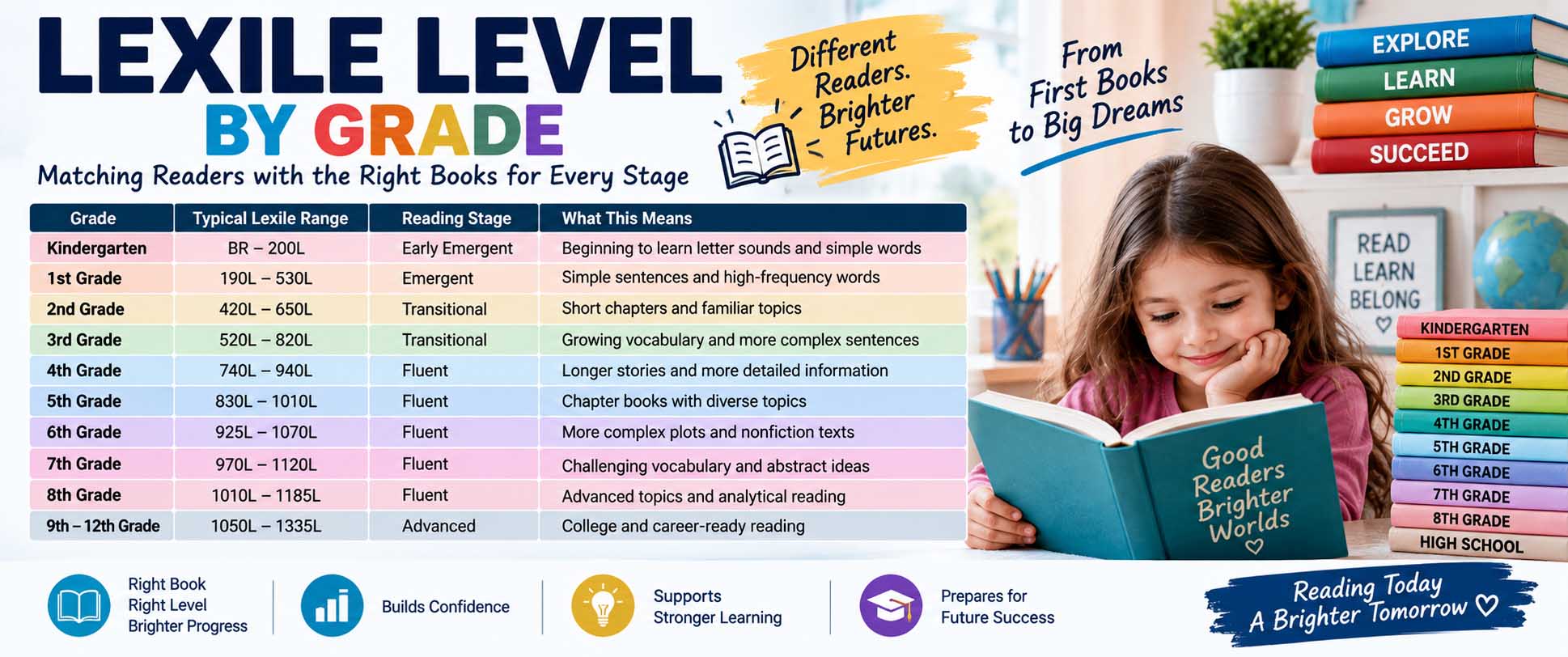
The following chart offers a practical overview of commonly referenced Lexile bands associated with grade levels. Exact expectations may differ among schools, assessments, instructional programs, and published frameworks.
| Grade Level | Approximate Lexile Range |
|---|---|
| Grade 1 | 190L–530L |
| Grade 2 | 420L–650L |
| Grade 3 | 520L–820L |
| Grade 4 | 740L–940L |
| Grade 5 | 830L–1010L |
| Grade 6 | 925L–1070L |
| Grade 7 | 970L–1120L |
| Grade 8 | 1010L–1185L |
| Grades 9–10 | 1050L–1335L |
| Grades 11–12 | 1185L–1385L |
These ranges overlap on purpose. Students do not suddenly move from one fixed reading ability to another when they enter a new grade.
Instead, reading develops gradually. One fourth grader, for example, might comfortably read material at 800L, while another may need easier text or be ready for considerably harder material.
For that reason, reading levels by grade should be interpreted as flexible reference ranges rather than rigid labels for individual students.
Understanding Lexile Scores by Grade Level
When people search for Lexile scores by grade level, they are often trying to answer one of two questions: “Is this book suitable for my child?” or “Is my child reading where they should be?”
A Lexile measure can contribute to both decisions, yet it should not provide the entire answer.
Suppose a fifth-grade student receives a measure of 900L. A teacher might use that information to identify books within an appropriate range while also considering the student’s comprehension, vocabulary, motivation, and reading purpose.
Meanwhile, another fifth grader could have a substantially different score. That difference does not automatically mean one child is successful and the other is failing.
Students develop at different rates, while language background, reading experience, instruction, learning differences, and familiarity with particular topics can all affect performance.
How to Read a Lexile Chart by Grade Level
A Lexile chart by grade level becomes much more useful when you understand what the numbers can and cannot tell you.
First, locate the student’s current grade. Then, look at the broad range associated with that grade rather than focusing on one target number.
Next, compare that information with the student’s measured Lexile level, if one is available.
However, do not automatically reject a book because its number falls slightly outside the expected range. A motivated student who already understands a subject may successfully read a harder text. Likewise, an easier book can still provide valuable reading practice, knowledge, enjoyment, or fluency development.
The goal is not to keep students permanently inside a narrow numerical band. Instead, the measure can help adults make more informed decisions about when a learner may benefit from easier, appropriately challenging, or more demanding material.
How Lexile Levels Relate to Early Reading Development
Parents often begin thinking about reading levels long before formal Lexile measures become central to schoolwork.
The question when do kids start reading has no single answer because early literacy develops in stages. Before children independently read books, they may learn letter names, recognize sounds, understand that print carries meaning, notice familiar words, and begin connecting spoken language with written symbols.
As these skills grow, children gradually become more independent readers.
Therefore, early reading instruction should not revolve around chasing a particular Lexile number. Young learners need a strong foundation in phonemic awareness, phonics, vocabulary, oral language, fluency, and comprehension.
Once students become more independent readers, text-complexity measures can become one useful tool among many.
Why Decoding Matters Before Reading-Level Numbers
Reading is much more than recognizing words quickly.
Understanding what is decoding in reading helps explain why some students may struggle even when they appear to know many familiar words. Decoding involves using knowledge of letter-sound relationships and spelling patterns to identify written words.
For example, a developing reader may encounter an unfamiliar word and use phonics knowledge to work through its sounds. As that skill becomes more automatic, the student can devote more mental attention to understanding sentences and ideas.
A student who has difficulty decoding may struggle with texts that appear appropriate according to a grade chart. Therefore, teachers should examine the underlying reading skills rather than simply moving the student to an easier book and stopping there.
Targeted instruction can address the skill causing difficulty.
Lexile Level by Grade Is Not the Same as Reading Comprehension
A Lexile score can provide useful information about text complexity and measured reading ability, but reading comprehension involves more.
Students also need to understand vocabulary, make connections, identify central ideas, follow text structure, make inferences, and connect new information with prior knowledge.
Consider two students with similar Lexile measures reading a science article about ecosystems. One student already knows about food chains, habitats, and biodiversity, while the other has little background knowledge.
Even though their measured reading levels are similar, the first student may understand the article more easily.
This is one reason teachers use multiple forms of evidence when evaluating reading development.
Fluency and Prosody Also Matter
Strong readers do not simply pronounce every word correctly. They usually read connected text with appropriate phrasing, rhythm, expression, and attention to punctuation.
That is where prosody in reading becomes useful. Prosody refers to expressive aspects of oral reading, including phrasing, stress, intonation, and rhythm.
For instance, a student might accurately decode every word in a paragraph but read in a slow, word-by-word pattern. Although accuracy is present, comprehension may suffer because so much attention goes toward processing individual words.
Repeated oral reading, teacher modeling, partner reading, and appropriately challenging texts can help students develop smoother reading.
Therefore, a complete reading assessment should consider fluency and comprehension alongside numerical measures.
Choosing Books Using Lexile Measures
A useful book should offer an appropriate balance between accessibility and challenge.
If a text is far too easy, it may provide limited opportunities for developing certain skills. On the other hand, a book that is much too difficult can turn reading into constant word-solving and reduce comprehension.
Start with the student’s current ability and purpose.
For independent reading, many students benefit from books they can understand without constant adult assistance. During guided instruction, however, a teacher may intentionally choose a more challenging text because support is available.
Interest matters too. A student fascinated by dinosaurs, space, sports, or history may persist with a difficult book because the subject provides strong motivation.
Therefore, use the Lexile number to narrow your choices, then consider content, age suitability, interest, vocabulary, and the student’s response to the first few pages.
How Teachers Can Use Lexile Information in the Classroom
Teachers can use Lexile measures to help differentiate reading materials without treating students as numbers.
For example, a class may study the same topic while students read different texts about it. Each learner can still participate in discussions and work toward common learning goals, even when text complexity varies.
Teachers can also use reading measures to track progress over time. However, one assessment should not determine every instructional decision.
Classroom observations, comprehension questions, writing responses, oral reading, vocabulary knowledge, and student discussions provide valuable information that a single score may miss.
Meanwhile, teachers can gradually expose students to more challenging material through guided practice rather than expecting independent mastery immediately.
How Parents Can Support Reading Growth at Home
Parents do not need to turn home reading into another testing session.
Instead, encourage regular reading and provide access to different kinds of material. Fiction, nonfiction, biographies, magazines, graphic novels, and age-appropriate informational texts can all support literacy.
After reading, ask natural questions such as:
- What happened in this chapter?
- Which character interested you most?
- What did you learn?
- Was anything confusing?
- What do you think will happen next?
- Why do you think the author included that detail?
These conversations provide insight into comprehension without making reading feel like an exam.
Also, let children sometimes choose easier books purely for enjoyment. Reading confidence and motivation matter, and students do not need to increase text difficulty every time they open a book.
Common Mistakes When Using Lexile Levels
One mistake is assuming that a Lexile measure equals a student’s grade.
A seventh grader with a measure associated with another grade band does not suddenly become a student in that grade. The score describes one aspect of reading performance, not the learner’s overall academic level.
Another mistake is choosing books only by number. Content can be inappropriate for a child’s age even when text complexity looks suitable.
Parents may also worry excessively about small score changes. Assessment performance can vary, while reading development rarely follows a perfectly straight line.
Finally, avoid turning higher numbers into a competition. The purpose of reading instruction is to build capable readers who understand, analyze, learn from, and enjoy texts—not simply to produce the largest possible score.
Frequently Asked Questions About Lexile Levels
What is a good Lexile level for a student?
Since reading development varies, there is no single “good” score for every child of the same age.
Can a student read above their grade’s Lexile range?
Yes. Some students comfortably read texts above typical grade-associated ranges. However, adults should still consider content maturity, background knowledge, and comprehension.
What does the L after a Lexile number mean?
For example, 850L represents a Lexile measure of 850.
Should children only read books at their Lexile level?
No. Students can benefit from easier books for fluency, enjoyment, and background knowledge.
Can Lexile scores improve?
Yes. As students develop vocabulary, decoding, fluency, comprehension, and reading experience, their measured reading performance can change. However, progress may not occur at a perfectly consistent rate.
Use Reading Levels as a Guide, Not a Limit
A Lexile level by grade is most helpful when it supports good teaching and book selection rather than becoming a rigid target
Still, numbers cannot capture every part of reading. Vocabulary, decoding, fluency, comprehension, background knowledge, motivation, and interest all shape how successfully a student interacts with a text.
Therefore, use Lexile information alongside teacher observations, assessment results, and the student’s actual reading experience. When students receive books that are both manageable and meaningful, they have a better chance to build skill, confidence, and a lasting habit of reading.