
Benefits of Chess: How the Game Supports Learning, Thinking, and Personal Growth
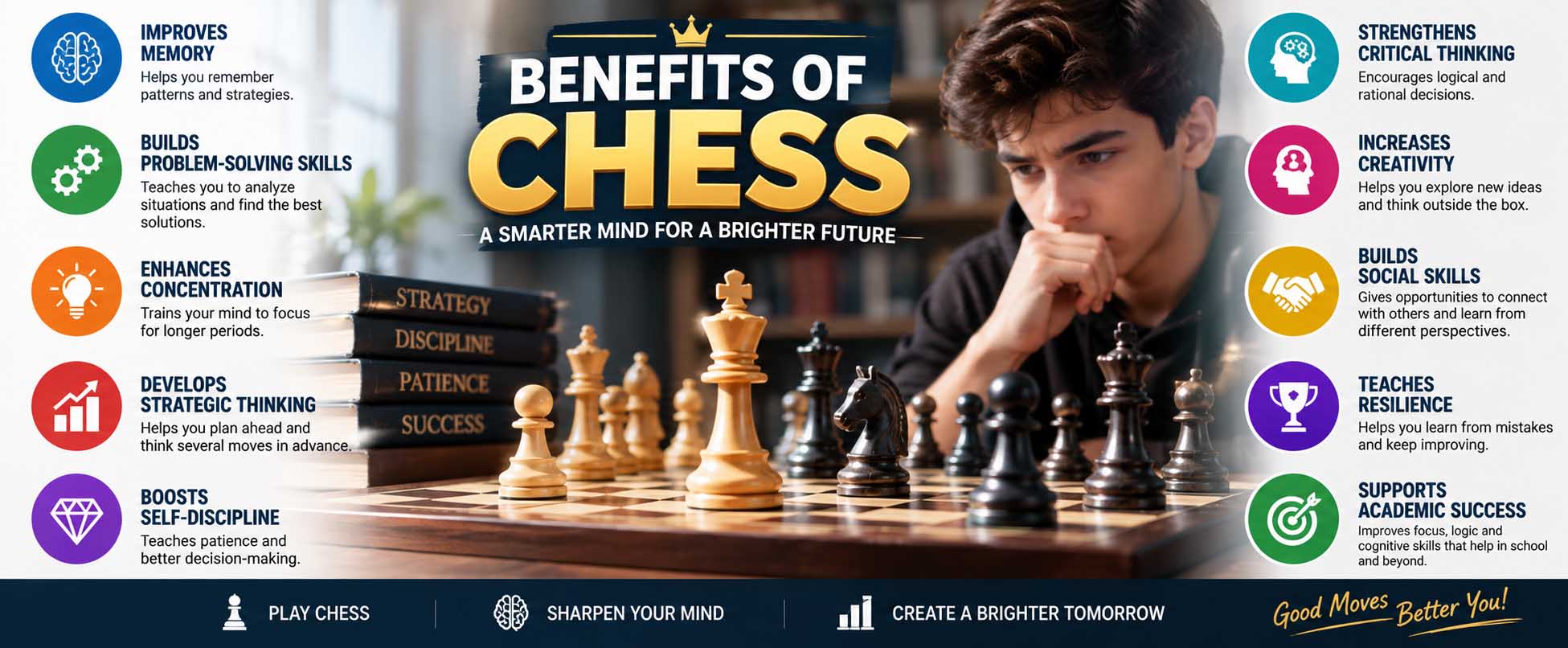
Benefits of Chess: How the Game Supports Learning, Thinking, and Personal Growth
Chess may look like a simple board game, yet every move asks a player to observe, plan, compare choices, and respond to changing situations. As a result, the benefits of chess can extend beyond learning how pieces move. Students, children, and adults can use the game as an enjoyable way to practice concentration, problem-solving, patience, and strategic thinking.
Unlike many learning activities, chess provides immediate feedback. When a move works, players see the advantage. When it fails, they can examine what happened and try a different approach next time. Therefore, chess can turn abstract thinking skills into practical habits that develop through repeated play.
What Are the Benefits of Chess?
The main benefits of chess come from the thinking processes involved in playing the game. Before making a move, a player usually has to examine the board, identify possible threats, consider several options, and predict how an opponent might respond.
Because these actions happen repeatedly, chess gives players regular practice with skills such as:
- Concentration and sustained attention
- Logical and strategic thinking
- Problem-solving
- Planning ahead
- Decision-making
- Pattern recognition
- Patience and self-control
- Learning from mistakes
However, chess should not be treated as a shortcut to academic success or higher intelligence. Instead, it works best as one useful activity among many that encourage active thinking and learning.
How Chess Exercises the Mind
Every chess position creates a small problem. For example, a student may need to protect a piece while also preparing an attack. Several moves might appear reasonable, so the player must decide which option fits the position best.
This process encourages deliberate thinking. Rather than reacting immediately, players learn to stop, inspect the board, and consider consequences.
That habit can also be useful in learning situations. Students often face similar processes when solving mathematics problems, organizing an assignment, or deciding how to approach a difficult question.
Chess can complement other forms of active learning as well. For younger students, the benefits of recess show why a balanced school day can include opportunities for both physical activity and mentally engaging play rather than relying only on classroom instruction.
Benefits of Chess for Concentration and Attention
A chess game demands attention because the position changes after every move. A player who stops paying attention may overlook an attack, lose a piece, or miss an opportunity.
Therefore, regular play gives students a structured reason to stay focused for a period of time.
Learning to Notice Details
Good chess players do not only look at the piece they want to move. Instead, they scan the board for checks, captures, threats, undefended pieces, and possible responses.
Beginners can practice this skill with a simple routine before each move:
- Check whether the king is under threat.
- Look for the opponent’s immediate threats.
- Identify possible captures.
- Consider two or three candidate moves.
- Think about the opponent’s likely response.
- Make the move only after a final check.
This routine slows down impulsive play. At the same time, it teaches students that careful observation often improves decision-making.
Benefits of Playing Chess for Problem-Solving
One reason educators and parents are interested in the benefits of playing chess is that the game constantly presents problems with multiple possible solutions.
Suppose a player’s queen is attacked. The obvious response might be to move the queen. However, another move could create a stronger threat, defend the queen indirectly, or win an opposing piece.
Consequently, players learn not to assume that the first answer they notice is automatically the best one.
Comparing Possible Solutions
Chess encourages players to generate alternatives and compare them. This process resembles problem-solving in academic subjects because students often need to examine several methods before selecting an effective approach.
For instance, a mathematics problem may have different solution methods. Likewise, a writing assignment may be organized in several ways. Chess reinforces the useful habit of asking, “What other options do I have?”
That question can make students more thoughtful learners.
Chess and Memory Skills
Chess involves several forms of memory. Beginners first remember how pieces move, while developing players begin recognizing common tactical patterns, opening ideas, mating patterns, and familiar endgame positions.
However, effective chess learning does not require memorizing hundreds of moves.
Instead, understanding patterns is often more useful. A student who understands why controlling the center matters can apply that idea to many positions without memorizing every possible sequence.
Similarly, recognizing a fork, pin, or discovered attack allows a player to notice familiar structures in new situations.
This pattern-based learning can make chess especially engaging because players gradually begin seeing ideas that previously went unnoticed.
Benefits of Chess for Kids
The benefits of chess for kids can include opportunities to practice patience, rule-following, planning, and respectful competition. Since both players follow the same rules, children learn to make choices within a clear structure.
Chess can also teach children that mistakes are a normal part of learning.
A child may lose a rook because of one careless move. Rather than treating the loss as failure, a teacher or parent can ask, “What did you miss?” and “What could you check next time?”
As a result, the mistake becomes a learning opportunity.
Supporting Social and Emotional Skills
Playing face-to-face chess also involves taking turns, waiting while another person thinks, handling wins appropriately, and responding calmly to losses.
These experiences can complement Social Emotional Learning Activities that help students practice self-management, responsible decision-making, communication, and respectful interaction with others.
Still, adults should keep the experience supportive. If every game becomes highly competitive, some beginners may lose interest. Therefore, children should have opportunities to solve puzzles, play casual games, and enjoy improvement without feeling pressure to win constantly.
Chess as a Classroom Learning Activity
Teachers do not need to turn students into tournament players to use chess effectively. Instead, short activities can introduce specific thinking skills.
For example, a teacher might display a simple position and ask students to find three legal moves. Students could then compare the advantages and disadvantages of each choice.
This approach encourages discussion because students must explain their reasoning rather than simply announce an answer.
Chess puzzles can also work well as short warm-up activities. Since many puzzles have a clear objective, students can practice observation and logical reasoning in manageable sessions.
However, chess should complement regular instruction rather than replace core academic activities.
Building Strategic Thinking and Planning Skills
Chess teaches a useful distinction between a move and a plan. A move changes the current position, while a plan connects several moves to a larger goal.
For example, a player might decide to control an open file. First, they may place a rook on that file. Next, they might double their rooks. Then, they may use the file to enter the opponent’s position.
Therefore, students begin seeing how small actions can contribute to a longer-term objective.
This idea applies naturally to studying. Preparing for an exam also involves a sequence of smaller actions: identifying topics, creating a schedule, reviewing material, practicing questions, and checking weak areas.
Creativity and Flexible Thinking Through Chess
Although chess has strict rules, players can still be highly creative. A position may offer several reasonable plans, and players often have to find unusual solutions when standard ideas fail.
Chess puzzles are particularly useful for this type of thinking. Sometimes the strongest move looks surprising at first, so students must challenge their initial assumptions.
Other recreational thinking activities can provide similar variety. For instance, Riddles for Adults can encourage learners to question obvious interpretations and search for alternative solutions, while chess applies flexible thinking within a rule-based strategic environment.
As players gain experience, they also develop personal preferences. Some enjoy attacking positions, while others prefer careful defensive play. Therefore, the game allows strategic creativity without removing structure.
Benefits of Playing Chess for Adults
The benefits of playing chess for adults are not limited to competition. Adults can play recreationally to challenge themselves, learn a new skill, socialize, or simply enjoy a mentally engaging activity.
Chess is also convenient because players can choose different formats. A casual over-the-board game may last an hour, while an online rapid game can fit into a shorter break.
For adult beginners, however, slower games are often more educational than very fast games. Extra thinking time makes it easier to examine threats and apply new ideas instead of relying mainly on instinct.
Adults who want to improve can also review their games afterward. Even a five-minute review can reveal recurring problems, such as overlooking undefended pieces or moving too quickly.
How to Start Playing Chess for Learning
Beginners do not need expensive equipment or advanced lessons. A board, basic rules, and regular practice are enough to begin.
A simple learning path can look like this:
Step 1: Learn Piece Movement
Start with how the king, queen, rooks, bishops, knights, and pawns move. Then, learn check, checkmate, castling, promotion, and en passant.
Step 2: Practice Simple Checkmates
Learn basic mating patterns, starting with positions such as king and queen against king. This helps beginners understand how pieces cooperate.
Step 3: Solve Easy Tactical Puzzles
Practice forks, pins, skewers, discovered attacks, and simple mating combinations. At first, accuracy matters more than speed.
Step 4: Play Slower Games
Choose a time control that provides enough time to think. Before each move, check the opponent’s threats and examine your candidate moves.
Step 5: Review Mistakes
After each game, find one or two moments where the position changed significantly. Ask what happened and what alternative move might have worked better.
This process makes each game part of a learning cycle rather than an isolated win or loss.
Common Mistakes New Chess Players Should Avoid
Beginners often focus heavily on attacking while ignoring their opponent’s ideas. As a result, they may create a threat but lose a valuable piece on the next move.
Another common mistake is playing too quickly. Even when plenty of time remains, beginners sometimes choose the first move that looks attractive.
Players may also become overly concerned with memorizing openings. Yet understanding basic principles usually provides a stronger foundation. Develop pieces, protect the king, compete for central space, and avoid moving the same piece repeatedly without a reason.
Finally, do not measure progress only through wins. A player who notices more threats, makes fewer major mistakes, or creates better plans is improving even when the final result is a loss.
What Are the Benefits of Playing Chess Regularly?
So, what are the benefits of playing chess consistently rather than occasionally? Regular practice provides repeated opportunities to apply the same thinking habits in new positions.
A practical schedule does not need to be demanding. A student might solve a few puzzles several times per week and play one thoughtful game on the weekend.
Consistency also makes reviewing progress easier. Over time, players can notice whether they are spotting tactics faster, planning more carefully, or making fewer impulsive moves.
However, balance still matters. Chess should fit alongside schoolwork, exercise, sleep, social activities, and other hobbies rather than replacing them.
Frequently Asked Questions
Is chess good for students?
Chess can be a useful educational activity because it gives students practice with concentration, planning, decision-making, pattern recognition, and problem-solving. However, it should support rather than replace regular academic learning.
At what age can children learn chess?
Many children can begin learning basic piece movement and simple rules during the early school years. However, readiness varies. Therefore, short, playful lessons are usually better than lengthy sessions for younger beginners.
Does chess make you smarter?
Chess provides practice with several thinking skills, but claims that simply playing chess automatically makes someone broadly “smarter” are too simplistic. Its educational value comes mainly from active practice, reflection, problem-solving, and sustained engagement.
How often should a beginner play chess?
A few short sessions each week can provide steady practice. Beginners often learn more from thoughtful games and review than from playing many fast games without examining their mistakes.
Is online chess useful for learning?
Yes. Online chess can provide convenient games, puzzles, lessons, and analysis. However, beginners should avoid relying completely on automated answers. Trying to identify mistakes independently before checking computer analysis can make practice more meaningful.
Making Chess a Useful Learning Habit
The benefits of chess become most meaningful when players treat the game as an opportunity to think rather than simply a contest to win. Each position encourages observation, each decision requires a choice, and each mistake offers information for the next game.
For students, a simple routine works well: learn one concept, practice it with puzzles, use it in a real game, and review what happened afterward. Meanwhile, parents and teachers can keep chess enjoyable by praising careful thinking and improvement rather than focusing only on results.
With patient, regular practice, chess can become both an entertaining hobby and a practical way to exercise concentration, planning, problem-solving, and thoughtful decision-making.