
Circular Flow of Income: Understanding How Money Moves in an Economy
Circular Flow of Income: Understanding How Money Moves in an Economy
The circular flow of income is one of the most important concepts in economics because it explains how money, goods, and services move between households, businesses, and the government. It shows how income earned in one part of the economy becomes spending in another, creating a continuous cycle of economic activity. Whether you are a student, business owner, or simply curious about economics, learning the circular flow of income helps you understand how economies function in the real world.
In simple terms, households provide labor and resources to firms, while firms pay wages, rent, and profits to households. Households then use this income to buy goods and services produced by firms. This creates a repeating cycle where production leads to income, and income leads to spending.
Circular Flow of Income Diagram
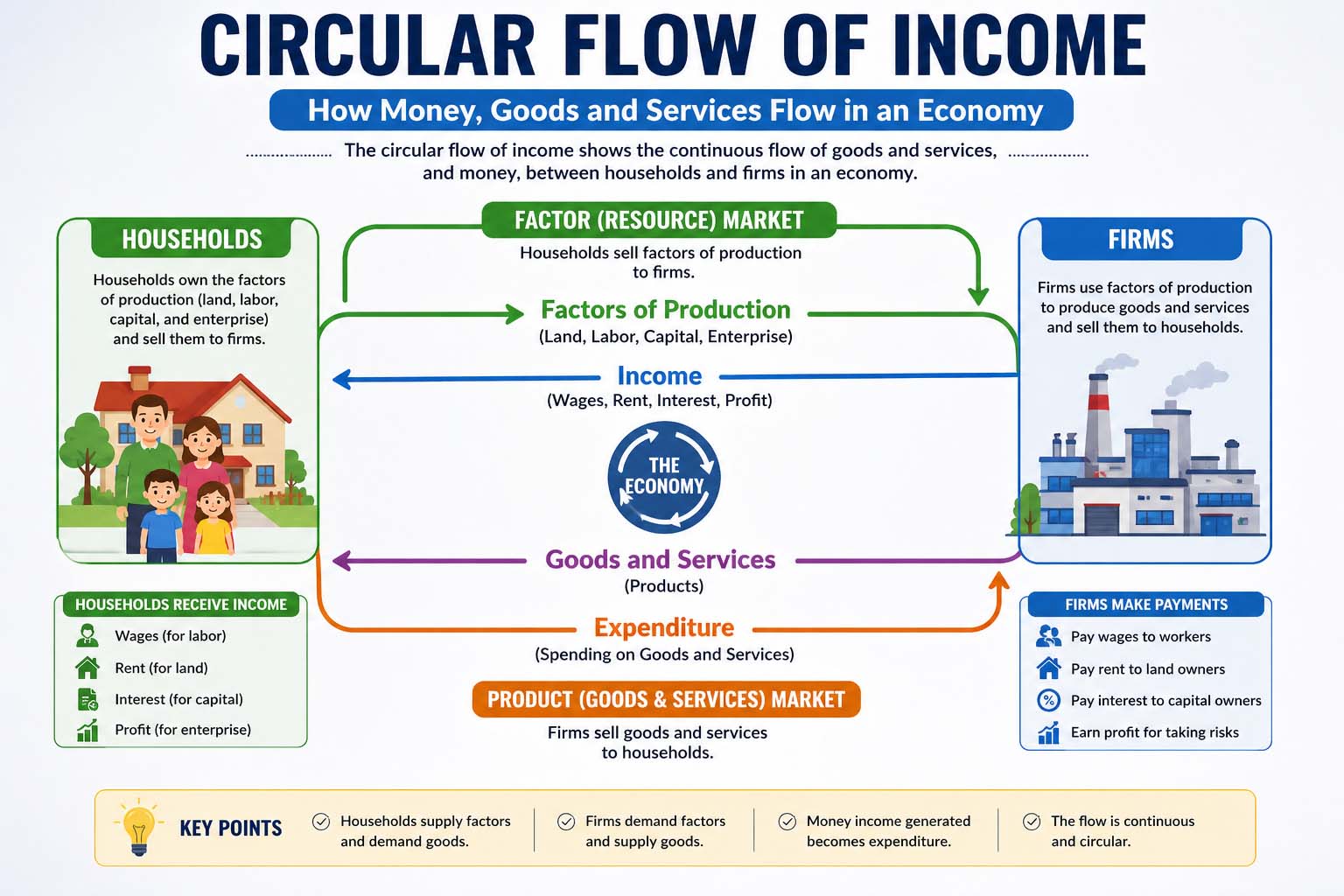
A circular flow of income diagram is a visual representation of the relationship between households and firms. In the basic two-sector model, households and firms are the main participants.
Households own factors of production such as labor, land, and capital. They sell these resources to firms through the factor market. In return, firms pay wages, salaries, rent, and profits. Households then use this income to purchase goods and services from firms through the product market.
The diagram usually has arrows showing money flowing in one direction and goods or resources flowing in the opposite direction. Resources move from households to firms, while finished products move from firms to households. At the same time, money flows from firms to households as income and returns to firms through consumer spending.
This simple diagram helps explain why production and consumption are interconnected. If one side slows down, the other side is also affected.
Circular Flow of Income A Level Economics
For students studying circular flow of income A Level economics, this topic is essential because it forms the foundation for macroeconomic analysis. At the A Level stage, students learn not only the simple two-sector model but also more complex versions involving government, banks, and international trade.
In advanced models, leakages and injections are introduced. Leakages are withdrawals from the circular flow, such as savings, taxes, and imports. These reduce spending in the economy. Injections are additions to spending, such as investment, government spending, and exports.
When injections equal leakages, the economy is in equilibrium. If injections are greater than leakages, economic activity expands. If leakages exceed injections, output and income may fall.
Understanding these relationships helps students analyze issues like unemployment, inflation, and economic growth. Learning how to identify the What Is a Central Idea of an economics passage can also make it easier to understand complex theories and exam questions.
Circular Flow of Income Model
The circular flow of income model can be expanded into several sectors depending on how detailed the analysis needs to be.
The two-sector model includes households and firms only. This is the simplest version and is useful for understanding basic relationships.
The three-sector model adds government. Governments collect taxes from households and firms, then spend money on public services, salaries, and infrastructure. This spending returns money to the economy.
The four-sector model includes the foreign sector. Imports represent money leaving the economy, while exports bring income from abroad. International trade plays a major role in modern economies.
The five-sector model may also include financial institutions. Banks collect savings and lend money for investment, helping businesses expand and consumers borrow.
Each version of the circular flow of income model gives a clearer picture of how a real economy works. Modern economies are complex, so economists use broader models to understand growth patterns and policy effects.
What Is the Circular Flow of Income?
Many people ask, what is the circular flow of income? It is the continuous movement of money, resources, goods, and services among different sectors of an economy.
Imagine a worker earning wages from a company. That worker uses part of the income to buy groceries, pay rent, or purchase clothing. The businesses receiving that money then pay employees and suppliers. Those people spend their income again, and the cycle continues.
This process keeps economic activity moving. If households stop spending, businesses may cut production. If firms stop hiring, household income falls. Because each part depends on another, economies rely on stable flows of income and spending.
The concept also explains why government policies matter. Tax cuts may increase household spending, while public investment can create jobs and stimulate demand. Central banks also influence the flow by adjusting interest rates that affect borrowing and saving.
Why the Circular Flow of Income Matters
The circular flow of income matters because it helps economists and policymakers understand how changes in one area affect the whole economy. For example, if consumer confidence falls and people save more, businesses may experience lower sales. This can reduce hiring and wages, leading to slower growth.
Similarly, increased business investment can create jobs, boost incomes, and encourage more spending. Government stimulus packages often aim to increase injections into the circular flow during recessions.
The model is also useful for businesses. Companies track consumer income and spending patterns to predict demand. Investors study economic flows to identify growth opportunities. Building professional skills such as those covered in Good Skills to Put on a Resume can also help students preparing for careers in economics, finance, and business.
Real-Life Example of Circular Flow of Income
Consider a bakery. The bakery hires workers and pays wages. Workers spend wages on rent, food, transport, and entertainment. The bakery also buys flour from suppliers and equipment from manufacturers. Suppliers pay their workers, who then spend their income elsewhere.
At the same time, customers buy bread and cakes from the bakery. This revenue helps the bakery continue paying workers and buying supplies. The bakery is one small part of a much larger circular flow of income happening across the economy every day.
Leakages and Injections Explained
Leakages occur when income is not immediately spent on domestic goods and services. Savings placed in banks, taxes paid to government, and imports purchased from overseas all reduce the immediate circular flow.
Injections restore or increase spending. Investment by businesses, government expenditure, and export earnings all add money back into the economy.
A healthy economy often depends on balancing leakages and injections. Too many leakages can slow growth, while strong injections can support expansion.
Conclusion
The circular flow of income is a powerful economic concept that explains how money moves continuously between households, firms, government, and other sectors. From the basic circular flow of income diagram to the advanced circular flow of income model, it helps us understand production, spending, employment, and growth. For students studying circular flow of income A Level economics, it is a key topic that builds strong economic understanding. If you ever wonder what is the circular flow of income, remember it is the ongoing cycle that keeps economies alive, linking every paycheck, purchase, investment, and policy decision together.