
Minimum Efficient Scale and Why It Matters in Economics
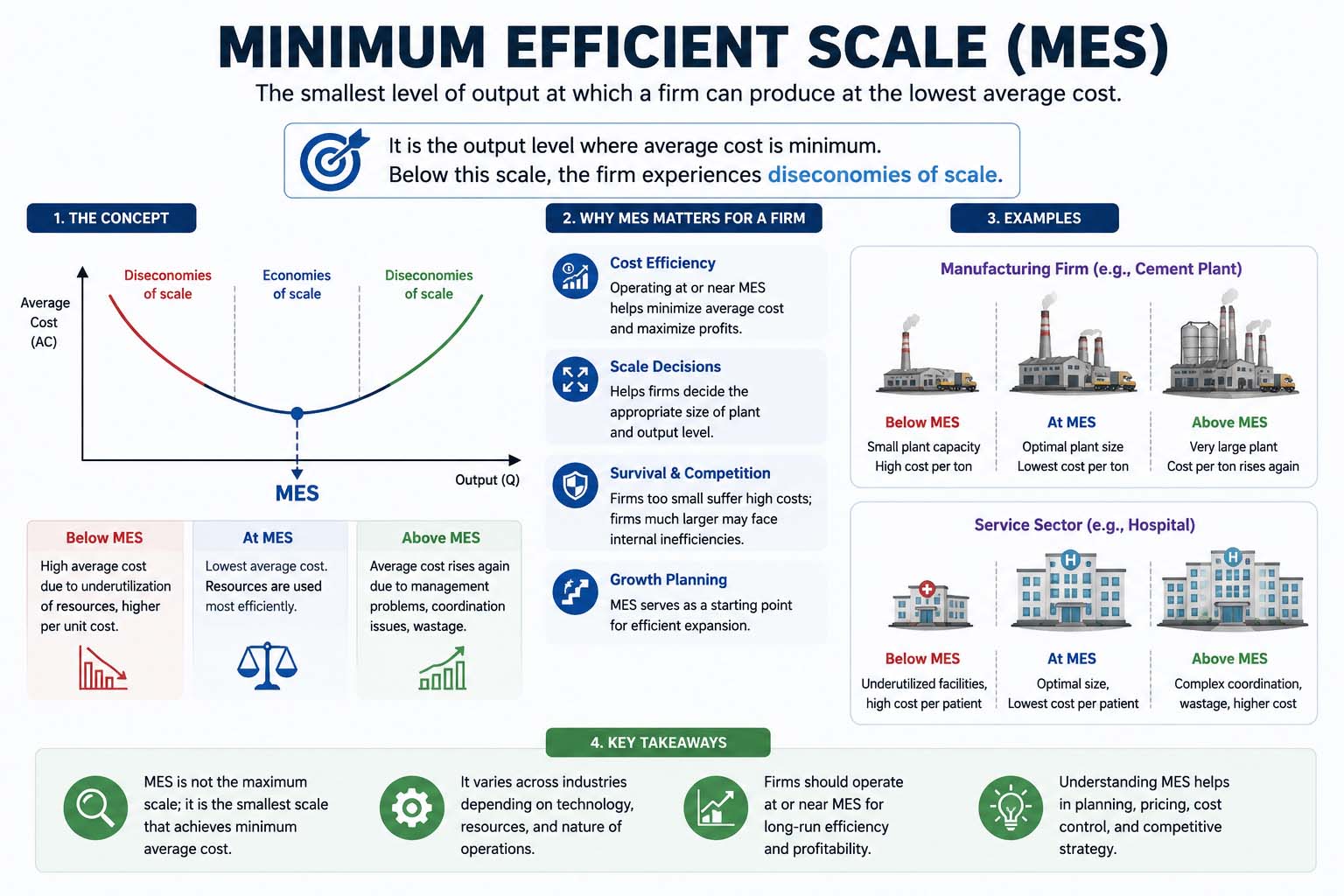
Minimum Efficient Scale and Why It Matters in Economics
Minimum efficient scale is one of the most important concepts in business and economics because it explains the production level where a company can operate at the lowest possible average cost. Businesses that understand minimum efficient scale can improve efficiency, reduce waste, and compete more effectively in the market. In modern industries, companies constantly look for ways to increase productivity while keeping costs under control, and this is where the idea of minimum efficient scale becomes highly valuable.
In economics, firms that achieve minimum efficient scale often gain an advantage over smaller competitors because they can produce goods at a lower cost per unit. This advantage allows them to offer competitive prices while still maintaining healthy profit margins. The concept is especially important in manufacturing, transportation, technology, and large-scale retail businesses where production costs play a major role in success.
Minimum Efficient Scale Economics
In minimum efficient scale economics, the term refers to the smallest amount of production a company must achieve to fully benefit from economies of scale. Economies of scale occur when production increases and the average cost of each product decreases. Businesses can spread fixed costs such as machinery, buildings, and salaries across a larger number of products, making operations more efficient.
For example, a car manufacturing company may spend millions of dollars on equipment and factories. If the company produces only a few cars, the average production cost will remain very high. However, when production expands to thousands of vehicles, the fixed costs become distributed across many units, reducing the cost per car. This point where costs become most is known as the .
Different industries have different minimum efficient scales. In industries like airline services or automobile manufacturing, the is very large because businesses require expensive infrastructure and technology. In contrast, smaller businesses such as local bakeries or small repair shops may reach with far less production.
Economists use this concept to study market structures and competition. Markets with very high minimum efficient scales often have fewer competitors because it is difficult for new businesses to enter the industry. This is why sectors like telecommunications and energy production are usually dominated by large corporations.
What Is the Minimum Efficient Scale
Many people ask, what is the minimum efficient scale and why is it important for businesses. The minimum efficient scale is the point where a company has reduced its average production costs as much as possible through economies of scale. Beyond this level, increasing production may not significantly lower costs anymore.
The concept helps companies determine the ideal production level for maximum efficiency. Businesses that operate belo may struggle because their costs are too high compared to larger competitors. On the other hand, companies operating near or at can maximize profits and remain competitive in the marketplace.
A useful example can be seen in the smartphone industry. Large smartphone manufacturers produce millions of devices every year. Because they purchase materials in bulk and use automated factories, they reduce production costs significantly. Smaller manufacturers may not achieve the same cost advantages because their production volume is lower. As a result, larger firms often dominate the market.
What Is Minimum Efficient Scale
Understanding what is efficient scale can help entrepreneurs make better business decisions. When starting a company, business owners must determine how much they need to produce in order to compete effectively. If production remains too low, the business may face high operational costs and reduced profits.
The minimum efficient scale varies depending on the type of industry and production process. In labor-intensive industries, the may be smaller because companies rely more on workers than expensive machinery. In capital-intensive industries, businesses often need large production facilities and high sales volumes to reach efficiency.
For example, a small coffee shop can reach efficient operation relatively quickly because startup costs are moderate. However, an oil refinery requires enormous investments and large-production before reaching minimum efficient scale. This difference explains why some industries are filled with small businesses while others are controlled by only a few giant firms.
Competition is closely linked to If the efficient scale is small, many companies can enter the market and compete easily. If the efficient scale is large, only businesses with significant financial resources can survive. This creates concentrated markets where large corporations dominate.
Minimum Efficient Scale of Production
The minimum efficient scale of production refers specifically to the production level at which average costs are minimized. This concept is essential for companies trying to optimize manufacturing operations and long-term growth strategies.
When businesses expand production, they often experience several benefits. They may receive discounts on bulk purchases, improve worker specialization, and increase operational efficiency. These advantages reduce average costs and improve profitability. However, after reaching the minimum scale of production, additional expansion may produce smaller cost savings.
In some situations, companies may even face diseconomies of scale after growing too large. Diseconomies of scale happen when management becomes inefficient, communication problems increase, or operational complexity creates higher costs.
The of production also affects global competition. Large multinational companies often achieve lower production costs because they operate massive facilities and serve international markets. Smaller local businesses may struggle to compete unless they focus on specialized products or niche markets.
Conclusion
Minimum efficient scale is a fundamental economic concept that explains the ideal production level where businesses achieve the lowest average costs. Companies that reach this level benefit from economies of scale, improved efficiency, and stronger market competitiveness. The idea plays an important role in understanding market structures, pricing strategies, and long-term business growth.
In minimum scale economics, firms aim to optimize production while controlling operational expenses.