
Product Life Cycle: A Complete Guide to Understanding Growth and Decline
Product Life Cycle: A Complete Guide to Understanding Growth and Decline
The product life cycle is one of the most important concepts in marketing and business strategy. It explains how a product moves through different phases from its introduction to eventual decline. Every successful business relies on understanding the product life cycle to make better decisions about pricing, promotion, and innovation. Whether you are launching a new or managing an existing one, knowing how the product life cycle works can help you stay competitive in a fast-changing market.
Product Life Cycle Diagram
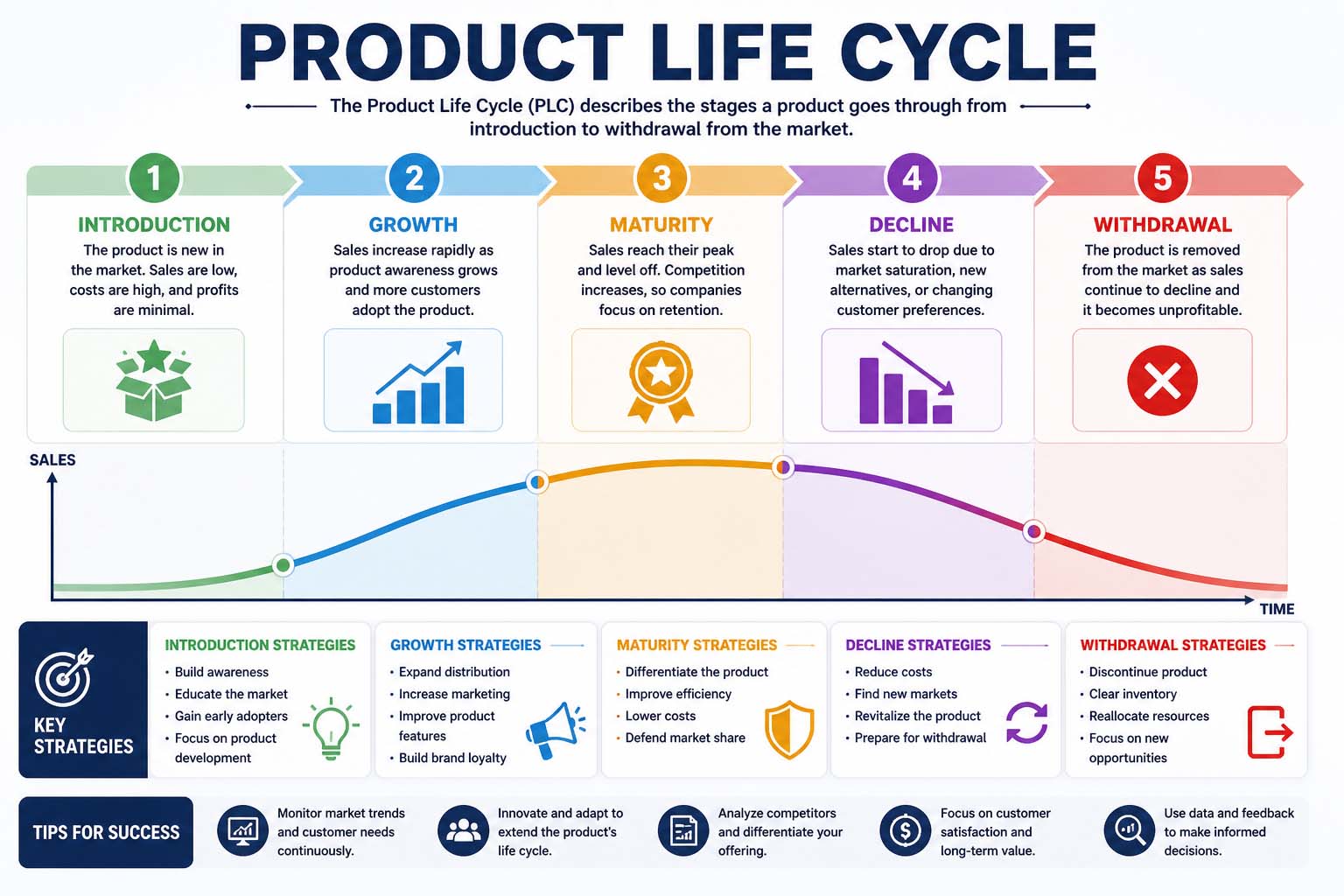
A product life cycle diagram visually represents the journey of a over time. Typically, this diagram is shown as a curve that rises and falls, indicating the product’s performance in terms of sales and profits. The horizontal axis represents time, while the vertical axis represents sales or revenue.
At the beginning of the life cycle, the curve starts low as the product is introduced to the market. As awareness increases, sales begin to rise, leading to growth. Eventually, the curve peaks during the maturity stage, where the product reaches its highest sales volume. After this, the curve gradually declines as demand decreases or new alternatives emerge.
This diagram helps businesses understand where their product currently stands and what strategies they should adopt next. For example, if a product is in the growth phase, companies may invest more in marketing. If it is in the decline phase, they may consider innovation or discontinuation.
Product Life Cycle Stages
During the maturity stage, businesses often focus on improving efficiency and reducing costs, which can be better understood through concepts like Minimum Efficient Scale and production optimization.
The product life stages consist of four main phases: introduction, growth, maturity, and decline. Each stage has its own characteristics and requires different business strategies.
Companies often invest heavily in advertising and promotion to build awareness. At this stage, profits may be minimal or even negative due to high development and marketing costs.
The growth stage is where the product starts gaining traction. Sales increase rapidly as more customers become aware of and trust the product. Competitors may enter the market, which pushes companies to improve quality and differentiate their offerings. Profit margins usually improve during this phase.
Most potential customers already own or use the product. Companies focus on maintaining market share through competitive pricing, branding, and product enhancements.
The decline stage occurs when demand begins to fall. This can happen due to changing consumer preferences, technological advancements, or increased competition. Businesses may reduce costs, find new markets, or discontinue the product altogether.
Understanding these stages allows businesses to anticipate challenges and make informed decisions to maximize profitability throughout the life cycle.
Product Development Life Cycle
The product development life cycle is closely related to the product life cycle but focuses on the process of creating and launching a new product. It includes several steps such as idea generation, research, design, testing, and commercialization.
In the idea generation phase, businesses brainstorm potential product concepts based on market needs and opportunities. This is followed by research and analysis to evaluate the feasibility of these ideas. Companies assess factors such as target audience, competition, and potential demand.
Next comes the design and development phase, where the product is created and refined. Prototypes are developed and tested to ensure functionality and quality. Feedback from testing is used to make improvements before the final launch.
Once the product is ready, it enters the commercialization stage, where it is introduced to the market. This marks the beginning of the life cycle. A well-managed development cycle ensures that the product meets customer expectations and has a higher chance of success in the market.
Product Life Cycle Graph
Businesses can also use tools like a Cost and Revenue Diagram to evaluate financial performance and understand how costs and earnings change over time.
In the introduction stage, the sales curve starts to rise slowly, while the profit curve may remain low or negative. During the growth stage, both curves increase significantly as the product gains popularity. The maturity stage shows a leveling off of sales and profits, while the decline stage shows a downward trend.
This graph is a valuable tool for strategic planning. It helps businesses determine when to invest more in marketing, when to innovate, and when to phase out a product. By analyzing the graph, companies can allocate resources more effectively and avoid unnecessary losses.
Importance of the Product Life Cycle
Developing Commercial Awareness helps businesses better understand market trends, customer needs, and strategic decisions throughout the product life cycle.
The plays a crucial role in business success. It provides a framework for understanding how products perform over time and how market conditions change. By analyzing the life cycle, companies can develop strategies that align with each stage.
For example, during the introduction stage, businesses focus on creating awareness. In the growth stage, they aim to expand their market share. During maturity, they work on maintaining customer loyalty, and in the decline stage, they explore ways to extend the product’s life or replace it with new offerings.
Factors Influencing the Product Life Cycle
Understanding broader economic relationships, such as the Circular Flow of Income, can help businesses analyze how consumers and markets influence product demand.
Changes in competitor pricing and market behavior can also influence product demand, making concepts such as the Kinked Demand Curve useful for understanding competitive markets.
Several factors can influence the life cycle, including technology, competition, and consumer behavior. Rapid technological advancements can shorten the life cycle of products, especially in industries like electronics and software.
Competition also plays a significant role. When new competitors enter the market, they can affect the demand for existing products. Companies must continuously innovate to stay ahead.
Managing the product life cycle effectively requires strategic planning and adaptability. In the introduction stage, businesses should focus on building brand awareness and educating customers about the product.
During the growth stage, companies should invest in marketing and expand distribution channels. This helps them capture a larger share of the market and establish a strong presence.
In the maturity stage, the focus shifts to differentiation. Businesses can introduce new features, improve quality, or offer competitive pricing to maintain their position.
Conclusion
The product life cycle is a powerful concept that helps businesses understand the journey of a from launch to decline. By analyzing the life cycle diagram, understanding the life cycle stages, managing the product development cycle, and interpreting the life cycle graph, companies can make informed decisions that drive success.