
Types of Counseling Certifications: Career Paths, Requirements, and How to Choose
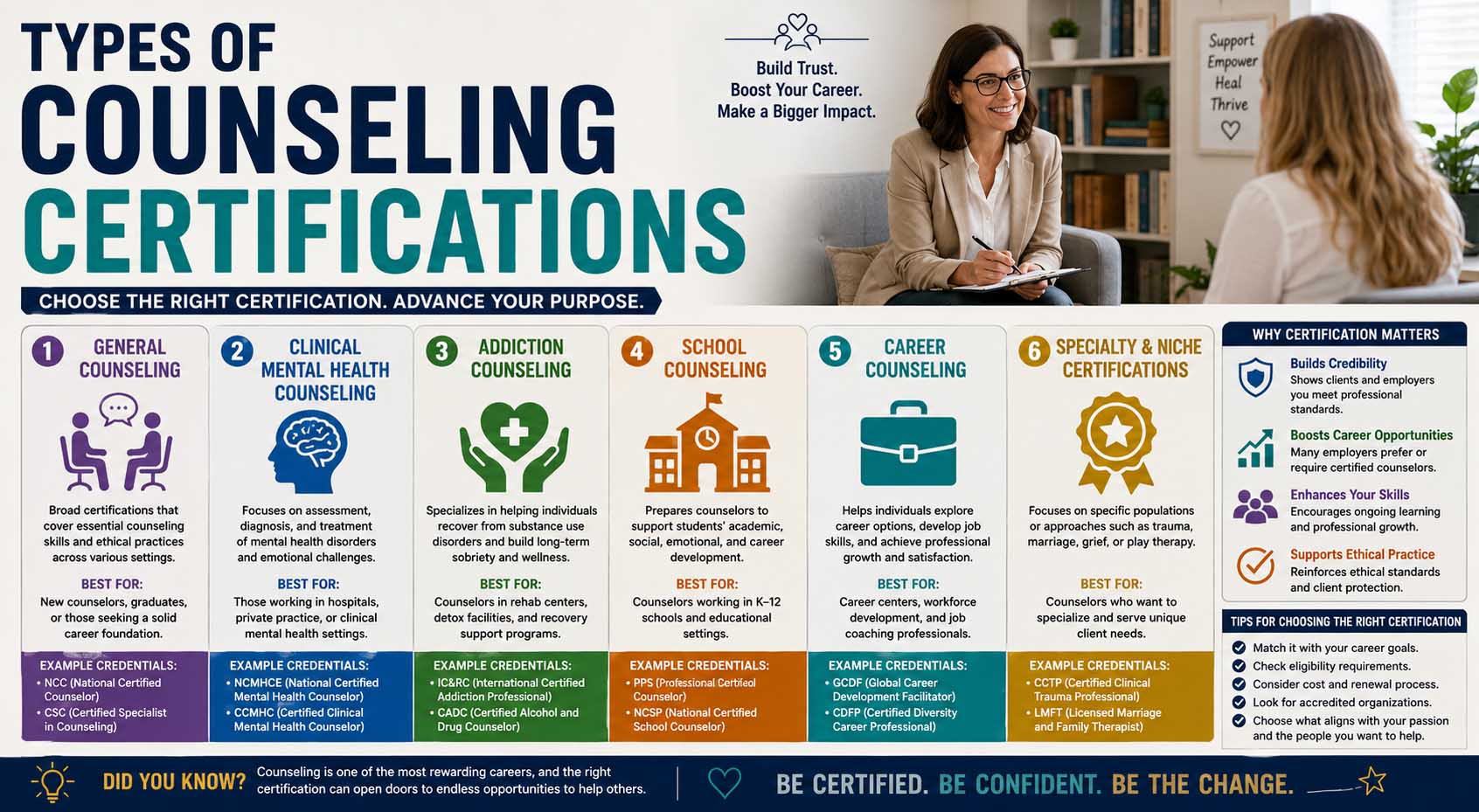
Types of Counseling Certifications: Career Paths, Requirements, and How to Choose
Choosing among the types of counseling certifications can feel confusing because counseling credentials do not all serve the same purpose. Some certifications demonstrate specialized knowledge, while professional licenses determine whether someone can legally practice independently in a particular jurisdiction. Meanwhile, certain credentials focus on areas such as mental health, school counseling, rehabilitation, addiction, career development, or couples and family work.
For students and professionals, the key is to identify the career first and then work backward through its education, supervised experience, examination, licensing, and optional certification requirements.
The exact rules vary by state, country, employer, and professional organization. Therefore, anyone planning a counseling career should verify current requirements with the relevant licensing board or credentialing body before enrolling in a program.
What Are Counseling Certifications?
Counseling certifications are credentials that can demonstrate education, training, knowledge, or competence in a counseling field.
However, certification and licensure are not interchangeable.
A license is generally a legal authorization issued by a government regulatory body. Depending on the jurisdiction, a counselor may need a specific license to provide certain professional services or practice independently.
Certification, on the other hand, is often awarded by a professional credentialing organization. It may demonstrate broader professional competence or specialization.
As a result, earning a certification does not automatically give someone legal authority to practice independently.
Before choosing a college program, students should therefore research the career they actually want. Someone asking What Should I Major In should consider not only personal interests but also whether the degree satisfies prerequisites for the professional credential or license they hope to pursue later.
Main Types of Counseling Certifications and Credentials
There is no single credential that covers every counseling career. Instead, professionals usually choose a pathway based on the population they want to serve and the setting in which they want to work.
Here is a quick overview.
| Counseling Area | Common Credential Focus | Typical Work Setting |
|---|---|---|
| Mental health counseling | General professional counseling | Clinics, private practices, agencies |
| School counseling | Student academic and personal support | Schools |
| Addiction counseling | Substance use and recovery | Treatment programs, clinics |
| Rehabilitation counseling | Disability and vocational support | Rehabilitation agencies, healthcare |
| Career counseling | Career planning and development | Colleges, workforce programs |
| Marriage and family counseling | Couples and family systems | Clinics, practices |
| Trauma-focused counseling | Trauma-informed specialization | Mental health settings |
| Grief counseling | Bereavement support | Hospices, agencies, private practices |
Titles and requirements vary considerably by location, so this table represents broad career categories rather than universal credential names.
1. General Mental Health Counseling Credentials
Mental health counseling is one of the broadest professional pathways.
Professionals in this field may help clients address emotional difficulties, behavioral concerns, relationship challenges, stress, adjustment issues, and other mental health needs within their legal scope of practice.
In the United States, professional titles vary by state. Examples can include Licensed Professional Counselor (LPC), Licensed Mental Health Counselor (LMHC), Licensed Clinical Professional Counselor (LCPC), and related designations.
These are generally licenses rather than optional certifications.
Requirements commonly involve graduate education, supervised professional experience, examinations, and an application to the relevant state licensing authority. However, the details differ, so prospective counselors should check the board in the state where they intend to work.
For many students, this pathway begins with graduate education. Comparing the types of masters degrees can help prospective counselors understand the difference between counseling-focused programs and related graduate options before committing to a program.
2. National Counseling Certifications
For example, the National Certified Counselor credential is a voluntary certification offered by the National Board for Certified Counselors in the United States.
Such credentials can provide evidence that a counselor has met the certification body’s professional standards.
However, national certification should not be confused with state licensure.
A professional may still need a state-issued license to perform regulated counseling services, regardless of national certification.
For that reason, students should investigate licensure requirements first. Afterward, they can determine whether a voluntary national certification would provide meaningful professional value.
3. School Counseling Credentials
School counselors work primarily with students and support academic planning, social and emotional development, and career or postsecondary preparation.
The pathway differs from general clinical counseling because public school systems may have specific education, certification, or educator-credential requirements.
Depending on the jurisdiction, candidates may need a master’s degree in school counseling or a related area, types of counseling certifications supervised field experience, examinations, background checks, and a state-issued school counseling credential.
School counselors also work within an educational environment rather than functioning simply as therapists inside schools.
Therefore, anyone interested in this career should check the requirements of the relevant education authority as well as the counseling profession.
4. Addiction and Substance Use Counseling Credentials
Addiction counseling focuses on people affected by substance use disorders and related behavioral, social, and recovery challenges.
Credentials in this field can vary widely.
Some jurisdictions offer different certification or licensing levels based on education and professional experience. Meanwhile, employers may require specialized training related to substance use assessment, treatment planning, ethics, recovery support, and co-occurring concerns.
Because requirements vary so much, applicants should avoid choosing a program based only on its title.
Instead, verify whether the training is recognized by the authority responsible for addiction counseling credentials in the area where you plan to work.
That step can prevent spending money and time on education that does not satisfy local professional requirements.
5. Rehabilitation Counseling Certification
Rehabilitation counselors help people with disabilities or health-related barriers pursue independence, employment, education, and community participation.
One recognized professional credential in the United States is the Certified Rehabilitation Counselor, or CRC.
This specialty combines counseling knowledge with disability, vocational, employment, and rehabilitation concepts.
Professionals may work in rehabilitation agencies, government programs, healthcare environments, nonprofit organizations, educational institutions, or related services.
Because rehabilitation counseling can involve specialized assessment and career planning, employers may value credentials that demonstrate expertise in this area.
6. Career Counseling and Career Development Credentials
Career counseling is another professional path for people interested in education, employment, workforce development, and professional growth.
They can work in colleges, schools, workforce agencies, private practices, career centers, and corporate settings.
Some professionals pursue specialized career development credentials rather than a general clinical credential.
For business-minded professionals, career counseling can also connect naturally with coaching, workforce development, talent management, and employee development.
In fact, counselors who understand practical career advancement strategies can help clients connect personal goals with realistic education, skill-building, networking, and employment decisions.
7. Marriage and Family Counseling Credentials
Professionals who want to work primarily with couples and families may pursue a marriage and family therapy pathway.
In the United States, Licensed Marriage and Family Therapist, commonly shortened to LMFT, is a regulated professional license rather than simply a general counseling certificate.
Training typically emphasizes relationships, family systems, couples, and interpersonal dynamics.
The education and supervised clinical requirements differ by jurisdiction.
This pathway can be especially suitable for professionals who want relationship and family systems to form the central focus of their work.
8. Trauma-Focused Counseling Certifications
Trauma-informed practice has become a major area of professional development across counseling and behavioral health.
Various organizations offer certificates or certifications related to trauma, trauma-informed care, and specific therapeutic approaches.
However, the quality and recognition of these credentials can differ substantially.
A short online course, for example, should not be treated as equivalent to a professional license or an advanced clinical qualification.
Before paying for a trauma-related certification, counselors should investigate the provider, eligibility requirements, training standards, examination process, continuing education expectations, and recognition among employers.
Specialty training can strengthen an existing professional foundation, but it should not be used to imply qualifications a person does not legally hold.
9. Grief and Bereavement Counseling Certifications
Grief-focused training can benefit professionals who support people coping with bereavement and significant loss.
Such professionals may work in hospice programs, hospitals, community organizations, counseling practices, religious organizations, or support services.
However, a grief counseling certificate does not necessarily qualify a person to provide independently regulated mental health treatment.
Therefore, professionals should understand the legal scope of their existing license or role before marketing grief counseling services.
10. Advanced Education and Counseling Specialization
Not every counselor needs doctoral education.
For many professional counseling roles, a qualifying master’s degree plus supervised experience and licensure provides the standard pathway.
However, some professionals pursue advanced academic training because they want to conduct research, teach at universities, lead organizations, supervise professionals, or build expertise in a specialized area.
Anyone considering that route should compare the types of doctorate degrees carefully because research-oriented doctorates and professionally focused doctoral programs can prepare graduates for different goals.
The best choice depends on the desired career rather than the prestige of the degree title.
Understanding Psychology Knowledge in Counseling
Counseling programs usually include psychological theories, research methods, assessment concepts, human development, ethics, and approaches to helping clients.
Students may encounter research terminology that initially seems separate from day-to-day counseling.
For instance, understanding Operational Definition Psychology helps students see how researchers turn abstract concepts such as stress, anxiety, motivation, or behavior into variables that can be observed or measured consistently.
That research literacy matters because professional counselors should be able to evaluate evidence rather than rely only on trends or personal opinions.
Evidence-informed practice can help professionals assess whether an intervention or approach has credible support.
How to Choose Between Types of Counseling Certifications
Choosing among the types of counseling certifications becomes easier when you start with your intended job rather than the credential name.
First, decide who you want to work with.
For example, do you want to support school students, people recovering from substance use, couples, people with disabilities, or adults seeking mental health services?
Next, identify the work setting.
A school, private practice, rehabilitation agency, hospital, college, nonprofit organization, and corporate career center may have very different qualification requirements.
Then research the legal requirements for that occupation in your location.
Look at:
- Required degree level
- Program accreditation requirements
- Required coursework
- Supervised experience
- Examinations
- Background checks
- Licensing fees
- Continuing education
- Renewal requirements
- Scope of practice
Finally, evaluate optional certifications only after understanding the required professional pathway.
Certification vs License vs Degree
These three terms often cause confusion.
A degree is an academic qualification awarded by a college or university.
A certification generally shows that a credentialing organization has determined that someone meets defined professional or specialty standards.
A license is government authorization to perform activities regulated by law.
One professional can hold all three.
For example, a counselor might earn a master’s degree, obtain a state professional counseling license, and later earn a voluntary specialty certification.
Each credential serves a different purpose.
Business Opportunities for Qualified Counselors
Counseling can also lead to business and leadership opportunities, although legal requirements remain central.
However, starting a counseling business involves more than clinical knowledge.
Professionals may need to understand business registration, insurance, recordkeeping, privacy requirements, billing systems, contracts, marketing ethics, scheduling, taxes, and professional liability.
Ethical marketing matters especially in counseling.
Businesses should describe credentials accurately and avoid claims that exaggerate qualifications or guarantee client outcomes.
Trust is a major part of professional services, so transparent credentialing can strengthen both ethical practice and business reputation.
Common Mistakes When Choosing a Counseling Credential
One of the biggest mistakes is assuming every online certificate leads to professional practice.
It does not.
Another mistake is selecting a graduate program without checking licensing requirements first. A degree may sound relevant while still lacking specific coursework, accreditation, or supervised training required by a licensing board.
Students may also focus too heavily on salary without considering the actual work.
Counseling careers can involve emotionally demanding situations, documentation, ethical responsibilities, continuing education, and regulatory oversight.
Finally, avoid collecting certifications simply to make a résumé longer.
A smaller number of respected, relevant credentials usually provides more professional value than numerous certificates that have little connection to your career.
FAQs About Counseling Certifications
What counseling certification is best?
There is no single best certification. The right credential depends on your intended role, population, location, education, and licensing requirements.
Can I become a counselor with an online certificate?
A short online certificate generally does not qualify someone for independently licensed professional counseling. Regulated counseling careers commonly require formal graduate education, supervised experience, examinations, and licensure, although requirements vary by jurisdiction.
Do counselors need a master’s degree?
Many professional counseling licenses in the United States require a qualifying graduate degree. However, requirements differ by occupation and jurisdiction, so candidates should verify them with the appropriate regulatory body.
Can counselors specialize after becoming licensed?
Yes. Licensed professionals may pursue further training or certifications in areas such as trauma, career development, rehabilitation, addiction, grief, or other specialties when those credentials fit their scope of practice.
Is certification the same as licensing?
No. Certification is generally issued by a credentialing organization, while a professional license is issued by a government authority and controls legally regulated practice.
Building the Right Counseling Career Path
The types of counseling certifications make more sense once you separate academic degrees, government licenses, and professional certifications.
Start by identifying the counseling role you want types of counseling certifications. Then check the official requirements in the jurisdiction where you intend to work, choose an education program that meets those requirements, complete any required supervised experience and examinations, and only then evaluate specialty certifications.
That approach may take more planning at the beginning, yet it can prevent expensive education mistakes later. More importantly, it helps you build a credential path that supports both professional credibility and the kind of counseling career you actually want.