
What Should I Major In? A Complete Student Guide to Choosing the Right College Major
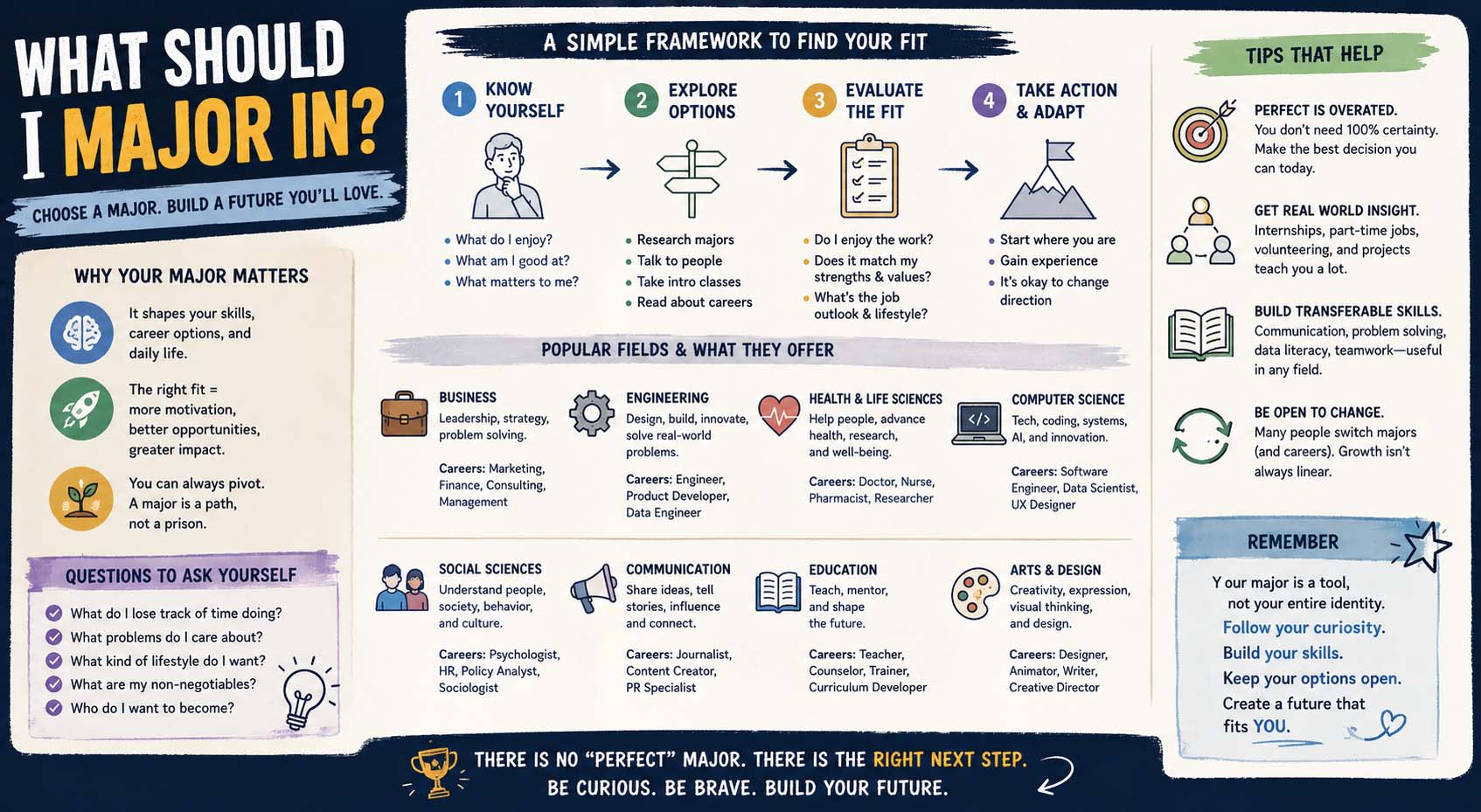
What Should I Major In? A Complete Student Guide to Choosing the Right College Major
Choosing a college major is one of the biggest decisions students make during their educational journey. Many students feel uncertain when balancing future careers, personal interests, and academic strengths. As a result, asking “what should I major in” is a natural part of planning for college and life after graduation.
The good news is that choosing a major does not have to feel overwhelming. With a practical approach, students can identify subjects they enjoy, understand their strengths, and explore career opportunities before making a decision.
Why Your College Major Matters
A college major influences the classes students take, the skills they develop, and some of the career paths available after graduation. However, a major does not completely determine someone’s future.
Students who choose subjects that match their interests and abilities may find it easier to stay engaged with their studies. At the same time, considering career goals can help students understand how different degree programs connect with future opportunities.
Many students also think ahead about continuing their education after college. Understanding What Is a Master’s Degree can help them see how advanced education may support long-term career growth in certain professions.
What Should I Major In? Start With Self-Evaluation
If you are asking “what should I major in,” start by evaluating your interests, abilities, and goals. A major should fit your circumstances rather than simply follow what friends, family members, or other students choose.
Consider these questions:
- What classes do I enjoy most?
- What skills come naturally to me?
- Do I prefer creative or analytical work?
- Which careers sound interesting?
- Do I enjoy working with people, technology, numbers, ideas, or practical tasks?
- What kind of work environment appeals to me?
- What lifestyle do I want in the future?
These questions can reveal patterns in your interests and strengths.
Next, research careers connected with those interests. Look at typical job duties, education requirements, work environments, and career paths. This combination of self-evaluation and career research can narrow a long list of majors into a more manageable set of choices.
How Major Quizzes Can Help
Many students use a “what should I major in quiz” to explore possible academic paths. These quizzes usually ask about personality, interests, hobbies, skills, and career preferences.
For example, a student who enjoys mathematics, technology, and problem-solving may receive suggestions related to computer science, engineering, or data-focused fields. Meanwhile, someone interested in communication and creativity may see options related to marketing, media, design, or communication.
However, quizzes should provide ideas rather than make the final decision. Therefore, compare quiz results with your actual academic strengths, interests, and career goals.
A useful result can introduce you to a field you had not previously considered. It can also give you new subjects to research before you commit to a program.
Free Resources for Exploring College Majors
Students may also search for a “what should I major in college quiz free” when they begin exploring degree options.
Free quizzes can be useful for high school students who have not yet narrowed their choices. Depending on the tool, suggestions may include:
- Technology
- Business
- Healthcare
- Education
- Engineering
- Arts and design
- Science
- Communication
After completing a quiz, research the suggested majors rather than accepting the results immediately. For instance, review required courses, common career paths, and the types of skills each program develops.
Career counselors, teachers, and academic advisors can also help students interpret their results. In addition, remember that many majors can lead to several careers rather than one specific job.
As students prepare for college applications, learning What Is Rolling Admission can also help them understand different admissions timelines and plan ahead.
Popular College Majors to Consider
There is no single best major for every student. Instead, the right choice depends on individual strengths, interests, educational goals, and preferred career direction.
Several broad fields offer different paths to explore.
Business Majors
Business programs may cover management, marketing, finance, accounting, operations, and entrepreneurship. Therefore, they can appeal to students interested in organizations, markets, leadership, or commercial decision-making.
Computer Science Majors
Computer science focuses on areas such as programming, algorithms, software development, computing systems, and related technologies.
Students who enjoy logical problem-solving and technology may want to explore this field. However, they should review the curriculum because program requirements can vary between colleges.
Healthcare Majors
Healthcare includes many academic and professional pathways. Students might explore nursing, sonography, healthcare administration, public health, laboratory science, or other specialized programs.
Because different healthcare careers have different education and licensing requirements, students should research the specific occupation they want to pursue.
Engineering Majors
Engineering can suit students who enjoy mathematics, science, design, and technical problem-solving. Options may include mechanical, electrical, civil, chemical, computer, and other engineering disciplines.
Therefore, students should compare individual engineering programs rather than treating engineering as a single academic path.
Psychology Majors
Psychology focuses on human behavior and mental processes. Depending on their goals, students may connect psychology with areas such as research, education, business, social services, or advanced professional study.
When comparing degree programs, students may also want to understand the Difference Between BA and BS, since universities may offer different degree options depending on the subject.
What Should I Major In to Become an Ultrasound Technician?
Students interested in medical imaging often ask “what should I major in to become an ultrasound technician?” A common educational path involves diagnostic medical sonography or a closely related program.
According to the U.S. Bureau of Labor Statistics guidance for diagnostic medical sonographers, these professionals typically need at least an associate’s degree or a postsecondary certificate. Sonography programs commonly include coursework and clinical training related to the profession. Some workers may also need a state license or professional certification, depending on the circumstances.
Therefore, students should not assume that a traditional four-year bachelor’s degree is always required. Instead, they should research suitable sonography programs, employer expectations, and any certification or licensing requirements that apply where they plan to work.
Programs may cover subjects such as anatomy, medical terminology, applied sciences, specialized sonography, and clinical practice. For students who enjoy healthcare, technology, patient interaction, and medical imaging, diagnostic medical sonography may be worth exploring.
How to Choose a College Major Step by Step
Students who still feel uncertain can use a structured process instead of trying to make the entire decision at once.
Step 1: Identify Your Interests
First, write down the subjects, hobbies, projects, and activities you genuinely enjoy.
Do not limit yourself to school subjects. For example, organizing events, building computers, creating videos, helping people, writing, or solving puzzles may reveal useful interests.
Step 2: Recognize Your Strengths
Next, consider the skills you already have or enjoy developing.
You might be strong at mathematics, communication, writing, research, creativity, leadership, organization, science, or technical problem-solving.
Interests and strengths do not always match perfectly. Therefore, consider both when exploring majors.
Step 3: Explore Related Careers
Then, research occupations connected with your strongest areas of interest.
Look beyond job titles. Consider what people actually do during a typical workday, what education they need, and what kind of environment they work in.
Step 4: Take a Major or Career Quiz
Next, use career assessments or major quizzes to generate additional ideas.
However, treat the results as suggestions. A quiz cannot fully account for your personal circumstances, academic record, finances, or long-term priorities.
Step 5: Talk to College Advisors
Teachers, counselors, college advisors, professionals, and mentors can provide useful perspectives.
For example, an advisor may help you compare similar programs or identify courses that allow you to explore a subject before committing to it.
Step 6: Research Career Requirements
Some occupations require specific degrees, licenses, certifications, graduate education, or professional training.
Therefore, work backward from a career when the profession has clear educational requirements.
Step 7: Stay Flexible
Finally, remember that interests and career goals can change.
Many careers also value transferable abilities such as communication, critical thinking, teamwork, research, and problem-solving. As a result, your major can be important without defining every future career decision.
Students should also think about What Will You Do to Maximize on Your Postsecondary Education Investment, since choosing the right major is only one part of building long-term academic and career success.
Common Mistakes When Choosing a College Major
Students can make the process harder by placing too much weight on a single factor.
One common mistake is choosing a major only because friends or family recommend it. Advice can be valuable. However, the final choice should also reflect the student’s abilities, interests, and goals.
Another mistake is focusing only on potential earnings. Income matters, but students should also consider job duties, education requirements, work environment, and whether the career fits their strengths.
Some students also believe they must have everything figured out before starting college. In reality, academic exploration can help clarify interests.
Therefore, uncertainty should encourage research rather than panic.
College Options for Undecided Students
Many colleges offer “undeclared” or “exploratory” options for students who have not selected a major.
These options may allow students to complete general education courses while exploring different academic subjects. However, policies vary by institution, so students should check how long they can remain undeclared and whether certain programs require early admission.
Career centers and academic advisors can also help students explore possible paths. In addition, internships, introductory courses, campus organizations, and conversations with faculty can provide practical insight into different fields.
Students who attend What Is Boarding School programs may already have experience with structured academic guidance before entering college.
Balancing Interests With Career Opportunities
Students often wonder whether they should follow their passion or choose a more practical career path. In many cases, the better question is how to balance personal interest with realistic opportunities.
For example, someone who enjoys creativity and technology might explore graphic design, digital media, user experience, or related technology fields.
Meanwhile, a student who enjoys helping people and studying science may explore nursing, sonography, public health, or other healthcare programs.
A student interested in business and communication could consider marketing, management, sales, or entrepreneurship.
Therefore, students do not always need to choose between enjoyment and practicality. Exploring where interests, abilities, and career opportunities overlap can provide a stronger starting point.
Questions to Ask Before Declaring Your Major
Before making a final decision, review the major from several angles.
Ask yourself:
- Do I enjoy the core subjects in this program?
- Am I prepared for the required courses?
- Which careers commonly connect with this field?
- Does my preferred career require further education?
- Can I gain relevant experience through internships or projects?
- Does the program fit my academic strengths?
- Would I still find this subject interesting after several years of study?
For example, enjoying technology does not automatically mean every technology-related degree will suit you. Similarly, liking science does not mean every healthcare career will match your preferred work environment.
Therefore, research the actual program rather than choosing based only on the major’s name.
What If I Am Still Undecided?
If you continue asking “what should I major in” after researching several options, narrow the decision instead of forcing an immediate answer.
Start by eliminating fields that clearly do not match your interests or strengths. Then, compare the remaining options based on coursework, career possibilities, education requirements, and personal preferences.
You can also take introductory courses in subjects that interest you. Meanwhile, speak with academic advisors about whether those courses count toward general education or degree requirements.
Another useful strategy is to explore real work environments. Internships, volunteering, job shadowing, student organizations, and conversations with professionals can show you what different fields are actually like.
As a result, practical exposure can turn an abstract choice into a more informed decision.
Frequently Asked Questions About College Majors
What Should I Major In if I Don’t Know My Career Yet?
If you do not know your future career, start by exploring interests, strengths, and subjects you enjoy. Then, research majors that provide skills applicable to several career paths.
You can also use introductory courses and academic advising to explore options before making a final choice.
Are College Major Quizzes Accurate?
Major quizzes can provide helpful suggestions, but they should not make the decision for you.
Instead, use the results as a starting point for further research. Compare suggested fields with your academic strengths, preferred careers, and actual interests.
Which Major Leads to an Ultrasound Career?
Diagnostic medical sonography is a common educational field for students interested in becoming diagnostic medical sonographers. Depending on the program and location, students may pursue an associate’s degree, bachelor’s degree, or postsecondary certificate.
Therefore, check the requirements for the specific programs and employers you are considering.
Is It Okay to Change Majors?
Yes. Students may discover new interests or career goals after taking college courses.
However, changing majors can affect course requirements, graduation timing, and costs. Therefore, students should discuss the change with an academic advisor and review how their completed credits apply to the new program.
Do Employers Care About Your Major?
It depends on the occupation. Some professions require specific education or credentials, while other employers may consider a broader combination of education, skills, internships, and experience.
Therefore, research the requirements for careers that interest you instead of assuming every employer evaluates majors in the same way.
Final Thoughts on Choosing Your Major
The question “what should I major in” is important, but it does not need to create fear or pressure. Choosing a major is a process of learning about yourself, exploring academic options, and understanding how different fields connect with possible careers.
By researching careers, using major quizzes as exploratory tools, talking with advisors, and gaining practical experience, students can make more informed academic decisions.
Whether someone chooses business, healthcare, technology, engineering, psychology, or a creative field, the best choice depends on personal interests, abilities, educational goals, and future plans.