
Diseconomies of Scale Explained
Diseconomies of Scale Explained
Businesses often aim to grow larger because expansion can reduce production costs and increase profits. However, growth does not always lead to greater efficiency. In some situations, companies become so large that operational costs begin rising instead of falling. This concept is known as diseconomies of scale. Understanding diseconomies of scale is important for business owners, managers, economists, and students because it explains why some organizations struggle after expanding too quickly.
Diseconomies of scale can affect companies in manufacturing, retail, technology, healthcare, and many other industries. As businesses increase in size, communication may become more difficult, management structures can grow complicated, and employees may feel disconnected from leadership. These challenges often reduce efficiency and productivity, causing average costs to rise over time.
What Is Diseconomies of Scale
Businesses often aim to reach the Minimum Efficient Scale where production becomes cost-effective before expansion begins creating additional challenges.
To understand what is diseconomies of , it is important to first recognize how businesses normally benefit from expansion. When companies grow, they usually experience economies of scale, which means production costs decrease because resources are used more efficiently. Larger organizations can often negotiate lower prices with suppliers, improve specialization, and spread fixed costs over greater output.
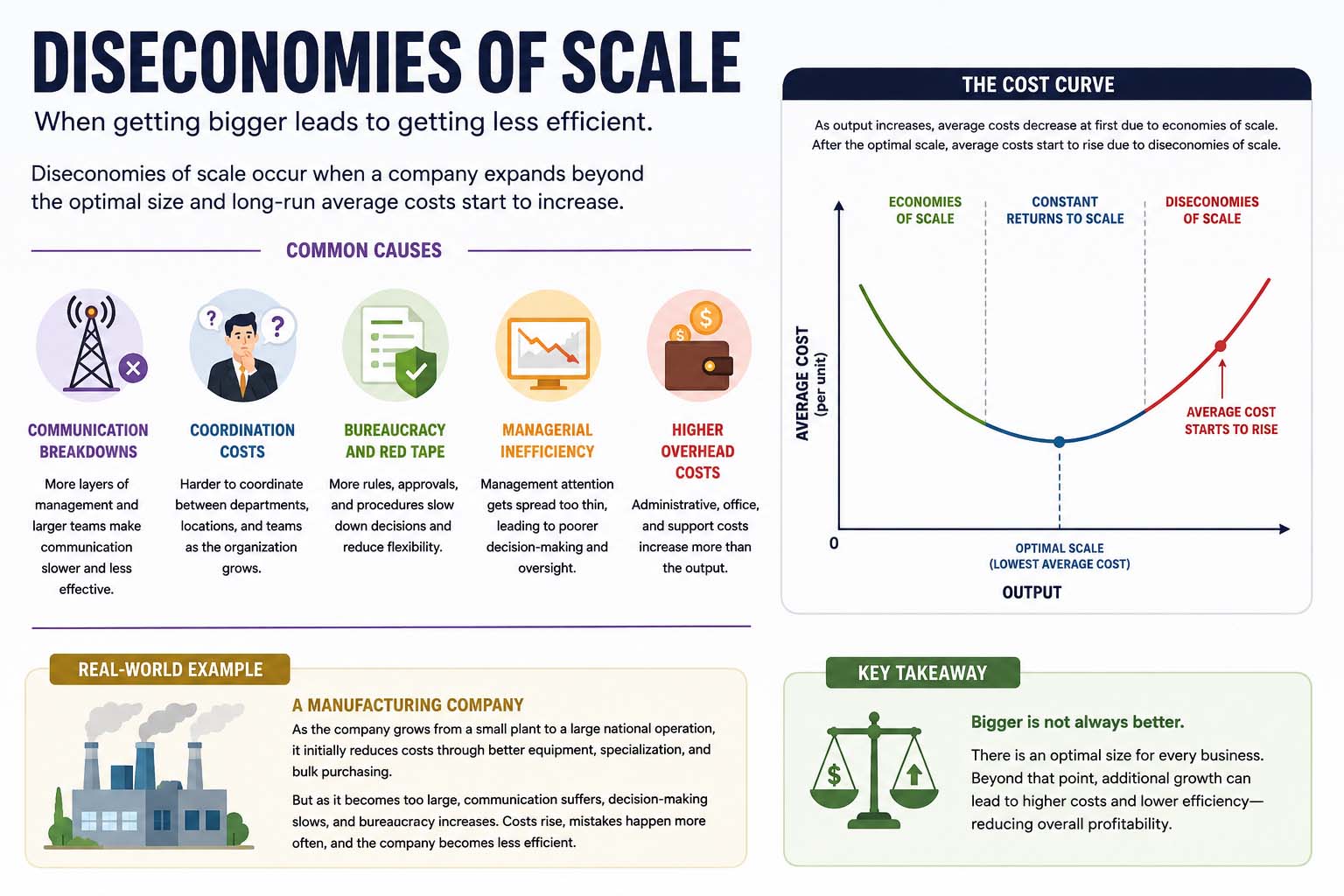
However, after reaching a certain size, companies may begin facing the opposite effect. of scale occur when the cost per unit increases as production expands. Instead of becoming more efficient, the organization becomes harder to manage. This often results in slower decision-making, higher operational expenses, and lower employee productivity.
One major reason for diseconomies of is communication breakdown. In smaller businesses, employees and managers can communicate quickly and directly. In larger corporations, information often passes through multiple departments and management levels, creating delays and confusion. Miscommunication can lead to mistakes, duplicated work, and reduced efficiency.
Another cause is management complexity. As organizations grow, they often require additional supervisors, departments, and administrative systems. While these structures are designed to improve organization, they can also create unnecessary bureaucracy. Employees may spend more time following procedures instead of focusing on productive work.
Motivation can also decline in large companies. Workers in smaller businesses often feel closely connected to company goals and leadership. In massive corporations, employees may feel overlooked or disconnected, reducing morale and productivity.
Diseconomies of Scale Definition
The diseconomies of scale definition refers to the situation where a company’s average costs increase because the business has grown beyond its optimal operating size. Economists use this concept to explain why large firms sometimes lose efficiency despite having greater resources.
In simple terms, diseconomies of scale happen when expansion creates more problems than benefits. Instead of lowering costs, growth begins increasing expenses related to management, coordination, communication, and operations.
There are two main categories associated with the diseconomies of scale definition: internal diseconomies and external diseconomies. Internal diseconomies occur within the company itself. These may involve poor communication, inefficient management, or outdated systems that cannot support further growth.
External diseconomies are caused by outside factors affecting large businesses. For example, if many companies operate in the same region, competition for workers, transportation, and resources can increase costs for everyone. Traffic congestion, rising wages, and higher property prices may all contribute to external diseconomies of scale.
Diseconomies of Scale Examples
Market competition and pricing decisions can also influence business performance, which is why concepts like the Kinked Demand Curve are useful in understanding competitive markets.
Looking at diseconomies of scale examples can make the concept easier to understand. Many well-known corporations have experienced difficulties after growing too large. These problems often appear in communication, customer service, and management efficiency.
One common example involves multinational retail companies. As a retail chain expands into hundreds or thousands of locations, maintaining consistent quality becomes more challenging. Different stores may experience inventory problems, staffing shortages, or customer service issues. Managing operations across multiple regions increases complexity and operational costs.
Another example can be found in manufacturing industries. A factory may initially reduce costs by increasing production, but eventually the facility becomes overcrowded. Machinery maintenance, worker coordination, and transportation delays can reduce efficiency. At that point, producing additional units becomes more expensive rather than cheaper.
Technology companies can also experience diseconomies of scale examples. Large tech firms often manage thousands of employees, multiple departments, and international offices. Decision-making may slow because approvals must pass through several layers of management. Innovation can decline when employees face excessive bureaucracy and lack flexibility.
Fast food chains sometimes struggle with diseconomies of scale as well. Expanding too rapidly can create inconsistent food quality, training difficulties, and supply chain problems. Maintaining standards across hundreds of restaurants requires extensive oversight and management resources.
Diseconomies of Scale Meaning
The diseconomies of scale meaning also highlights the importance of balance in business strategy. Companies need enough growth to remain competitive, but they must avoid becoming so large that operations become unmanageable.
One important aspect of the concept is organizational structure. As companies expand, they often add multiple management layers to control operations. Unfortunately, this can create slower communication and reduced flexibility. Employees may feel less empowered to make decisions, causing delays and inefficiency.
Financial costs also increase when businesses grow too large. Administrative expenses, training costs, office space, and technological systems all require significant investment. If these expenses rise faster than revenue, profitability declines.
Globalization has made managing large companies even more complex. Businesses operating internationally must handle different regulations, currencies, cultural expectations, and supply chains. These factors can contribute to diseconomies of scale if not managed effectively.
Conclusion
Diseconomies of scale are an important economic and business concept that explains why larger companies do not always operate more efficiently. While expansion can initially reduce production costs, excessive growth often creates communication issues, management complexity, and higher operational expenses.