
How to Find Percent Increase: Complete Student Guide for 2026
How to Find Percent Increase: Complete Student Guide for 2026
Learning how to find percent increase is an important math skill used in school, business, finance, science, and everyday life. Percent increase shows how much a value has grown compared with its original value. Fortunately, the calculation becomes simple when you follow the formula in the correct order.
Students use percentage increases when working with prices, populations, grades, statistics, and scientific data. Therefore, understanding the basic method can make many percentage problems easier to solve.
How to Find Percent Increase and Understand the Result
Percent increase measures how much a value grows relative to its original amount. In other words, it expresses the increase as a percentage of the value where you started.
For example, suppose the price of a book rises from $20 to $25. The increase is $5. However, percentage increase tells you how large that $5 change is compared with the original $20 price.
Percentage increase commonly appears in:
- School math problems
- Business reports
- Population growth
- Sports statistics
- Science experiments
- Price comparisons
- Financial calculations
Understanding this concept helps students interpret numerical changes more confidently. It also connects with topics such as How to Find the Average, where students analyze and compare numerical data in different ways.
How to Find Percent Increase Using the Formula
The basic formula is:
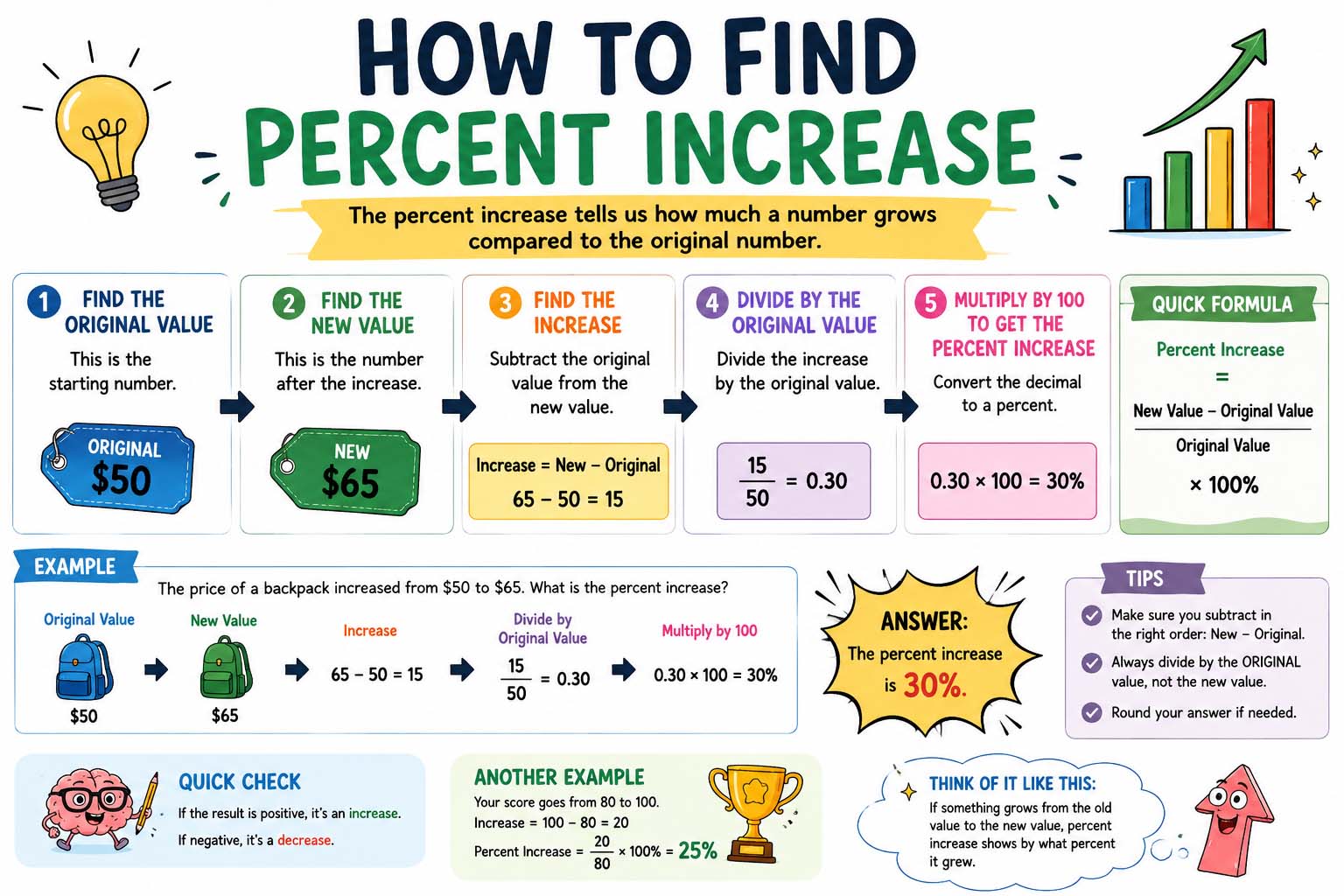
Percent Increase = ((New Value − Original Value) ÷ Original Value) × 100
The calculation has three main operations: subtraction, division, and multiplication.
First, subtract the original value from the new value to find the amount of increase. Next, divide that increase by the original value. Finally, multiply the result by 100 to convert it into a percentage.
For a standard explanation of percentage calculations, see Khan Academy’s lesson on percentages.
How to Find Percent Increase Step by Step
The easiest way to solve a percentage increase problem is to separate the calculation into three steps. This approach helps you identify each value correctly and reduces calculation errors.
How to Find the Increase Between Two Values
First, subtract the original number from the new number.
Suppose:
Original number = 40
New number = 50
Calculate:
50 − 40 = 10
Therefore, the amount of increase is 10.
How to Calculate Percent Increase From the Original Value
Next, divide the increase by the original value.
10 ÷ 40 = 0.25
This step compares the increase with the amount you started with.
How to Convert an Increase to a Percentage
Finally, multiply the decimal by 100.
0.25 × 100 = 25%
Therefore, the percent increase from 40 to 50 is 25%.
If your calculation produces a long decimal, you may also need to Round to the Nearest Hundredth before presenting the final answer.
How to Find Percent Increase Between Two Numbers
To calculate a percentage increase between two numbers, first identify which number represents the original value and which represents the new value.
For example, suppose a value rises from 60 to 75.
First, find the increase:
75 − 60 = 15
Next, divide the increase by the original value:
15 ÷ 60 = 0.25
Then, multiply by 100:
0.25 × 100 = 25%
Therefore, the value increased by 25%.
The original number matters because the calculation compares the difference with the starting value. Using the new value as the divisor would produce a different result.
How to Calculate Percent Increase With a Price Example
Consider a phone that originally costs $500 and later costs $650.
First, calculate the difference:
$650 − $500 = $150
Next, divide $150 by the original $500 price:
150 ÷ 500 = 0.30
Finally, multiply by 100:
0.30 × 100 = 30%
Therefore, the phone’s price increased by 30%.
This example also shows why simply finding the difference is not enough. The $150 increase tells you the amount of change, while 30% shows the size of that change relative to the original price.
How Percent Increase Works in Real-World Examples
Percentage increase appears in many situations outside the classroom. As a result, understanding the calculation can help students interpret everyday numerical information.
How to Find Percent Increase in Prices
Businesses may change prices over time. Therefore, shoppers can use percentage increases to compare a new price with an older one.
For example, comparing the percentage increase can show whether a small-looking price change is significant relative to the original cost.
How to Calculate Percent Increase in Population
Researchers can use percentage changes to describe how populations grow over a particular period. This makes it easier to compare growth when the starting populations differ.
How to Find Percent Increase in Sports Statistics
Players and teams often compare statistics across games or seasons. For example, a player may want to measure the percentage increase in points scored.
How to Find Percentage Increase in Business Growth
Companies frequently compare values such as sales, revenue, or customer numbers across different periods. Percentage changes provide context that a simple numerical difference may not show.
How to Find Percent Increase in Grades
Students can compare earlier and later scores to measure improvement.
However, students should distinguish between percentage increase and percentage-point change when working with scores already expressed as percentages.
These calculations also connect with What Is a Unit Rate, since both concepts help students compare numerical values in meaningful ways.
Common Mistakes When Finding Percent Increase
Percentage increase problems become much easier when students know which mistakes to avoid.
Using the Wrong Value in the Percent Increase Formula
Always divide the increase by the original value.
For example, when a number increases from 80 to 100, the original value is 80. Therefore, divide the change by 80, not 100.
The calculation is:
20 ÷ 80 × 100 = 25%
How to Convert the Result to Percent Increase
Division usually produces a decimal. Consequently, multiply that decimal by 100 to express the answer as a percentage.
For instance, 0.25 becomes 25% after multiplying by 100.
Confusing Increase With Percent Increase
Suppose a value rises from 50 to 60. The numerical increase is 10, but the percentage increase is 20%.
Therefore, an amount of increase and a percentage increase are not the same thing.
Finding Percent Increase With the Correct Subtraction Order
For an increase, subtract the original value from the new value:
New Value − Original Value
Using the correct order keeps the change positive when the value has increased.
Tips for Finding Percent Increase Correctly
Students can improve their skills through regular practice. First, write the formula clearly before inserting any numbers.
Next, identify the original and new values. This simple step can prevent one of the most common calculation errors.
Using real-world examples can also make the concept easier to understand. For instance, practice with prices, grades, sports scores, or other familiar numbers.
In addition, check each calculation before moving to the next step. A small subtraction or division error can change the final percentage.
Creating organized notes becomes easier when you know How to Make a Study Guide, allowing you to review formulas and worked examples more efficiently.
Why Learning How to Find Percent Increase Matters
Percentage increase is a foundational concept that appears in several subjects. For example, students may encounter percentage changes in mathematics, economics, business, finance, statistics, and science.
Learning the concept also strengthens skills involving fractions and decimals. After all, the calculation requires students to move between numerical forms before reaching the final percentage.
As students progress, these skills can support more advanced mathematical work. They also complement topics such as What Is a Mixed Number, where students develop a stronger understanding of fractions and numerical operations.
How to Find Percent Increase vs. Percent Decrease
Percent increase and percent decrease both measure change relative to an original value. However, the direction of the change determines which term applies.
How to Calculate Percent Increase
Use percent increase when the new value is greater than the original value.
For example:
Original value = 100
New value = 120
The value increased by 20%.
Percent Increase and Percent Decrease Calculations
Use percent decrease when the new value is smaller than the original value.
For example:
Original value = 100
New value = 80
The value decreased by 20%.
In both cases, you compare the amount of change with the original value. The main difference is whether the value moves up or down.
How to Find Percent Increase in Data
Modern apps, websites, and business tools frequently display percentage changes. For example, dashboards may show increases in website traffic, sales, users, engagement, or performance.
Therefore, understanding percentage calculations can help students read charts, reports, and digital data more confidently.
The same mathematical principle still applies. First, identify the starting value. Then, calculate the change and compare it with that starting value. Finally, multiply the result by 100 to express the change as a percentage.
How to Find Percent Increase With the Formula
If you need a simple way to remember the process, use these three steps:
- Subtract: New value − Original value
- Divide: Increase ÷ Original value
- Multiply: Result × 100
For example, if a number increases from 200 to 250:
250 − 200 = 50
50 ÷ 200 = 0.25
0.25 × 100 = 25%
Therefore, the percentage increase is 25%.
A useful shortcut is to remember the order: difference, divide, percentage. However, always divide by the original value rather than the new value.
FAQs About How to Find Percent Increase
What Is the Percent Increase Formula?
The formula is:
((New Value − Original Value) ÷ Original Value) × 100
First, calculate the increase. Then, divide it by the original value and multiply the result by 100.
How Do You Calculate Percent Increase?
First, subtract the original value from the new value. Next, divide the difference by the original value. Finally, multiply the result by 100.
How Do You Find Percent Increase Between Two Numbers?
Identify the original and new numbers first. Then, subtract the original from the new number, divide the difference by the original number, and multiply by 100.
Why Does the Percent Increase Formula Use the Original Value?
You divide by the original number because the calculation measures the change relative to the starting value. Therefore, using the original value provides the correct comparison.
Can Percent Increase Be More Than 100%?
Yes. For example, if a value rises from 50 to 125, the increase is 75. Since 75 ÷ 50 = 1.5, the percentage increase is 150%.
A percentage increase above 100% simply means the amount added is greater than the entire original value.
Final Review of How to Find Percent Increase
Learning how to find percent increase becomes much easier when you remember the three basic operations: subtract, divide, and multiply by 100. First, find the difference between the new and original values. Next, divide that difference by the original value. Finally, multiply the result by 100.
This skill applies to schoolwork, prices, business data, science, statistics, and many everyday situations. Therefore, practicing with different numbers can help students recognize the process quickly and avoid common mistakes.
Once you understand which value is the original number, percentage increase problems become straightforward and easier to solve accurately.