
How Hard Is It to Get Into Dental School? A Realistic Guide for Students
How Hard Is It to Get Into Dental School? A Realistic Guide for Students
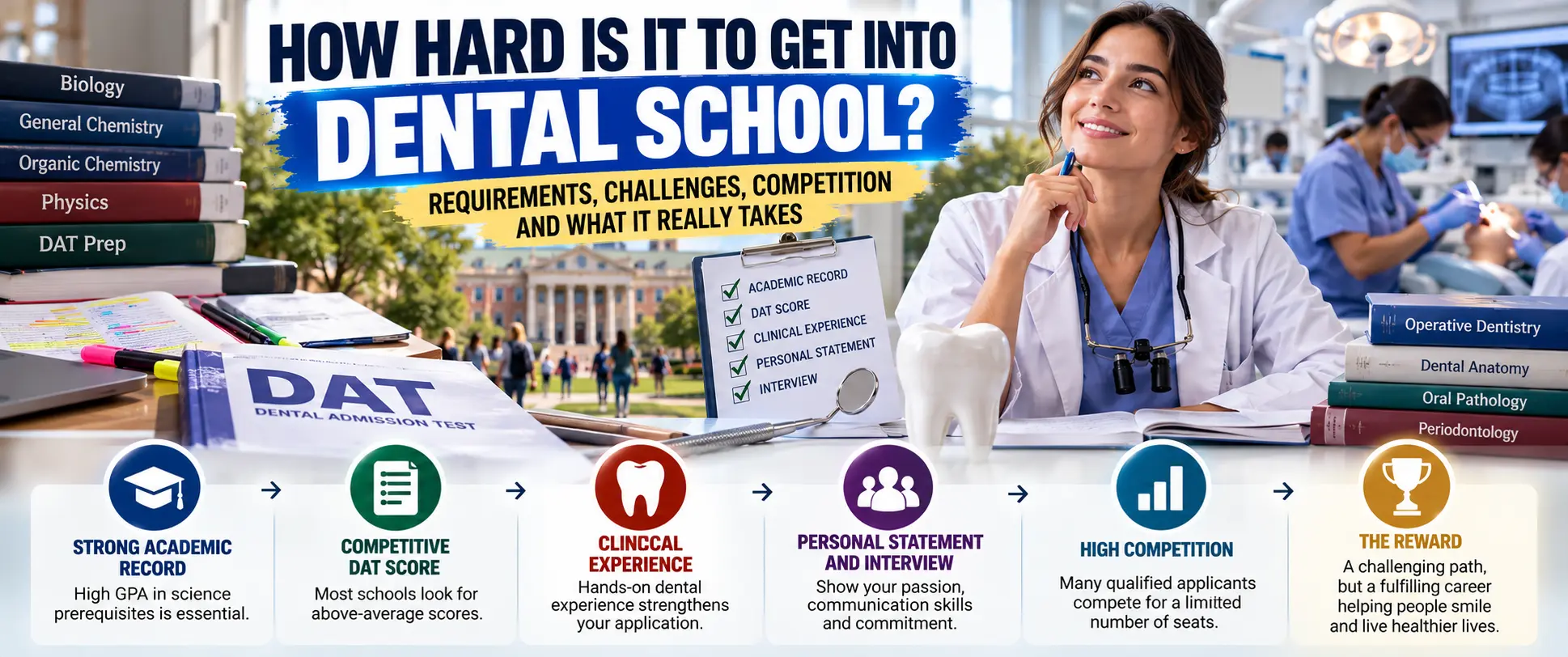
If dentistry interests you, you may already be wondering, how hard is it to get into dental school? The straightforward answer is that dental school admission is competitive, and strong grades alone do not guarantee acceptance. Schools generally consider your academic record, required science courses, Dental Admission Test performance where applicable, dental exposure, recommendations, personal statement, interviews, and evidence that you understand the profession.
Still, competitive does not mean impossible. Students who prepare early, understand individual school requirements, build a balanced application, and apply strategically can improve their chances significantly.
Instead of viewing admission as one enormous hurdle, it helps to break the process into smaller parts. Once you know what dental schools are evaluating, you can spend your undergraduate years building those qualities step by step.
How Hard Is It to Get Into Dental School Compared With College?
Getting admitted to dental school is generally more specialized than applying to undergraduate college. Applicants have already completed substantial college-level work, and schools can evaluate their performance in challenging science courses.
Dental programs also have limited class sizes. As a result, applicants may compete with many other students who have strong academic records and similar career goals.
However, schools do not necessarily expect every successful applicant to look identical. Admissions committees can consider academic achievement alongside experiences, communication skills, motivation for dentistry, recommendations, and other qualities identified by the program.
Therefore, your goal should not be to create a supposedly perfect application. Instead, build an application that shows academic readiness and a well-informed commitment to dentistry.
What Academic Preparation Does Dental School Require?
Most applicants complete an undergraduate education before beginning dental school, although specific degree and prerequisite policies vary among programs.
Dental schools commonly require or recommend college coursework in areas such as biology, general chemistry, organic chemistry, and physics. Some programs also expect or recommend subjects such as biochemistry, English, mathematics, microbiology, or anatomy.
Because requirements differ, check the current prerequisites for every school on your list before choosing courses.
Students who are unsure about their undergraduate direction often ask What Should I Major In before planning a professional-school pathway. For dentistry, you generally do not need to choose one universal “pre-dental” major, but you do need to complete the prerequisites required by the schools where you intend to apply.
A biology or chemistry major may overlap conveniently with those courses. However, students from other academic backgrounds can also pursue dentistry if they complete the necessary prerequisites.
How Much Does GPA Matter?
Your college GPA is a major part of a dental school application because it provides evidence of how you have performed academically over time.
Schools may look at more than one academic measure. For instance, admissions reviewers can consider overall GPA, science coursework, academic trends, course difficulty, and performance in prerequisite subjects.
Therefore, one difficult semester does not necessarily define an entire application. However, consistently weak academic performance can make admission harder.
Students sometimes focus on What Is the Highest GPA when thinking about competitive admissions. Yet dental schools are usually more interested in your complete academic record than in whether you achieved a mathematically perfect number.
An upward academic trend may also provide useful context. For example, a student who struggled during the first year but later earned strong grades in advanced sciences can demonstrate academic growth.
Still, applicants should review current statistics published by individual dental schools rather than relying on a single unofficial “good GPA” number.
The DAT Adds Another Academic Challenge
For many U.S. dental school applicants, the Dental Admission Test, or DAT, is another major part of the process.
The exam evaluates several areas relevant to dental education. Therefore, preparing for it requires both subject knowledge and a structured study plan.
Rather than beginning with random practice questions, students can first identify weaker content areas. Next, they can create a realistic study schedule and gradually add timed practice.
Consistency tends to work better than occasional marathon sessions.
For example, a student balancing college classes with DAT preparation may study in shorter scheduled blocks during the semester and increase practice during lighter academic periods.
Applicants should always check current testing requirements and policies because individual programs may differ in how they use admission-test results.
How Hard Is It to Get Into Dental School Without Experience?
Academic performance tells schools whether you can handle demanding coursework. However, it does not necessarily show whether you understand what dentists actually do.
For that reason, exposure to dentistry can be a valuable part of preparing for admission.
Shadowing a dentist allows students to observe patient communication, procedures, office operations, teamwork, and the daily responsibilities of the profession.
Meanwhile, volunteering and community service can demonstrate that you have spent time working with people outside the classroom.
Research can also be useful for students genuinely interested in scientific investigation, although applicants should not assume every activity is mandatory at every school.
The strongest experiences usually have a clear purpose. Instead of collecting activities only to fill an application, choose opportunities that help you learn about healthcare, dentistry, service, leadership, or communication.
Building a Strong Application Step by Step
Dental school preparation becomes easier to manage when you start early.
During your first college years, focus on building effective study habits and completing foundational courses. At the same time, begin learning about dentistry through shadowing, campus organizations, career events, or conversations with dental professionals.
Later, research individual dental schools and compare their prerequisite requirements. Then, plan your DAT preparation around your academic schedule and intended application timeline.
Before applying, organize recommendation letters, experiences, academic information, and personal-statement ideas well in advance.
Finally, submit a carefully reviewed application and prepare for possible interviews.
Thinking about What Will You Do to Maximize on Your Postsecondary Education Investment can also help you evaluate your undergraduate choices, academic opportunities, and future professional-school costs instead of focusing only on admission.
Dental School Applications Are More Than Numbers
A strong GPA and DAT performance can help demonstrate academic readiness, but admissions decisions can involve much more.
Your personal statement gives you an opportunity to explain why dentistry fits your goals. Therefore, avoid simply repeating information already listed elsewhere in your application.
Instead, use specific experiences to explain how your interest developed.
Recommendation letters can provide another perspective on your academic ability, character, or professional potential. Consequently, building genuine relationships with professors and mentors can be more useful than requesting a letter from someone who barely knows you.
Interviews matter as well. Schools may use them to assess communication, motivation, judgment, professionalism, and your understanding of dentistry.
How Hard Is It to Get Into Harvard Dental School?
Students asking how hard is it to get into Harvard dental school should expect a highly selective admissions environment.
Harvard School of Dental Medicine evaluates applicants for its Doctor of Dental Medicine program using its current admissions criteria and requirements. Because requirements, class profiles, testing policies, and application procedures can change, applicants should use the school’s official admissions information when planning.
A student interested in a highly selective program should still avoid building an entire application around one school.
Instead, research several programs that match your academic profile, career interests, learning preferences, location goals, and financial circumstances.
That approach provides a more balanced application strategy.
How Hard Is It to Get Into UCLA Dental School?
The question how hard is it to get into UCLA dental school also comes up frequently among prospective dental students.
UCLA’s School of Dentistry has its own prerequisites, application procedures, and selection process. Therefore, students should compare their preparation directly against the school’s current official requirements.
Applicants should also consider fit beyond admission statistics.
For instance, research opportunities, clinical education, curriculum, location, student support, tuition, and career goals can all affect whether a dental school makes sense for you.
As a result, getting accepted should not be your only consideration. You also want a program where you can successfully complete your professional education.
How Hard Is It to Get Into NYU Dental School?
Students researching how hard is it to get into NYU dental school should take the same evidence-based approach.
NYU College of Dentistry publishes its current admission requirements and application guidance for prospective students. Since policies can change between application cycles, always confirm details from the official school before applying.
Rather than assuming a well-known school requires one specific applicant profile, examine its prerequisites and application expectations carefully.
Then compare those requirements with your coursework, experiences, test preparation, and career goals.
This approach is far more useful than relying on online anecdotes from applicants whose academic backgrounds may be very different from yours.
How Hard Is It to Get Into Dental Hygiene School?
Students sometimes confuse dentistry and dental hygiene because both careers involve oral health. However, they follow different educational and licensing pathways.
So, how hard is it to get into dental hygiene school? Admission can still be competitive, especially when a program has limited clinical places. However, prerequisites, program length, entrance requirements, and credentials differ from those for dental school.
Dental hygienists focus heavily on preventive oral healthcare, patient education, assessments, and related clinical services within their authorized scope of practice.
Dentists complete a different professional education pathway and have a broader scope that can include diagnosis and complex dental treatment.
Therefore, students should choose between these paths based on the work they want to perform rather than assuming one is simply an easier version of the other.
Paying for the Path to Dentistry
Cost deserves attention long before you receive an acceptance letter.
Students may need to pay for undergraduate education, application fees, admission testing, interviews or related expenses, and eventually dental school tuition and living costs.
Scholarships and financial aid can help some students. However, availability and eligibility vary widely.
If you are researching what is a full ride scholarship, remember that fully funded opportunities can be highly competitive and should not be the only part of your financial plan.
Instead, compare tuition, living expenses, scholarships, grants, loan options, and expected borrowing across programs.
A less expensive school that fits your goals may sometimes make more financial sense than a higher-cost option chosen mainly for name recognition.
Dental School vs. Medical School Preparation
Dentistry and medicine share some academic foundations, particularly in the sciences, but they lead to different professions.
Students reviewing the steps to becoming a doctor may notice similarities such as undergraduate prerequisites, professional-school applications, admission testing, and extensive clinical education.
However, prospective dentists should prepare specifically for dental education rather than treating dentistry as an alternative route to medicine.
Shadowing professionals in both fields can help undecided students understand the differences before committing to years of training.
Common Mistakes That Can Make Admission Harder
Waiting too long to research prerequisites is a common problem. Since requirements can vary, missing one course may complicate your application timeline.
Another mistake is sacrificing academic performance by taking on too many extracurricular activities. Dental exposure matters, yet it should not come at the expense of your ability to demonstrate academic readiness.
Some applicants also apply to schools without researching whether their academic record, prerequisites, goals, or residency status align with the program.
Finally, avoid treating your personal statement like a list of achievements. Admissions reviewers can already see many of your activities elsewhere. Instead, explain what meaningful experiences taught you and why they shaped your interest in dentistry.
FAQs About Getting Into Dental School
Do you need a perfect GPA for dental school?
No. Dental schools evaluate applicants using multiple factors, although academic performance remains a significant part of the process. Competitive expectations also vary among schools.
Is the DAT difficult?
Many students find the DAT challenging because it requires preparation across several areas and includes time pressure. However, a structured study schedule and regular practice can make preparation more manageable.
What undergraduate major is best for dental school?
There is no single major that every dental applicant must choose. Select a field you can succeed in while completing the prerequisites required by your target dental schools.
Can you get into dental school after weak freshman grades?
It may still be possible. Stronger performance in later semesters, especially in demanding science courses, can demonstrate academic improvement. However, each school evaluates applications according to its own criteria.
Should I apply to only my dream dental school?
Usually, relying on one program creates unnecessary risk. Instead, research multiple schools and build a list based on requirements, educational fit, finances, location, and your overall applicant profile.
Make Dental School Admission a Long-Term Project
So, how hard is it to get into dental school? Admission can be demanding because applicants need to demonstrate academic readiness, prepare for admission testing where required, gain meaningful exposure to dentistry, and complete a detailed application process.
However, you do not need to accomplish everything at once. Start with your coursework, protect your GPA, learn about dentistry firsthand, research schools early, and prepare for the DAT on a realistic schedule.
Most of all, keep checking current requirements directly with the dental schools you plan to apply to. When you treat dental school admission as a multi-year preparation process rather than a last-minute competition, each step becomes much easier to understand and manage.