
What Is the Hardest Language to Learn? Complete Student Guide for 2026
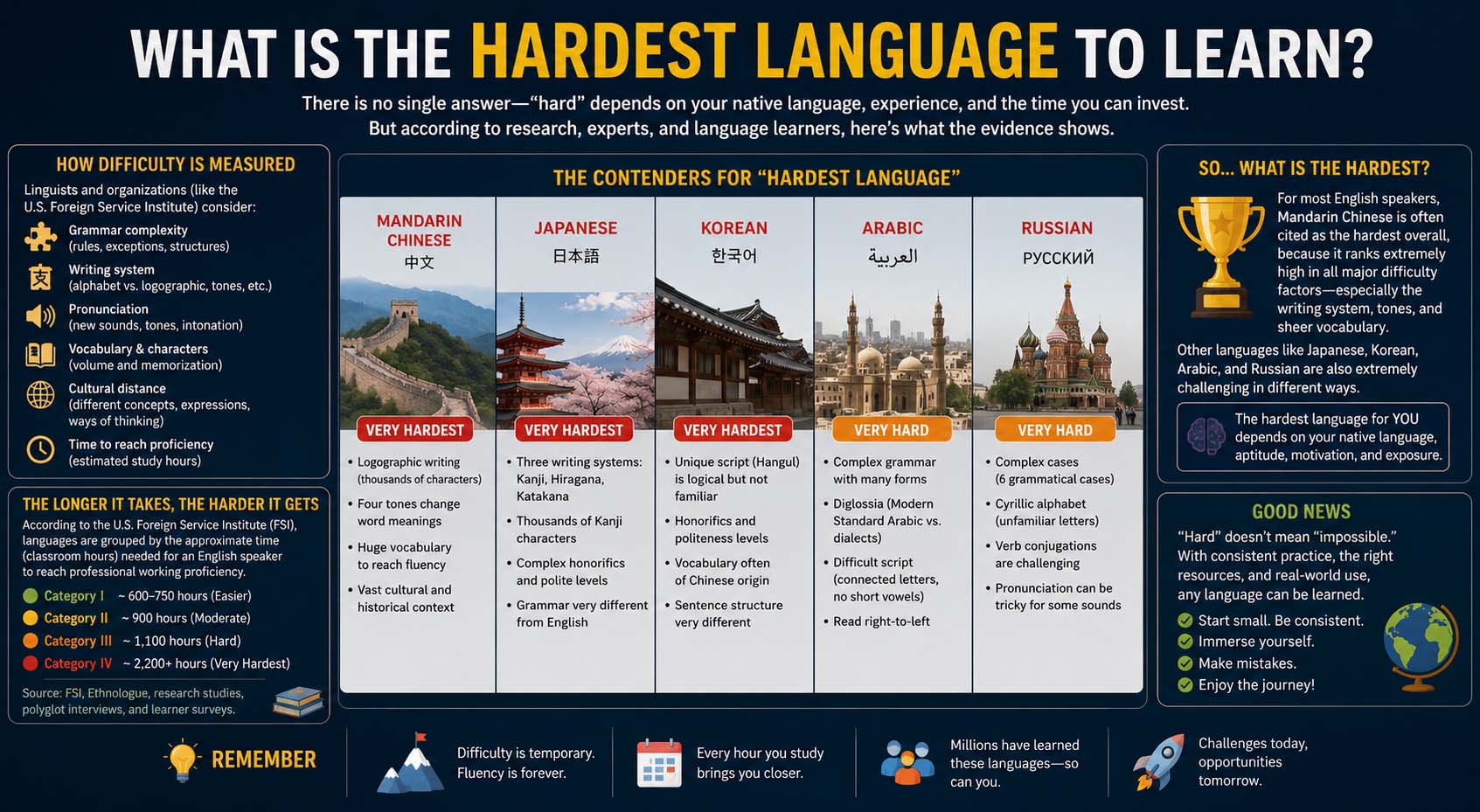
What Is the Hardest Language to Learn? Complete Student Guide for 2026
Some languages are relatively easy for beginners, while others require years of study and practice. Because of this, many students ask questions like what is the hardest language to learn or what language is the hardest to learn for English speakers.
The answer depends on several factors, including grammar, writing systems, pronunciation, vocabulary, and cultural differences. A language that feels easy for one person may feel extremely difficult for another.
What Makes a Language Difficult to Learn?
Not all languages are equally difficult for every learner.
Several factors influence language difficulty:
Writing systems.
Grammar complexity.
Pronunciation.
Sentence structure.
Vocabulary differences.
Listening speed.
Cultural context.
Languages similar to your native language are usually easier to understand. For example, English speakers may learn Spanish faster than Japanese because both languages share some familiar patterns and vocabulary roots.
What Is the Hardest Language to Learn in the World?
Many experts and language learners believe some of the hardest languages include:
Mandarin Chinese.
Arabic.
Japanese.
Korean.
Russian.
Hungarian.
Finnish.
These languages often appear on difficulty rankings because they require students to learn unfamiliar grammar rules, writing systems, or pronunciation styles.
However, difficulty levels still vary depending on the learner’s background and experience.
What Language Is the Hardest to Learn for English Speakers?
For native English speakers, languages with major structural differences are usually the most challenging.
Mandarin Chinese
Mandarin Chinese is often considered one of the hardest languages because it uses tones.
A single word can have different meanings depending on pronunciation pitch.
Students must also memorize thousands of Chinese characters instead of learning a simple alphabet.
Arabic
Arabic has complex grammar and a writing system read from right to left.
Different regional dialects can also make learning more difficult.
Japanese
Japanese uses multiple writing systems, including:
Hiragana.
Katakana.
Kanji.
The sentence structure is very different from English, which can confuse beginners.
What Is the Most Hardest Language to Learn?
Although “most hardest” is not grammatically correct in formal English, many people search this phrase online.
Languages commonly described as the most difficult include:
Mandarin Chinese because of tones and characters.
Japanese because of writing complexity.
Arabic because of grammar and dialect variations.
Korean because of sentence structure and honorifics.
Each language presents unique challenges that require patience and consistent practice.
Why Mandarin Chinese Is So Difficult
Many learners struggle with Mandarin because pronunciation changes meaning completely.
For example, one syllable spoken with four different tones may represent four unrelated words.
Students must also learn character recognition instead of relying on alphabetical spelling.
Despite its difficulty, Mandarin remains highly valuable because it is one of the most spoken languages in the world.
Why Japanese Is Challenging for Beginners
Japanese combines several difficult learning elements.
Students must memorize:
Kanji characters.
Polite speech forms.
Different sentence structures.
Context-based meanings.
Listening comprehension can also be difficult because Japanese speakers often speak quickly and omit certain subjects from sentences.
However, anime, gaming, and pop culture motivate many students to continue learning.
Arabic Grammar and Writing Challenges
Arabic introduces learners to an entirely different script system.
Letters change shape depending on their position inside words.
Grammar rules are also very detailed compared to English.
In addition, spoken dialects differ greatly between countries, which means learners may understand formal Arabic but struggle with everyday conversations.
Korean and Sentence Structure
Korean has a unique sentence structure that differs significantly from English.
Verbs usually appear at the end of sentences.
Honorific speech levels also affect vocabulary and grammar choices.
Although Hangul is easier to read than Chinese characters, mastering natural Korean conversation still requires extensive practice.
Hardest Languages Compared
| Language | Main Difficulty |
|---|---|
| Mandarin Chinese | Tones and characters |
| Japanese | Multiple writing systems |
| Arabic | Grammar and dialects |
| Korean | Sentence structure |
| Russian | Cases and pronunciation |
| Finnish | Complex grammar |
| Hungarian | Unique vocabulary |
Can Difficult Languages Become Easier?
Yes. Even the hardest languages become easier with consistent study.
Many students improve faster by:
Practicing daily.
Listening to native speakers.
Watching movies or shows.
Using language apps.
Reading beginner material.
Speaking regularly.
Consistency matters more than studying for extremely long hours once in a while.
Step-by-Step Tips for Learning Difficult Languages
Start With Basic Vocabulary
Learn common words and phrases first.
Practice Listening Daily
Hearing native pronunciation improves comprehension over time.
Use Flashcards
Flashcards help memorize vocabulary and writing systems.
Study Grammar Slowly
Trying to master every grammar rule immediately can become overwhelming.
Speak Without Fear
Making mistakes is part of the learning process.
Best Resources for Language Learners in 2026
Modern students have more learning tools than ever before.
Popular resources include:
Language learning apps.
Online tutoring.
YouTube lessons.
Podcasts.
Interactive games.
AI-powered study tools.
Virtual language exchanges.
Combining multiple resources often produces better results than using only one method.
Why Motivation Is Important
Learning difficult languages takes time.
Students who stay motivated usually succeed faster.
Helpful motivation strategies include:
Watching foreign movies.
Following music artists.
Reading simple books.
Setting small goals.
Celebrating progress.
Personal interest in a culture often makes difficult languages feel more enjoyable.
Common Mistakes Students Make
Many learners become frustrated too quickly.
Common mistakes include:
Trying to study too much at once.
Ignoring pronunciation practice.
Comparing progress with others.
Skipping listening exercises.
Expecting fluency too fast.
Language learning is a long-term process that improves gradually over time.
FAQ About the Hardest Languages to Learn
What is the hardest language to learn in the world?
Many experts consider Mandarin Chinese one of the hardest because of tones and character memorization.
What language is the hardest to learn for English speakers?
Japanese, Arabic, and Mandarin Chinese are often considered especially difficult for English speakers.
Is Japanese harder than Korean?
Difficulty depends on the learner, but Japanese writing systems are usually considered more challenging.
Can adults learn difficult languages?
Yes. Adults can successfully learn challenging languages with consistent practice and motivation.
Fluency may take several years depending on study time, language complexity, and learning methods.
Conclusion
Understanding what is the hardest language to learn depends on grammar, pronunciation, writing systems, and cultural differences. Languages like Mandarin Chinese, Japanese, Arabic, and Korean are often considered among the most difficult for English speakers because they require learners to adapt to completely different language structures.