Summative Assessment Examples: A Complete Guide for Students and Educators
Summative Assessment Examples: A Complete Guide for Students and Educators
Assessment plays a critical role in education. Teachers use different assessment methods to monitor progress, evaluate learning, and improve instructional strategies. One of the most common evaluation methods is the summative assessment.
Understanding summative assessment examples helps students, parents, and educators recognize how learning is measured at the end of a lesson, unit, semester, or course.
This guide explains what summative assessments are, provides practical examples, compares them with formative assessments, and offers useful guidance for academic success.
What Is a Summative Assessment?
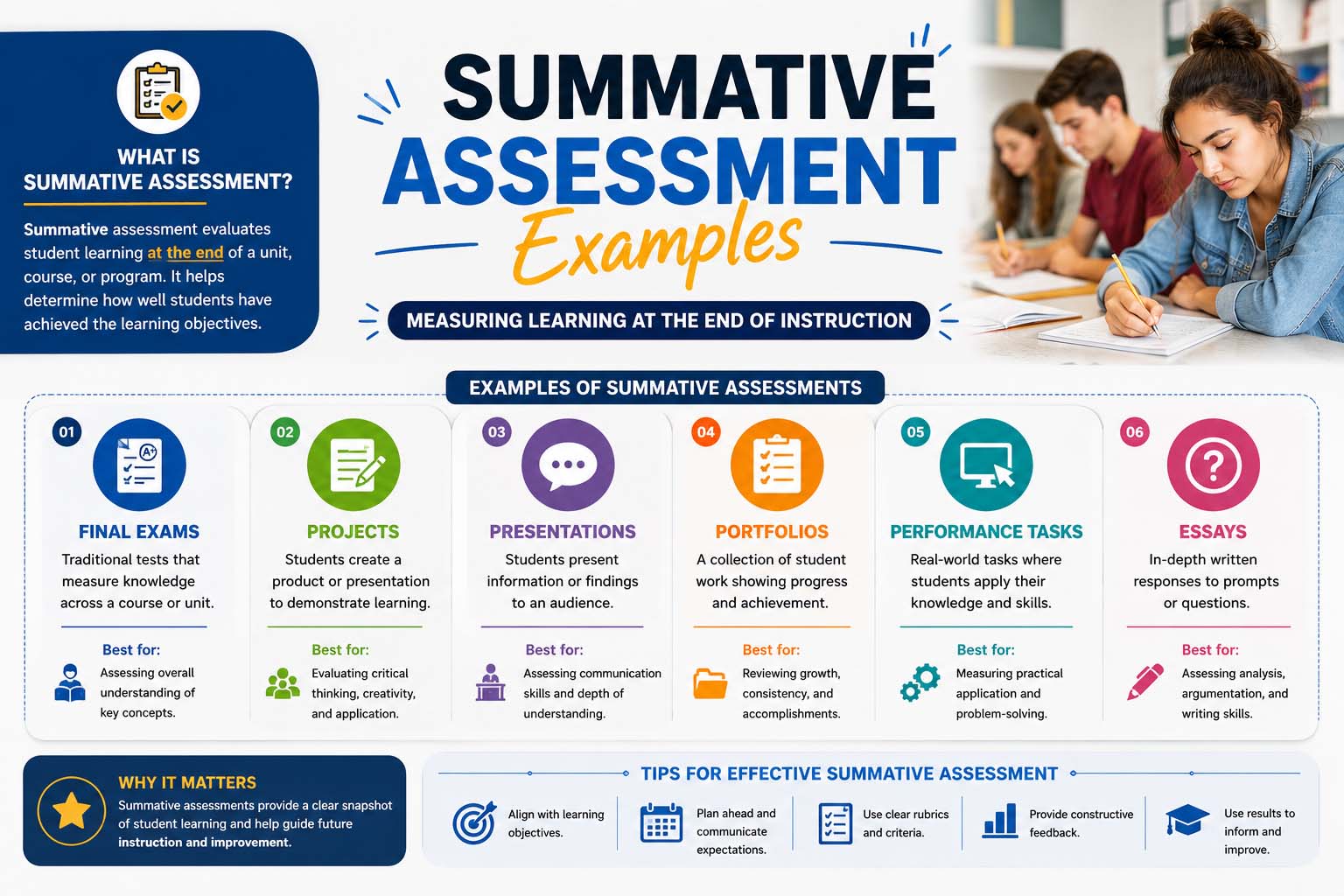
A summative assessment is an evaluation used to measure what students have learned after a specific instructional period.
Unlike ongoing classroom activities that provide feedback during learning, summative assessments typically occur at the end of a unit or course.
Common purposes include:
- Measuring achievement
- Determining grades
- Evaluating learning outcomes
- Assessing mastery of standards
Summative assessments help educators determine whether learning objectives have been achieved.
Why Are Summative Assessments Important?
Summative assessments provide valuable information for both students and teachers.
Benefits include:
- Measuring overall understanding
- Identifying academic strengths
- Supporting grading decisions
- Tracking curriculum effectiveness
- Preparing students for future academic challenges
These assessments often serve as benchmarks for educational progress.
Examples of Summative Assessment
Many students encounter examples of summative assessment throughout their academic careers.
Common examples include:
Final Exams
A final exam evaluates knowledge gained throughout an entire course.
End-of-Unit Tests
Teachers often administer tests after completing a specific unit.
Research Projects
Students demonstrate understanding through detailed research and presentations.
Standardized Tests
State and national assessments measure academic achievement across larger populations.
Essays
Written assignments can evaluate critical thinking, writing skills, and subject knowledge.
These examples help teachers assess long-term learning outcomes.
Common Summative Assessment Examples in Classrooms
Different grade levels use different assessment methods.
Elementary School
Examples include:
- Unit quizzes
- Reading comprehension tests
- End-of-term projects
Middle School
Students may complete:
- Science projects
- History presentations
- Semester exams
High School
Common assessments include:
- Final examinations
- Research papers
- Capstone projects
College and University
Higher education often uses:
- Comprehensive exams
- Thesis projects
- Final presentations
Each assessment type measures mastery in different ways.
Summative Assessment Examples in Math
Many educators search for summative assessment examples in math because mathematics often requires specific evaluation methods.
Unit Tests
Students complete exams covering concepts such as:
- Fractions
- Algebra
- Geometry
- Statistics
Problem-Solving Assessments
Students demonstrate their ability to apply mathematical concepts to real-world situations.
Cumulative Exams
Performance Tasks
Students solve complex problems while explaining their reasoning.
Math summative assessments help measure both procedural and conceptual understanding.
Formative vs Summative Assessment Examples
One of the most common educational questions involves formative vs summative assessment examples.
Although both assessment types support learning, they serve different purposes.
| Formative Assessment | Summative Assessment |
|---|---|
| Occurs during learning | Occurs after learning |
| Provides feedback | Measures achievement |
| Low stakes | Often graded |
| Guides instruction | Evaluates outcomes |
| Ongoing process | Final evaluation |
Understanding this distinction helps students better prepare for each type of assessment.
Formative and Summative Assessment Examples
To better understand the difference, consider these formative and summative assessment examples.
Formative Assessment Examples
- Classroom discussions
- Exit tickets
- Practice quizzes
- Homework activities
- Peer reviews
Summative Assessment Examples
- Final exams
- End-of-unit tests
- Research papers
- Major projects
- Standardized assessments
Both approaches work together to support student success.
How Teachers Design Summative Assessments
Creating effective assessments requires careful planning.
Step 1: Define Learning Objectives
Teachers identify what students should know or be able to do.
Step 2: Choose Assessment Methods
Different objectives may require:
- Tests
- Projects
- Presentations
- Essays
Step 3: Develop Evaluation Criteria
Rubrics help ensure fair grading.
Step 4: Administer the Assessment
Students complete the final evaluation.
Step 5: Analyze Results
Teachers use results to measure learning effectiveness.
This process supports accurate assessment of student achievement.
Benefits of Summative Assessments
When designed effectively, summative assessments provide several advantages.
Measures Long-Term Learning
They evaluate overall knowledge retention.
Supports Accountability
Schools can demonstrate educational outcomes.
Encourages Goal Setting
Students gain insight into their academic progress.
Provides Performance Data
Results help educators identify strengths and weaknesses.
These benefits contribute to continuous educational improvement.
Challenges of Summative Assessments
Although useful, summative assessments also have limitations.
Test Anxiety
Some students perform poorly under pressure.
Limited Feedback Timing
Feedback often comes after instruction has ended.
Single-Day Performance
Time Requirements
Large projects and exams can require significant preparation.
Recognizing these challenges helps educators balance assessment methods.
Student Tips for Success on Summative Assessments
Students can improve performance by following proven strategies.
Study Consistently
Avoid waiting until the last minute.
Review Learning Objectives
Focus on key concepts covered during instruction.
Practice with Sample Questions
Familiarity reduces test anxiety.
Organize Notes
Well-organized materials support efficient review.
Get Adequate Rest
Good preparation often leads to better outcomes.
How Summative Assessments Support Learning
Some students view assessments only as grading tools.
However, they also help:
- Reinforce learning
- Encourage reflection
- Identify growth areas
- Prepare students for future challenges
When used alongside formative assessments, they contribute to a well-rounded educational experience.
FAQ
What is a summative assessment?
A summative assessment measures student learning at the end of a unit, course, or instructional period.
What are some examples of summative assessment?
Examples include final exams, research projects, presentations, and standardized tests.
Formative assessments occur during learning, while summative assessments evaluate learning after instruction is completed.
What are summative assessment examples in math?
Examples include unit tests, cumulative exams, performance tasks, and problem-solving assessments.
Why are summative assessments important?
They measure achievement, support grading decisions, and evaluate educational effectiveness.
Are summative assessments always tests?
No. Projects, presentations, essays, and portfolios can also serve as summative assessments.
Conclusion
Understanding summative assessment examples helps students and educators appreciate how learning is evaluated over time. From common examples of summative assessment and practical summative assessment examples in math to comparisons involving formative vs summative assessment examples and broader formative and summative assessment examples, these tools play a vital role in modern education. When combined with effective teaching strategies and ongoing formative assessments, summative assessments provide meaningful insights into student achievement and academic growth.