
What Is Rolling Admission?
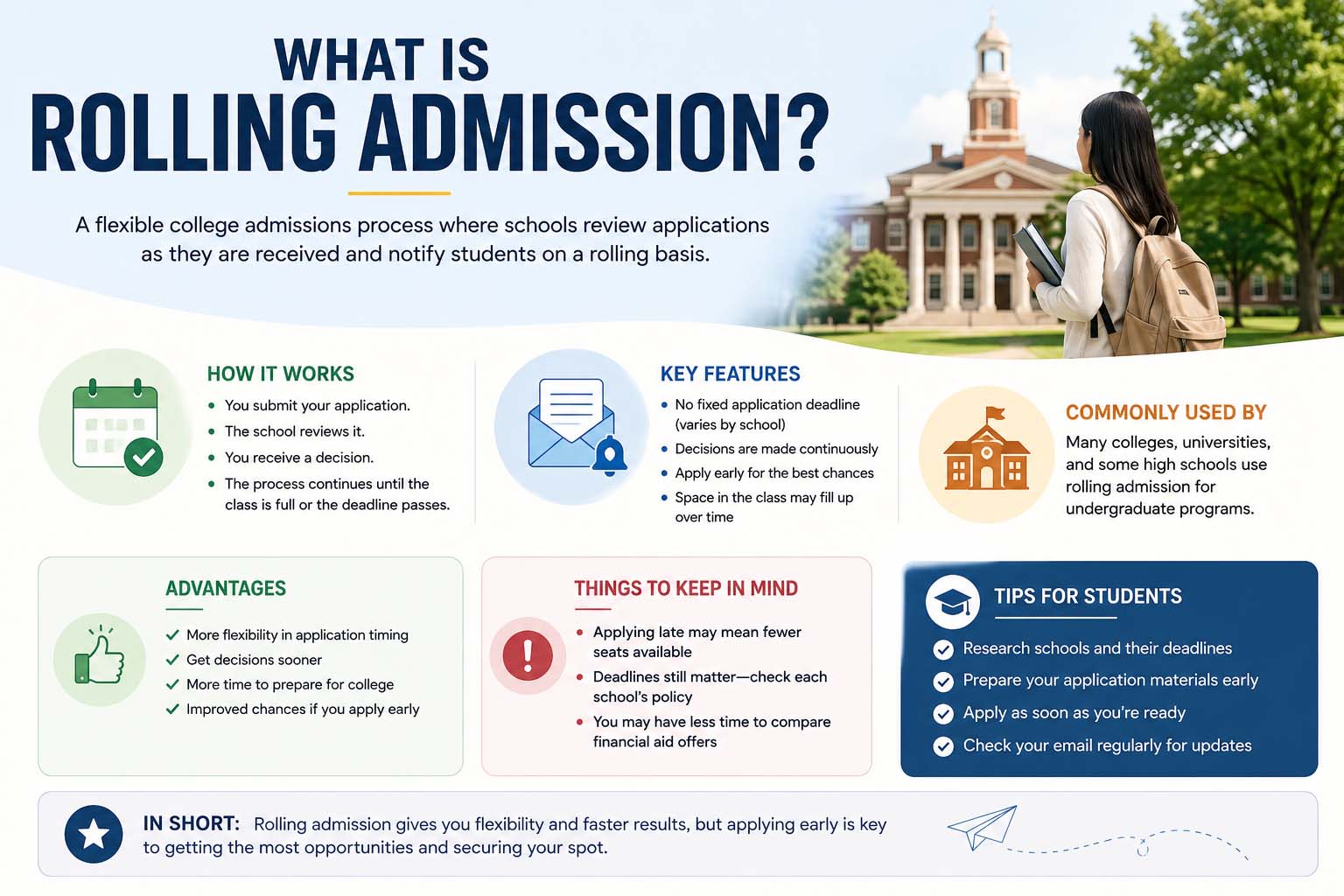
Applying to college involves understanding different admissions processes. One term that students frequently encounter is rolling admission. While some colleges have strict application deadlines and release decisions on a specific date, others review applications as they arrive.
Understanding what is rolling admission can help students make informed decisions, improve their chances of acceptance, and reduce the stress associated with the college application process.
This guide explains how works, its advantages and disadvantages, and how it compares to other admissions options.
What Is Rolling Admission?
is a college admissions process where applications are reviewed continuously as they are received.
Instead of waiting until a fixed deadline to evaluate all applicants at once, colleges with rolling admissions assess applications individually throughout the admissions cycle.
Once a decision is made, students are notified relatively quickly.
This process typically continues until all available spots in the incoming class have been filled.
What Is a Rolling Admission?
Many students ask, what is a rolling admission and how does it differ from traditional admissions?
A admission system allows colleges to:
- Accept applications over an extended period
- Review applications continuously
- Send decisions throughout the year
- Fill available enrollment spots gradually
This approach provides flexibility for both institutions and students.
Rather than competing within a single decision date, applicants are considered as their materials arrive.
How Does Rolling Admission Work?
The process follows a simple structure.
Step 1: Submit Your Application
Students complete and submit their application, including required materials such as:
- Academic transcripts
- Application forms
- Personal essays
- Recommendation letters
- Test scores (if required)
Step 2: Application Review
Admissions officers review applications shortly after submission.
Step 3: Admission Decision
Students receive one of several possible outcomes:
- Accepted
- Denied
- Waitlisted
- Deferred
Step 4: Enrollment Decision
Accepted students decide whether to enroll before the college’s enrollment deadline.
This process often results in faster responses compared to traditional admissions systems.
What Is Rolling Admission for College?
The phrase what is rolling admission for college refers specifically to colleges and universities that use this flexible admissions model.
Many institutions use rolling admissions because it allows them to:
- Manage applications efficiently
- Fill class seats steadily
- Offer students greater flexibility
- Reduce processing bottlenecks
Students benefit by receiving decisions sooner and potentially having more time to plan financially and academically.
What Is Rolling Admission in College?
When discussing what is rolling in college, it is important to understand that colleges still have application windows.
admission does not mean applications are accepted forever.
Most institutions establish:
- Opening dates
- Priority deadlines
- Final application deadlines
Students who apply earlier often have advantages because more spaces remain available.
Benefits of Rolling Admission
Rolling offers several advantages.
Earlier Decisions
One of the biggest benefits is receiving admission decisions sooner.
Instead of waiting months, students may receive results within weeks.
Less Stress
Students can submit applications when they are ready rather than rushing to meet a single deadline.
More Flexibility
Rolling allows applicants to create a broader application strategy.
Increased Planning Time
Earlier decisions provide more time for:
- Financial aid planning
- Housing arrangements
- Scholarship applications
- Course preparation
This flexibility is especially helpful for first-time college applicants.
Potential Drawbacks of Rolling Admission
Although has many benefits, it is not perfect.
Limited Space Over Time
As colleges accept students throughout the cycle, fewer spaces remain available later.
Earlier Applicants May Have an Advantage
Students who apply early often compete for more available seats.
Financial Aid Availability
Some scholarships and financial aid programs may have limited funds that are distributed early.
For these reasons, applying sooner is usually recommended.
Why Applying Early Matters
Even with , timing remains important.
Advantages of Early Applications
- More available class seats
- Greater scholarship opportunities
- Faster decisions
- Increased housing options
Students should avoid assuming that removes the need for early preparation.
Example of Rolling Admission
Imagine a university opens applications on September 1.
Instead of waiting until January to review every application, the admissions team begins evaluating submissions immediately.
Student A
Applies in September.
Result:
- Decision received in October
- More available spots
- Early scholarship consideration
Student B
Applies in March.
Result:
- Fewer remaining seats
- Potentially greater competition
- Reduced scholarship availability
This example illustrates why early submission can be beneficial.
What Is RollingAdmission vs Early Action?
A common question is what is rollingadmission vs early action.
Although both options can provide earlier decisions, they operate differently.
| Feature | Rolling Admission | Early Action |
|---|---|---|
| Application Review | Ongoing | Fixed Deadline |
| Decision Timing | Continuous | Specific Release Date |
| Application Window | Extended | Limited |
| Flexibility | High | Moderate |
| Enrollment Commitment | Usually No | Usually No |
Applications are reviewed as they arrive.
Early Action
Students apply by a specific deadline and receive decisions on a scheduled date.
Understanding these differences helps students choose the best strategy.
Student Tips for Rolling Admission Success
Students can improve their chances by following a few simple guidelines.
Apply Early
Complete All Materials
Ensure all documents are submitted correctly.
Monitor Deadlines
still has deadlines and capacity limits.
Research Scholarships
Many scholarships operate on separate timelines.
Stay Organized
Keep track of:
- Application status
- Required documents
- Financial aid forms
- Housing deadlines
Organization can significantly reduce application stress.
Common Myths About Rolling Admission
Myth 1: There Are No Deadlines
Most colleges still establish final deadlines.
Myth 2: Applying Late Doesn’t Matter
Available spaces may decrease as admissions continue.
Myth 3: Acceptance Is Guaranteed
does not guarantee .
Academic standards still apply.
Myth 4: Decisions Are Instant
Although faster, decisions still require review time.
Who Should Consider Rolling Admission Colleges?
can be a great option for:
- Students needing flexibility
- Applicants finalizing college lists
- Individuals seeking quicker decisions
It provides a less rigid alternative to traditional admissions systems.
FAQ
What is rolling admission?
Rolling is a process where colleges review applications continuously as they are received and issue decisions throughout the admissions cycle.
What is a rolling admission?
A admission system evaluates applications individually rather than waiting for a single review deadline.
What is rolling admission for college?
It is a flexible admissions process used by many colleges to review and accept applicants throughout the year.
What is rolling admission in college?
It refers to colleges evaluating applications on an ongoing basis until available spaces are filled.
What is rolling admission vs early action?
admission reviews applications continuously, while early action uses a fixed application deadline and decision release schedule.
Is it better to apply early for rolling admission?
Yes. Earlier applications generally have access to more available spaces, scholarships, and housing opportunities.
Conclusion
Understanding what is rolling admission can help students navigate the college admissions process with greater confidence. Unlike traditional admissions systems, offers flexibility, earlier decisions, and extended application windows.