What Is a Unit Rate? A Complete Student Guide with Easy Examples
What Is a Unit Rate? A Complete Student Guide with Easy Examples
Unit rates are one of the most useful math concepts students learn because they help compare quantities fairly and solve everyday problems. Whether you’re calculating the price per item, miles per hour, or cost per pound, you’re using a unit rate.
If you’ve been asking “what is a unit rate”, this guide explains the concept in simple language. You’ll also learn how to calculate unit rates, see real-life examples, and discover why unit rates are important in school and daily life.
What Is a Unit Rate?
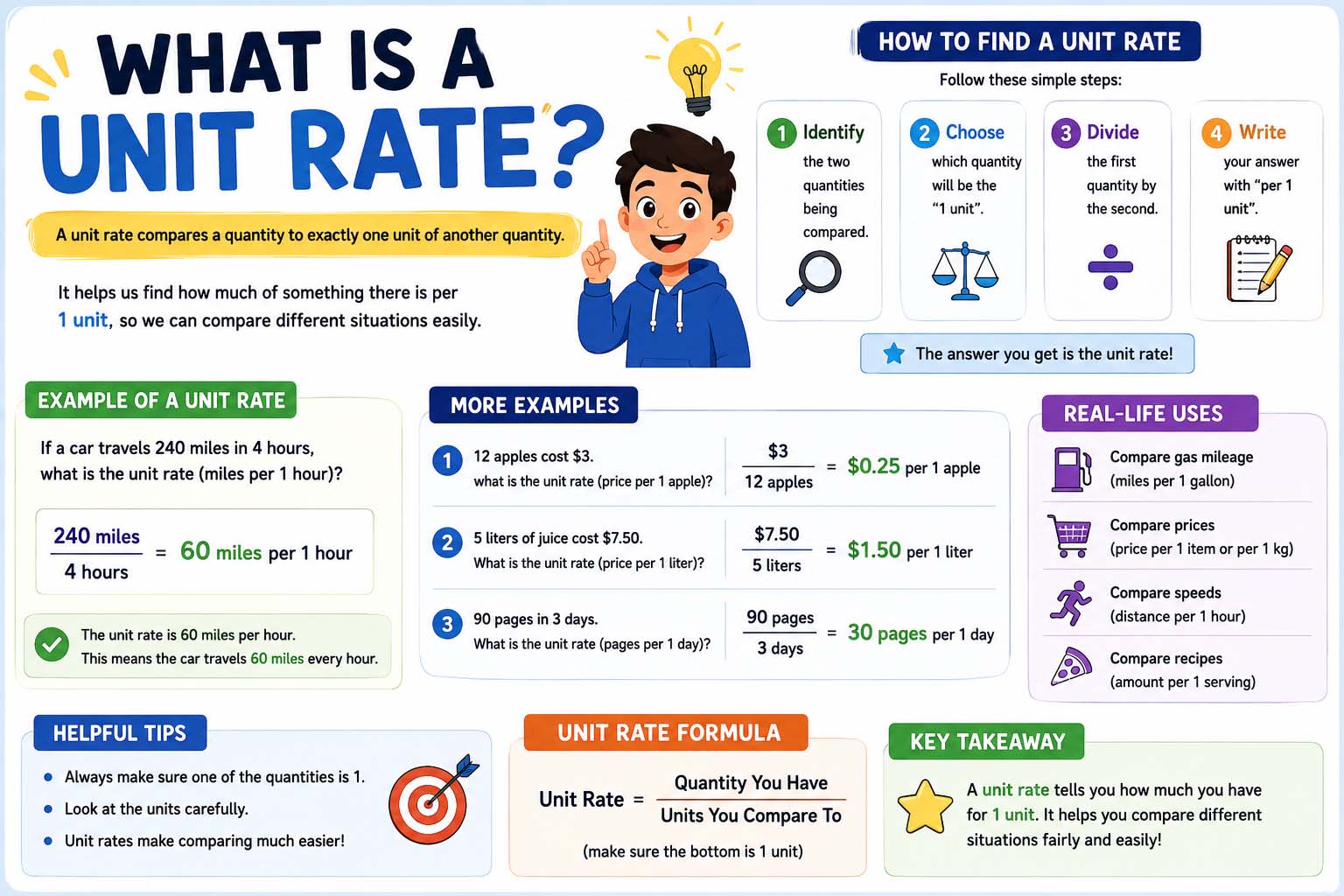
A unit rate is a where the second quantity is 1 unit.
In simple words, it tells you how much of something there is for one item, person, mile, hour, pound, or any other single unit.
For example:
- $12 for 3 notebooks = $4 per notebook
- 180 miles in 3 hours = 60 miles per hour
- 24 apples in 6 bags = 4 apples per bag
Because the second number becomes 1, comparing different rates becomes much easier.
What Is a Unit Rate in Math?
Many students ask, what is a unit rate in math.
In mathematics, a is found by dividing one quantity by another until the denominator equals 1.
Formula:
Unit Rate = First Quantity ÷ Second Quantity
Examples include:
- Dollars per item
- Miles per hour
- Words per minute
- Cost per kilogram
- Calories per serving
Unit rates help students compare prices, speeds, and measurements accurately.
Why Are Unit Rates Important?
They help you:
- Compare product prices
- Calculate travel speed
- Understand fuel efficiency
- Compare wages
- Read nutrition labels
- Make better shopping decisions
Learning unit rates also builds strong problem-solving skills used in later math courses.
Step-by-Step: How to Find a Unit Rate
Finding a rate is simple when you follow these steps.
Step 1: Identify the Two Quantities
Example:
18 pencils cost $9.
Quantities:
- 18 pencils
- $9
Step 2: Decide Which Unit Should Equal One
We want the cost of one pencil.
Step 3: Divide
$9 ÷ 18 = $0.50
$0.50 per pencil
What Is a Unit Rate in Math Grade 6?
One common classroom question is what is a unit rate in math grade 6.
In Grade 6, students learn to:
- Understand ratios
- Solve rate problems
- Compare equivalent rates
- Find unit prices
- Interpret graphs involving rates
Teachers often use everyday examples to help students understand the concept.
Example:
20 cookies cost $5.
Find the cost of one cookie.
Solution:
$5 ÷ 20 = $0.25
Each cookie costs 25 cents.
What Is an Example of a Unit Rate?
Many learners ask, what is an example of a unit rate.
Here are several simple examples.
Example 1: Price
5 bottles cost $15.
$15 ÷ 5 = $3 per bottle
Example 2: Speed
240 miles in 4 hours.
Example 3: Pay Rate
A student earns $80 for 8 hours.
Example 4: Grocery Shopping
3 kilograms of apples cost $9.
9 ÷ 3 = $3 per kilogram
These examples show how unit rates help compare values fairly.
Real-Life Uses of Unit Rates
You probably use unit rates more often than you realize.
Shopping
Compare:
- Price per ounce
- Price per pound
- Price per item
Driving
Calculate:
- Miles per gallon
- Miles per hour
Cooking
Recipes often use:
- Cups per serving
- Grams per portion
Sports
Statistics include:
- Points per game
- Goals per match
- Runs per inning
Unit Rate vs. Ratio
Students sometimes confuse ratios and unit rates.
| Ratio | Unit Rate |
|---|---|
| Compares two quantities | Compares to one unit |
| Example: 8:4 | Example: 2 per 1 |
| Doesn’t always equal 1 | Second quantity equals 1 |
Every is based on a ratio, but not every ratio is a unit rate.
Common Mistakes Students Make
Avoid these common errors.
Dividing the Wrong Way
Always read the question carefully.
For example:
“Cost per notebook”
means:
Cost ÷ Number of notebooks
Forgetting Units
Always include units.
Instead of writing:
4
Write:
4 dollars per notebook
Rounding Too Early
Keep decimals until the final answer whenever possible.
Practice Problems
Problem 1
12 bananas cost $6.
Answer:
$6 ÷ 12 = $0.50 per banana
Problem 2
150 miles in 3 hours.
Answer:
Problem 3
30 pages read in 2 hours.
Answer:
30 ÷ 2 = 15 pages per hour
Practicing these problems helps build confidence.
Study Tips for Learning Unit Rates
Students can master unit rates by following these simple strategies.
Practice Daily
Solve several word problems each week.
Use Real-Life Examples
Compare grocery prices or calculate travel speed.
Draw Tables
Organizing information into tables makes problems easier to understand.
Check Your Units
Always make sure the answer includes the correct measurement.
Why Teachers Teach Unit Rates
Unit rates prepare students for many future math topics, including:
- Proportions
- Percentages
- Algebra
- Graphing
- Statistics
They also develop logical thinking and decision-making skills.
Frequently Asked Questions
What is a unit rate?
A is a where one quantity is compared to exactly one of another quantity.
What is a unit rate in math?
In math, a is found by dividing two quantities so that the denominator becomes one.
What is a unit rate in math Grade 6?
Grade 6 students use unit rates to solve ratio problems, compare prices, calculate speeds, and understand proportional relationships.
If 8 oranges cost $4, the rate is $0.50 per orange.
Why are unit rates important?
They help compare prices, speeds, wages, and measurements fairly and accurately.
How do you calculate a unit rate?
Divide the first quantity by the second quantity until the second quantity equals one.
Conclusion
Understanding what is a unit rate is an essential math skill that helps students solve both classroom problems and everyday situations. Whether you’re comparing grocery prices, calculating speed, or finding the cost per item, unit rates make information easier to understand and compare.
By learning what is a unit rate in math, practicing Grade 6 unit rate problems, and working through real-world examples, students can build confidence and improve their mathematical reasoning. With regular practice, finding unit rates becomes a quick and valuable skill that supports future success in mathematics and everyday decision-making.