How to Make a Study Guide: A Complete Student Guide for Better Exam Preparation
How to Make a Study Guide: A Complete Student Guide for Better Exam Preparation
A well-organized study guide can make learning easier, improve information retention, and reduce stress before exams. Whether you’re preparing for a final exam, a quiz, or a major test, understanding how to make a study guide can help you study more efficiently and achieve better academic results.
Instead of reviewing scattered notes, textbooks, and handouts, a combines important information into one organized resource. Students who create their own study guides often develop a deeper understanding of the material because the process itself reinforces learning.
This guide explains how to create an effective , provides examples, and shares practical strategies that can improve academic performance.
What Is a Study Guide?
A is a structured collection of key concepts, definitions, formulas, summaries, and practice questions designed to help students review material before an assessment.
A good helps students:
- Organize information
- Identify important topics
- Focus on key concepts
- Improve memory retention
- Prepare more effectively for exams
Study guides can be created on paper, digitally, or through online tools.
Why Study Guides Are Important
Many students spend hours rereading notes without seeing significant improvement.
Study guides offer several advantages:
Better Organization
Information is arranged logically and easier to review.
Improved Focus
Students can concentrate on the most important material.
Faster Revision
A reduces the need to search through multiple sources.
Increased Confidence
Well-prepared students often feel less anxious before exams.
Creating a is not just about collecting information—it is also an active learning process.
Step-by-Step: How to Make a Study Guide
Understanding the process can help students create more effective learning materials.
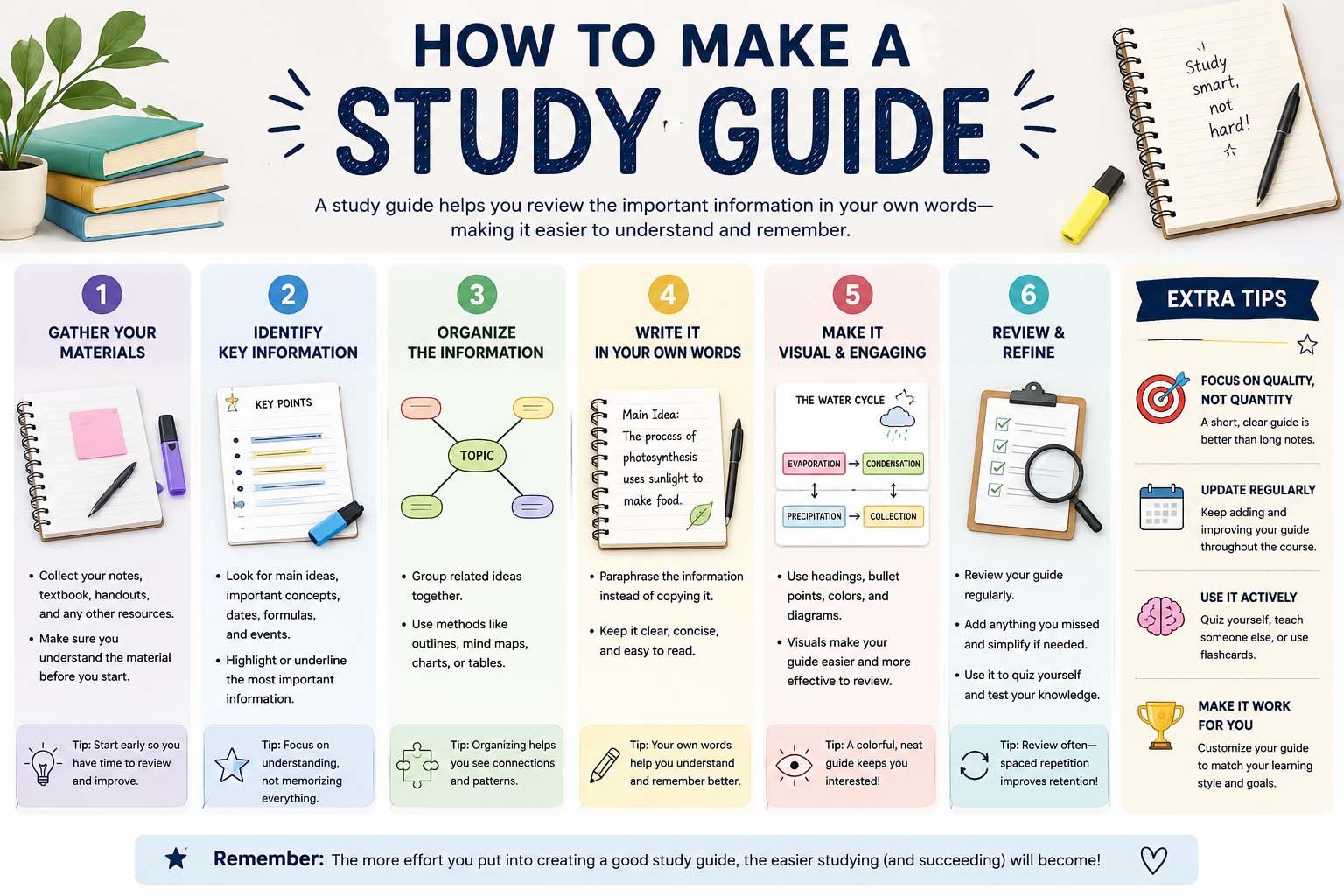
Step 1: Gather Your Study Materials
Before creating your guide, collect:
- Class notes
- Textbooks
- Lecture slides
- Assignments
- Practice quizzes
- Study handouts
Having everything in one place makes organization easier.
Step 2: Identify Key Topics
Review your materials and highlight:
- Main concepts
- Important definitions
- Formulas
- Dates
- Vocabulary terms
- Frequently tested subjects
Focus on content your teacher or professor emphasized during lessons.
Step 3: Organize Information by Category
Create sections based on topics.
For example:
Biology
- Cell Structure
- Genetics
- Photosynthesis
- Human Body Systems
Grouping information improves understanding and recall.
Step 4: Summarize Important Information
Avoid copying entire textbook pages.
Instead:
- Use bullet points
- Write concise explanations
- Focus on key facts
Summarizing information helps reinforce learning.
Step 5: Add Visual Elements
Visual tools can improve memory retention.
Examples include:
- Charts
- Tables
- Diagrams
- Mind maps
- Flowcharts
Many students remember visual information more easily than large blocks of text.
Step 6: Include Practice Questions
Practice questions help test understanding.
Examples:
- Multiple-choice questions
- Short-answer questions
- Flashcards
- Essay prompts
Self-testing is one of the most effective study methods.
How to Make a Good Study Guide
Students often ask how to make a good study guide rather than simply creating one.
The difference comes down to quality and usability.
Keep It Simple
Avoid unnecessary details.
Focus on information most likely to appear on assessments.
Use Clear Headings
Organized sections make reviewing easier.
Highlight Important Concepts
Use:
- Bold text
- Colors
- Underlining
- Symbols
These visual cues improve navigation.
Make It Personalized
Study guides work best when written in your own words.
This process strengthens understanding and memory.
How to Make a Study Guide for an Exam
Many students specifically search for how to make a study guide for an exam.
Review the Exam Outline
Identify:
- Topics covered
- Question types
- Important chapters
Prioritize Weak Areas
Spend extra time on concepts you find challenging.
Create a Review Schedule
For subjects like math and science, solving problems is essential.
Exam-focused study guides should emphasize both content review and active practice.
How to Make a Study Guide for a Test
A smaller classroom test may require a more focused strategy.
When learning how to make a study guide for a test, consider:
Concentrating on Recent Material
Most tests cover specific chapters or lessons.
Reviewing Teacher Notes
Teachers often provide clues about what will appear on assessments.
Creating Quick Reference Sheets
Short study guides are easier to review before a test.
Using Flashcards
Flashcards work particularly well for:
- Vocabulary
- Definitions
- Dates
- Concepts
Targeted preparation can improve efficiency and save time.
How to Make a Study Guide on Google Docs
Digital study guides have become increasingly popular.
Students frequently ask how to make a study guide on Google Docs.
Create a New Document
Open Google Docs and start a blank file.
Add Headings
Use heading styles to organize topics.
Insert Tables
Tables can organize:
- Definitions
- Formulas
- Comparisons
Use Bullet Points
Bullets improve readability.
Add Images and Diagrams
Visual elements help explain complex concepts.
Share with Study Groups
Google Docs makes collaboration simple.
Multiple students can contribute notes and ideas in real time.
Study Guide Example
Here is a simple example.
History Study Guide
Causes of World War I
- Militarism
- Alliances
- Imperialism
- Nationalism
Important Dates
- 1914: War begins
- 1918: War ends
Key Terms
- Treaty
- Armistice
- Alliance
This format keeps information organized and easy to review.
Common Mistakes to Avoid
Copying Notes Word-for-Word
Summarization improves learning more than copying.
Including Too Much Information
Overloaded study guides become difficult to review.
Waiting Until the Last Minute
Creating a guide gradually improves retention.
Ignoring Practice Questions
Testing yourself is one of the most effective learning strategies.
Avoiding these mistakes can significantly improve study outcomes.
Additional Study Tips
Use Active Recall
Try remembering information without looking at notes.
Practice Spaced Repetition
Review material over multiple days instead of cramming.
Study in Short Sessions
Many students focus better during shorter, concentrated sessions.
Teach the Material
Explaining concepts to someone else helps reinforce understanding.
FAQ
What is a study guide?
A is an organized resource containing important information used for exam and test preparation.
How do I make a study guide quickly?
Gather materials, identify key concepts, organize topics, and create concise summaries.
How to make a good study guide?
Focus on organization, clarity, summaries, visual elements, and practice questions.
How to make a study guide for an exam?
Review the exam outline, prioritize key topics, and include practice questions and examples.
How to make a study guide on Google Docs?
Create a document, organize sections with headings, add tables and visuals, and share if needed.
Are study guides effective?
Yes. Study guides help improve organization, retention, review efficiency, and exam confidence.
Conclusion
Learning how to make a study guide is one of the most valuable academic skills students can develop. A well-designed study guide helps organize information, improve understanding, and support long-term learning. Whether you’re learning how to make a good study guide, how to make a for an exam, how to make a for a test, or how to make a on Google Docs, the key is creating a resource that is clear, organized, and personalized